Official wiring and controller checks
Use the exact panel and controller manuals for final limits. These references help keep the series-vs-parallel decision anchored to real voltage, current, and controller constraints.
Pre-arrival checks
Before finalizing a string
Confirm open-circuit voltage in cold conditions, controller PV voltage limit, battery-side current, roof shade pattern, disconnects, fuses, and expansion headroom.
Should RV solar panels be wired in series or parallel?
Wire RV solar panels in series when higher voltage and lower current help the roof-to-controller run, and wire in parallel when shade tolerance and lower voltage matter more. The right answer depends on panel placement, controller limits, wire length, and campsite shade. Check the solar wiring diagram and MPPT controller guide together.
Most RV solar wiring debates are missing context
Series vs. parallel gets discussed as if one layout is modern and the other is outdated. That is not how it works. Both are valid. Both show up in good systems. Both can be the wrong answer if the rest of the install is not considered.
The right question is not "which is best?" It is:
which wiring layout best supports this roof, this controller, this battery bank, and this camping style?
That is a much more useful question because it forces you to think about the whole system instead of a single electrical idea in isolation.
Once the array layout is real, compare the controller against that voltage and current plan. The MPPT charge controller buyer guide walks through exact 30A and 40A options after this wiring decision is no longer a guess.
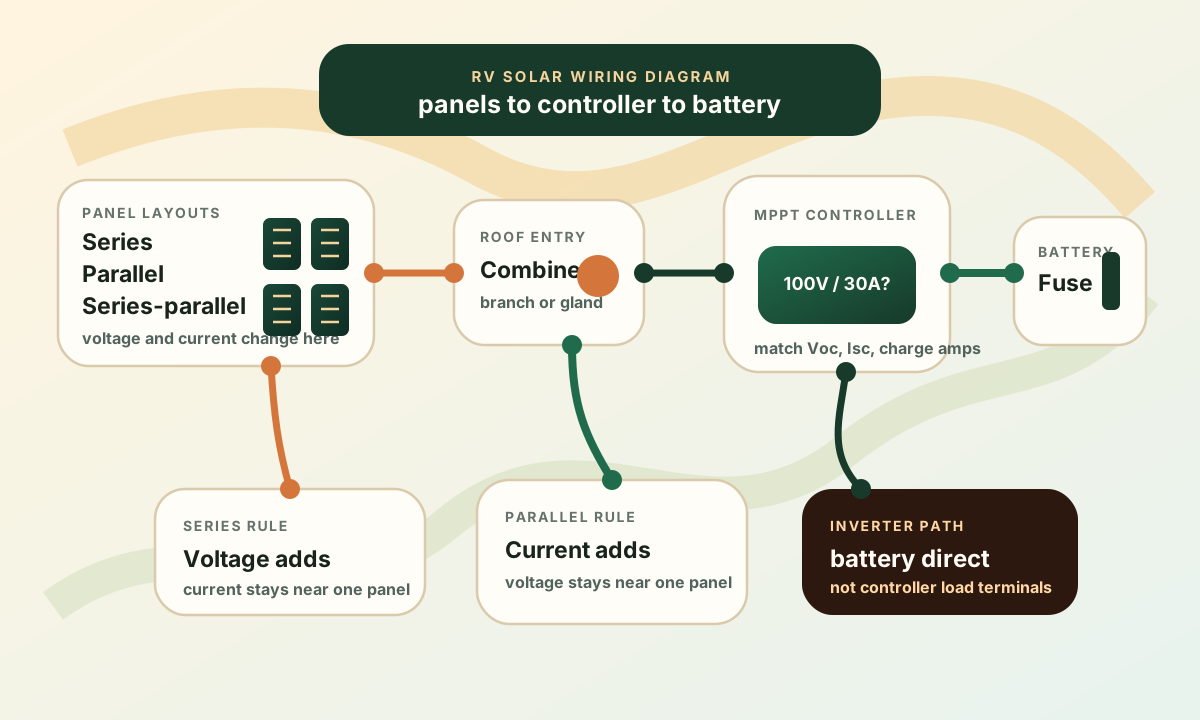
If you need a diagram-first view before this tradeoff layer, use the RV solar wiring diagram to trace the path from panels to controller to battery protection.
What series wiring means
When panels are wired in series, their voltages add while the current stays the same as the individual panel string current.
The practical effect is:
- higher array voltage
- lower current on the panel side
- less pressure on wire size for a given run length
- stronger dependence on controller input limits
Series wiring is often attractive in RVs because roof layouts and interior cable routes can be awkward. Higher voltage can help you move power more cleanly from the roof to the controller, especially when paired with an MPPT controller designed for it.
What parallel wiring means
When panels are wired in parallel, voltage stays the same while current adds.
The practical effect is:
- lower array voltage
- higher current on the panel side
- more sensitivity to voltage drop across the same run
- less aggressive demand on high input-voltage controller support
Parallel layouts are often easier for beginners to picture because each panel is effectively feeding the same voltage into the system. That simplicity can be appealing in small systems or where shading behavior matters more than wiring efficiency.
The real tradeoffs in an RV
The technical definitions are simple. The useful decision comes from how those definitions play out on a travel rig.
Compare
Compare fast
Use one comparison matrix to scan the practical differences. Small screens stack each row; wider screens keep the first column pinned.
| Spec | Series | Parallel |
|---|---|---|
| Voltage | Higher array voltage | Lower array voltage |
| Current | Lower array current | Higher array current |
| Cable behavior | Often easier to manage over longer runs | Can require more attention to voltage drop |
| Shade behavior | Can be more affected by panel mismatch or shading in a string | Can be more forgiving when one panel is underperforming |
| Controller fit | Needs controller input voltage headroom | Less dependent on high input-voltage capability |
Shade is where theory meets campsite reality
Many RVers camp around trees, buildings, or uneven light throughout the day. That is where the neatest electrical answer on paper may stop being the best practical answer.
In a series string, one shaded or mismatched panel can influence the performance of the string more than people expect. In a parallel layout, individual panels can be somewhat more independent, which may help in broken-light conditions.
That does not mean parallel is automatically superior in shade. It means shading deserves more attention than people often give it. If the roof has unavoidable partial shading from air conditioners, antennas, or vents, a purely series layout may not be as elegant in practice as it looks on the diagram.
Higher voltage can simplify a roof-to-controller run
One of the strongest arguments for series wiring is that higher voltage can help make panel-side runs more manageable. RVs are not giant houses, but the path from roof panel to controller is often stranger than beginners expect. You may pass through glands, cabinets, false walls, and limited-entry points that make clean cable routing valuable.
Lower current on that side can make the run easier to design well. That is why many RV systems lean toward series-friendly or hybrid layouts once the owner moves beyond a very small starter system.
But that advantage exists only if the controller is selected for it. If the controller cannot comfortably handle the array's open-circuit voltage, especially in colder conditions, the whole design logic falls apart.
Small arrays often tolerate simpler answers
On a modest two-panel weekend setup, parallel wiring may be perfectly appropriate. The array is small, the controller choice may be straightforward, and the performance difference between layouts might not justify extra complexity.
As the system grows, however, layout decisions start affecting more than just electrical neatness. They affect:
- controller selection
- roof flexibility
- serviceability
- expandability
- how much redesign is needed later
That is why a small-system answer is not always a good big-system answer.
Roof geometry should influence your decision
If your roof can support a clean matched pair or string with minimal shade interaction, series may become more attractive. If panel placement is fragmented across obstacles or different roof zones, parallel or hybrid layouts may become easier to live with.
This is also where expansion planning matters. A design that uses all available controller input headroom from day one may leave no easy room to grow. A layout that looks slightly less elegant at first may actually be the more future-proof choice.
A hybrid approach is often the most realistic answer
Some RVers assume the decision has to be all series or all parallel. It does not. Depending on panel count and controller capability, a hybrid arrangement can sometimes deliver the best mix of manageable voltage, sensible current, and layout flexibility.
Hybrid designs are especially useful when:
- the array is larger than a simple two-panel setup
- roof geometry is imperfect
- you want a tidy system without overcommitting to a single string
- the controller supports the chosen configuration comfortably
The right hybrid arrangement depends on the actual panel specs and controller limits, but the bigger point is this: the best RV solar design is often the one that avoids ideological wiring decisions.
Think in terms of system fit, not internet debates
Series and parallel are tools. Good RV solar design comes from using the right tool for roof space, shade patterns, controller input limits, and the way the system may evolve over time.
Common mistakes RVers make here
Mistake 1: choosing the layout before choosing the controller
This reverses the design process. Your controller's voltage and current capabilities should shape what is reasonable, not the other way around.
Mistake 2: ignoring cold-weather voltage rise
A design that seems fine based on room-temperature panel numbers can get too close to controller input limits in colder conditions.
Mistake 3: overreacting to one shade scenario
Yes, shading matters. But so do cable runs, roof routing, expandability, and system size. It is possible to optimize too hard for one afternoon tree-shadow problem and end up with a worse overall system.
Mistake 4: wiring for today's array only
If you know you may add panels later, build with that in mind. Otherwise you may end up replacing the controller or reworking the layout sooner than expected.
How to decide more confidently
A useful decision sequence looks like this:
- Confirm daily power needs and likely system size
- Map actual roof panel positions
- Note expected shade sources
- Choose a controller that fits the likely array envelope
- Compare series, parallel, and hybrid layouts against that real system
When done in that order, the answer usually becomes much clearer.
If the array is small and shading is irregular, parallel may feel safer. If the system is more ambitious and the roof path benefits from higher voltage, series or hybrid often start looking stronger. The point is not to force either answer. The point is to let the system tell you what it wants.
If roof fit is still fuzzy, use the RV roof layout planner before choosing a controller. If the question is whether the system is large enough overall, run the RV solar calculator and compare the answer with the solar shade management guide.
The best wiring layout is the one you will not need to apologize for later
Six months from now, you should be able to open the cabinet, look at the array layout, and understand why it was built that way. A good layout is easy to explain:
- the controller supports it comfortably
- the roof geometry justified it
- the cable route benefits from it
- the shade tradeoffs were understood
- future expansion was considered
That is a far better standard than copying whichever diagram was easiest to find.
Frequently asked
Questions RVers usually ask next.
Is series wiring more efficient for RV solar?
It can be advantageous because higher voltage often helps with panel-side cable behavior and works well with MPPT controllers. But that does not make it universally better. Shade, controller limits, and roof layout can still make parallel or hybrid layouts the smarter choice.
Is parallel better if I camp in partial shade?
It can be more forgiving in some shaded conditions because individual panels are less tied together than in a single series string. But the full system still matters, including controller fit and cable run quality.
Can I mix series and parallel in one RV array?
Sometimes, yes. Many larger or awkward roof layouts use a hybrid approach. The important part is ensuring the controller and overall design support the resulting voltage and current characteristics.
Should beginners default to parallel because it feels simpler?
Not automatically. A small starter setup may work well in parallel, but many RV installations become cleaner and easier to scale with a controller and panel plan that allows series or hybrid configurations.
Freshness note
Last checked April 17, 2026
This topic can change when products, plans, prices, campsite rules, or fit guidance move. These notes show what was reviewed most recently.
This review included
- Verified series vs parallel wiring calculations, voltage/amperage limits, and combiner box requirements against current NEC guidance and manufacturer specs.
Recent change log
April 17, 2026
Published series vs parallel solar wiring guide with verified electrical calculations and safety requirements.
Broader editorial corrections are tracked on the Corrections and Updates page.


