How many solar watts does an RV need?
Most RVs need about 200-400W for light weekend use, 400-800W for balanced boondocking, and 800-1,400W or more for remote work, Starlink-class internet, or heavier inverter routines. Start with daily watt-hours, divide by realistic sun hours, then add loss margin. Use the RV solar calculator before buying panels.
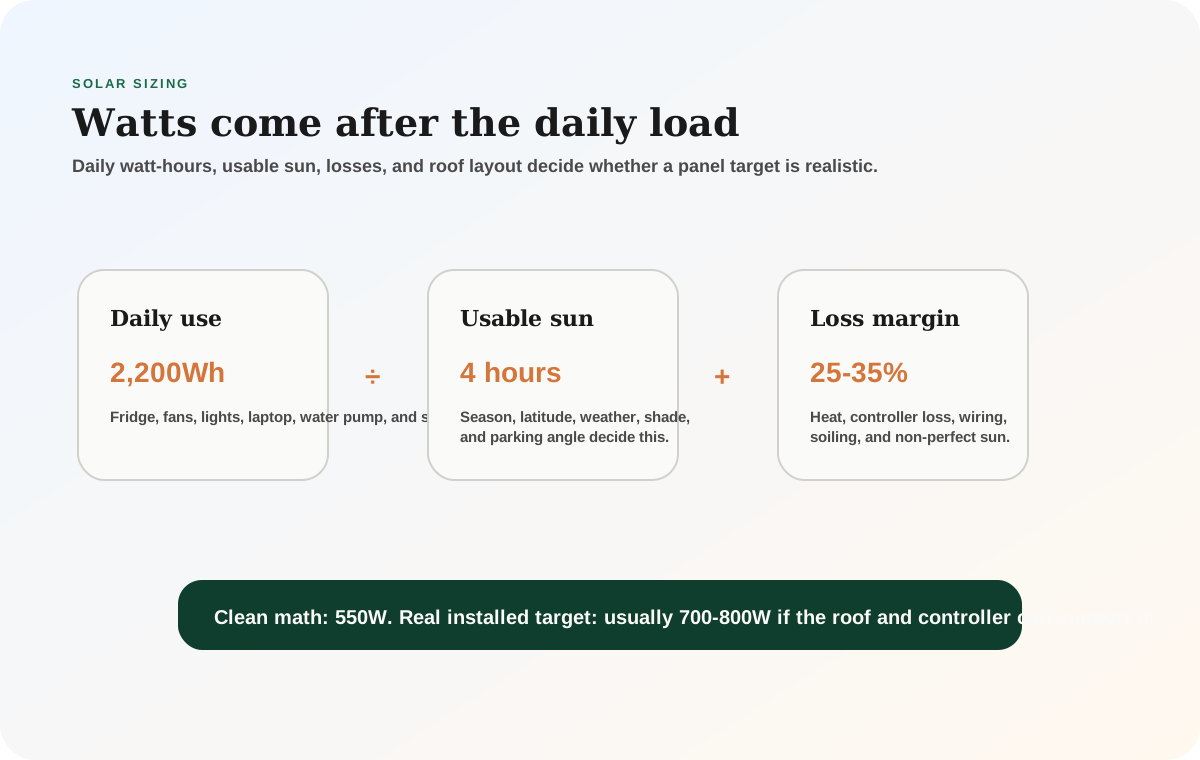
RV solar sizing snapshot
Use these as starting lanes. Your real answer comes from watt-hours, sun, shade, roof space, battery size, and how often you can recharge another way.
Light weekend use
200-400W
Works best for LED lights, fans, propane-fridge controls, device charging, and short trips with modest reserve needs.
Balanced boondocking
400-800W
A common target for 12V fridge use, fans, lights, laptops, water pump, and normal off-grid habits.
Remote-work heavy
800-1,400W+
Starts making sense when laptops, monitors, internet gear, inverter loads, and multi-day recovery matter.
First constraint to check
Roof shade
Air conditioners, vents, antennas, awnings, and roof curvature can limit the useful array before the math does.
Solar math references
RV solar is more variable than house solar because panels are flat, hot, often shaded, and moved between regions. These references help keep the sizing math honest.
Pre-arrival checks
PVWatts is not an RV guarantee
It is a useful planning reference, but RV panels are often flat, warm, partially shaded, and limited by roof layout.
Controller limits matter
Panel watts only help if the charge controller can accept the array voltage and current in the planned wiring layout.
Battery acceptance matters
A full or cold battery may not accept the theoretical harvest even when the array is producing well.
Start with daily watt-hours, not panel watts
Panel wattage is the last number people want to buy and the first number they ask about.
That is backward.
Start with the daily load:
- fridge
- lights
- fans
- water pump
- laptop and device charging
- router, hotspot, or Starlink-class internet
- furnace controls and fan
- inverter appliances
- parasitic loads from detectors, displays, and control boards
If you do not know the wattage of each load, build the first version from the RV appliance wattage chart. If you already know the main loads, run them through the solar calculator and then sanity-check the output here.
The working formula is:
daily watt-hours / usable sun hours / real-world efficiency = solar watts
For a fast RV estimate, I usually use 0.70-0.80 for real-world efficiency. That leaves room for controller losses, wiring, panel heat, imperfect angle, dust, haze, shade, and battery charging behavior.
Why the loss factor matters
A 400W roof array does not hand you 400W all day. The useful question is how many watt-hours it can harvest across your real charging window after heat, shade, angle, wiring, controller, and battery behavior are included.
Worked examples
Compare
Solar sizing examples using daily watt-hours, usable sun hours, and a 0.75 planning efficiency.
Use one comparison matrix to scan the practical differences. Small screens stack each row; wider screens keep the first column pinned.
| Spec | Light weekend | Balanced boondocking | Remote-work day | Roof-limited Class B |
|---|---|---|---|---|
| Daily use | 900Wh | 2,200Wh | 4,000Wh | 1,600Wh |
| Usable sun assumption | 5 hours | 4 hours | 4 hours | 4.5 hours |
| Clean math before loss margin | 900 / 5 = 180W | 2,200 / 4 = 550W | 4,000 / 4 = 1,000W | 1,600 / 4.5 = 356W |
| Planning target with loss margin | 250-300W | 700-800W | 1,200-1,400W | 450-600W if the roof can fit it |
| Main watchout | Cloudy-day recovery can still be weak | Roof shade and battery size become the next constraints | Array size may exceed roof space and require alternator or generator support | The roof may be the limit before the load list feels comfortable |
Example 1: light weekend use
Assume the rig uses:
- 150Wh for lights
- 180Wh for fans
- 150Wh for phone and tablet charging
- 120Wh for water pump and controls
- 300Wh of miscellaneous small loads
That is about 900Wh per day.
With 5 usable sun hours:
900 / 5 = 180W before losses
After real-world margin:
180 / 0.75 = 240W
In practice, that means a 200W array may work in good conditions, while 300W feels calmer if roof space and budget allow. This is the range where portable panels can also make sense if the roof is shaded.
Example 2: balanced boondocking
Assume the rig uses:
- 700Wh for a 12V compressor fridge
- 250Wh for fans
- 250Wh for lights, pump, and device charging
- 400Wh for laptop charging
- 250Wh for router or hotspot gear
- 350Wh for short inverter use and margin
That is about 2,200Wh per day.
With 4 usable sun hours:
2,200 / 4 = 550W before losses
After real-world margin:
550 / 0.75 = 733W
That is why a balanced boondocking setup often lands around 700-800W instead of the neat 550W spreadsheet answer. The extra panel capacity is not vanity. It is what helps the battery recover when the site is hot, dusty, flat-mounted, or partially shaded.
Example 3: remote-work day
Assume the rig uses:
- 800Wh for a 12V fridge in warm weather
- 450Wh for a laptop and monitor setup
- 500-750Wh for Starlink-class internet across a long workday
- 250Wh for fans
- 300Wh for lights, pump, devices, and background loads
- 800-1,000Wh for inverter bursts, cooking, or extra work gear
That can easily become 3,500-4,000Wh per day.
With 4 usable sun hours:
4,000 / 4 = 1,000W before losses
After real-world margin:
1,000 / 0.75 = 1,333W
This is the point where the answer may not be "add one more panel." It may be a bigger roof array, more battery, alternator charging, generator support, or a more disciplined work-power routine.
Solar watts must fit the roof
The calculator can say 900W. Your roof may only fit 600W cleanly.
That is common on:
- Class B vans
- small travel trailers
- rigs with multiple roof vents
- rigs with large air conditioners
- rigs with antennas, skylights, curved roof areas, or roof racks
Before buying panels, draw the actual roof. Mark air conditioners, vents, antennas, skylights, shade zones, roof seams, ladder clearance, cable entry, and walkable service paths. Then use the RV solar installation guide before you drill or route cable.
Do not size the array only from the ground
The best panel size on paper may be the worst panel size on your roof. A layout with fewer panels and less shade can outperform a bigger array that is constantly clipped by vents, antennas, or an air conditioner shadow.
Charge controller sizing is part of the wattage decision
Panel watts turn into controller decisions quickly.
A 400W array on a 12V battery bank can ask a controller to handle roughly 30A or more in good conditions. An 800W array can push the conversation toward larger controllers, higher-voltage strings, or split-controller layouts.
That is why the sequence matters:
- Estimate daily watt-hours.
- Convert to panel watts.
- Confirm the roof layout.
- Choose series, parallel, or series-parallel wiring.
- Verify controller voltage and current limits.
- Confirm the battery bank can accept the charge rate.
If the controller is the next bottleneck, use the MPPT charge controller buyer guide after the panel layout is sketched.
Battery size changes how solar feels
Solar is daily income. Battery capacity is savings.
Too little solar means the battery never catches up. Too little battery means the rig cannot bridge overnight loads, cloudy windows, or workday spikes even if the roof produces well at noon.
That is why the same 600W array can feel different in two RVs:
- A 100Ah battery bank may fill quickly but run out overnight.
- A 400Ah LiFePO4 bank may carry the night but need more sun to fully recover after cloudy days.
Use the battery bank sizing guide after you have a real daily load number. If you are still comparing chemistry, the lithium vs. AGM guide explains why usable capacity changes the whole solar conversation.
Shade can beat wattage
One shaded panel can reduce output dramatically depending on panel wiring, bypass diode behavior, controller behavior, and how the shade crosses the cells.
For RVs, the usual shade sources are not trees alone. They are:
- air conditioner shadows
- vent covers
- antennas
- roof racks
- nearby rigs
- winter sun angle
- campsite trees
- dirt and pollen
If the roof has unavoidable shade, a slightly smaller array with cleaner exposure may be better than a crowded roof. Portable panels can also help when the RV parks in shade but the panel can sit in sun.
The simplest buying bands
Use these bands to narrow the conversation before you run exact numbers.
Compare
Practical RV solar wattage bands.
Use one comparison matrix to scan the practical differences. Small screens stack each row; wider screens keep the first column pinned.
| Solar size | Best fit | Watchout |
|---|---|---|
| 100-200W | Battery maintenance, lights, phones, small weekend loads | It will not support fridge-heavy or work-heavy use by itself. |
| 300-400W | Light boondocking, propane-fridge rigs, small lithium banks | Cloudy weather and compressor fridges can still outrun it. |
| 500-800W | Balanced boondocking with a 12V fridge, laptops, fans, and modest inverter use | Roof layout and controller sizing need attention. |
| 900-1,400W | Remote work, larger lithium banks, Starlink-class internet, heavier daily loads | Many RV roofs cannot fit this cleanly without tradeoffs. |
| 1,500W+ | Large fifth wheels, serious lithium banks, hybrid solar/alternator/generator systems | This becomes a full electrical design, not just panel shopping. |
Common sizing mistakes
The first mistake is using summer desert sun as the year-round answer. A system that works beautifully in April Arizona may feel very different in a smoky mountain site, a Pacific Northwest shoulder-season trip, or a shaded campground.
The second mistake is ignoring inverter loads. Coffee makers, microwaves, induction burners, and hair dryers can use large bursts of energy. Solar may replace that energy later, but the battery must survive the load first.
The third mistake is buying panels before checking the roof. A panel that almost fits can create cable-routing problems, shade problems, and service-access problems.
The fourth mistake is forgetting that the battery may be the actual bottleneck. A small lead-acid bank may not use a large array well, while a large lithium bank can accept more energy but may need a bigger array to recover fully.
Use the calculator next
The fastest path is:
- Build the daily load list.
- Pick a realistic sun-hour assumption.
- Run the RV solar calculator.
- Sketch the roof.
- Confirm controller limits with the planned wiring.
- Confirm the battery bank and charging sources support the target.
The calculator gives you the planning target. The roof, controller, and battery decide whether that target becomes a clean install.
Final thought
The right number of RV solar watts is not the biggest number you can afford. It is the number that matches your daily load, roof, battery, controller, and travel rhythm.
If your daily use is honest, solar sizing gets much easier. If the daily use is guessed, every panel decision is guesswork wearing a spec sheet.
Frequently asked
Questions RVers usually ask next.
How do I calculate how many solar watts my RV needs?
Estimate daily watt-hours, divide by realistic usable sun hours, then divide again by a real-world efficiency factor such as 0.70-0.80. That gives a practical panel-wattage target before roof and controller constraints.
Is 400W of solar enough for an RV?
It can be enough for disciplined weekend use, propane-fridge rigs, or modest lithium setups. It may be tight for a 12V fridge, remote work, Starlink-class internet, or repeated cloudy days unless another charging source helps.
Is 800W of solar a lot on an RV?
For many travel trailers and motorhomes, 800W is a strong balanced-boondocking target. It still needs enough battery capacity, controller capacity, roof room, and load discipline to feel useful.
Can solar run everything in an RV?
Not automatically. Solar can replace daily energy, but high-wattage appliances, air conditioning, bad weather, shade, and small battery banks can still overwhelm the system. Heavy loads often need a hybrid plan with battery, alternator, shore, or generator support.
Should I add more solar or more battery first?
If the battery runs out overnight, storage may be the limiter. If the battery never recovers during the day, solar or another charging source may be the limiter. In most RVs, the clean answer comes from sizing both together.
Freshness note
Last checked April 21, 2026
This topic can change when products, plans, prices, campsite rules, or fit guidance move. These notes show what was reviewed most recently.
This review included
- Rechecked the solar sizing math against the current calculator assumptions for daily load, realistic sun hours, and system losses.
- Checked NREL PVWatts loss-factor guidance and kept the article's 0.70-0.80 real-world planning range aligned with roof-mounted RV conditions.
- Expanded the light, balanced, remote-work, and roof-limited examples so the article gives exact watt-hour-to-panel math instead of only broad bands.
Recent change log
April 21, 2026
Expanded the solar-wattage guide with a custom sizing visual, official PVWatts reference, worked examples, roof-space constraints, controller checks, and clearer calculator handoffs.
April 10, 2026
Added visible last-checked proof for the solar sizing formulas, examples, and calculator next step.
April 10, 2026
Tightened the article intro spacing and supporting visuals during the broader article-layout cleanup.
Broader editorial corrections are tracked on the Corrections and Updates page.


