Source checks used for this guide
Battery specs vary by exact model. Use these representative official pages to verify voltage, depth-of-discharge, cycle-life, weight, and low-temperature behavior before buying.
Pre-arrival checks
Before mixing or converting
Confirm converter, solar controller, DC-to-DC charger, battery monitor, and low-temperature protection settings for the exact battery model.
Is lithium or AGM better for RV batteries?
Lithium is usually better for regular off-grid RVing because it gives more usable capacity, lower weight, faster charging, and a longer cycle-life ceiling. AGM still makes sense for occasional trips, modest loads, and lower upfront cost. Run your daily loads through the battery calculator before comparing battery prices.
If you are still guessing at capacity, pause here and work through the RV battery bank sizing guide. Chemistry choice should follow the load profile, not the other way around.
The real comparison is usable capacity
Battery labels are rated capacity, not the amount you should plan to use every night.
AGM lead-acid batteries are commonly planned around roughly 50% depth of discharge for decent life. Some spec sheets show more cycles at lighter discharge and fewer cycles at deeper discharge, which is the point: AGM life is sensitive to how hard you cycle it.
LiFePO4 batteries are commonly planned around 80-90% usable depth of discharge. Some manufacturers publish cycle-life figures at 80% depth of discharge, which is why lithium often looks expensive at checkout and then much cheaper across years of use.
Compare
Compare fast
Use one comparison matrix to scan the practical differences. Small screens stack each row; wider screens keep the first column pinned.
| Spec | AGM deep-cycle | LiFePO4 lithium |
|---|---|---|
| Usable DoD | ~50% DoD planning target; the checked Renogy 100Ah AGM lists 500 cycles at 50% DoD | ~80-90% DoD planning target; the checked Renogy Pro LiFePO4 lists 5,000 cycles at 80% DoD, while Battle Born lists 100% usable depth |
| Typical 100Ah price | ~$100-$150 for budget AGM, with checked RV-brand examples around ~$200-$250 | ~$600-$900 for smart, heated, RV-focused LiFePO4; budget lithium can be lower |
| Cycle life | ~300-500 cycles for deeper-cycled AGM planning; the checked Renogy AGM lists 500 cycles at 50% DoD | ~2,000-3,000+ cycles as a practical LiFePO4 floor; premium models can publish 5,000+ cycles at stated DoD |
| Weight per 100Ah | ~60-65 lb for many 100Ah AGM batteries; checked RV/marine examples ranged from 63.9 lb into the high-60s | ~28-31 lb for many 100Ah LiFePO4 batteries; checked examples were 26.9 lb and 31 lb |
| 200Ah worked example | 200Ah AGM = ~100Ah usable, or about 1,200Wh at 12V planning math | 200Ah LiFePO4 = ~160-180Ah usable, or about 2,050-2,300Wh at 12.8V planning math |
| What the extra lithium cost buys | Lower first-day cost, but more weight and less usable reserve from the same nameplate Ah | More usable reserve, less weight, flatter voltage, and more cycle life if the charger profile is right |
| Charging voltage | AGM absorption commonly sits around 14.4-14.8V with float afterward | LiFePO4 commonly wants ~14.4-14.6V charge voltage, no equalization, and different float behavior |
| Cold charging | Can charge below freezing with reduced acceptance and lead-acid limits | Many LiFePO4 batteries must not charge below freezing unless they have low-temp cutoff or self-heating |
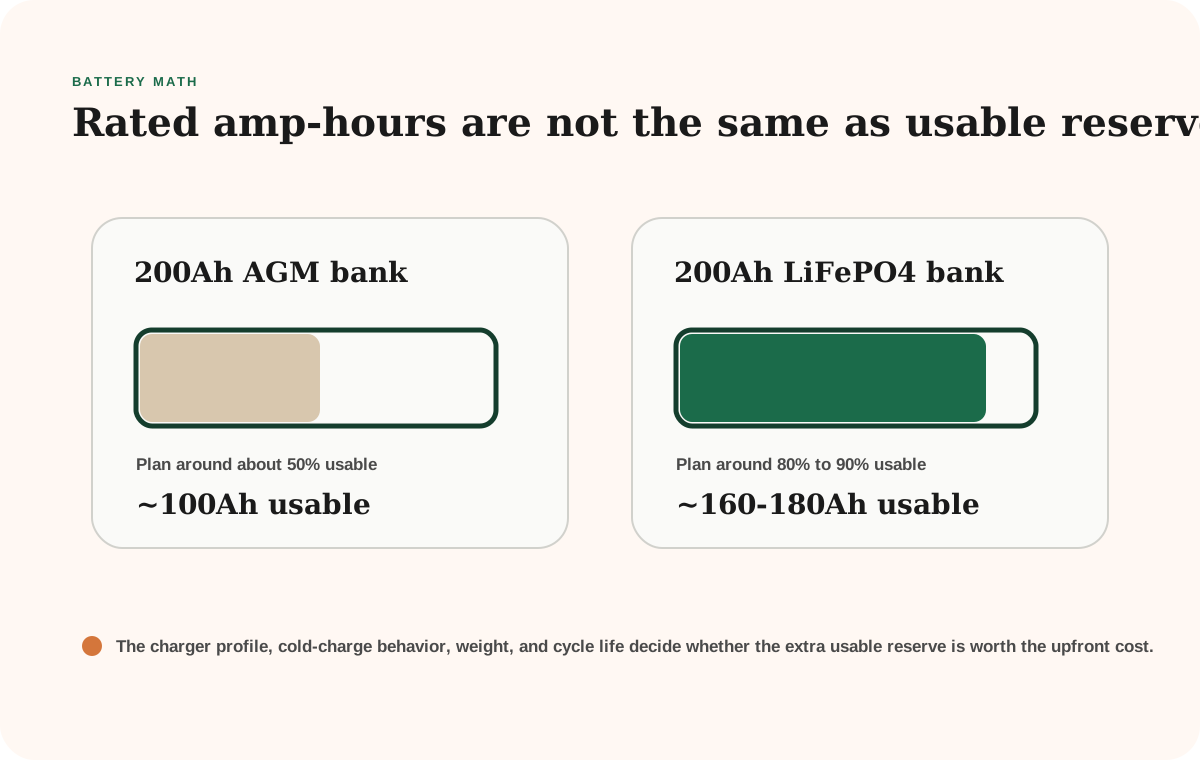
The quick math: 200Ah AGM = ~100Ah usable. 200Ah LiFePO4 = ~160-180Ah usable. That 60-80Ah gap is the reason the lithium bank can feel larger even when the sticker capacity looks identical.
Worked example: 200Ah AGM vs 200Ah lithium
Assume two 100Ah batteries either way.
With AGM:
- rated bank: 200Ah
- practical planning depth: about 50%
- usable reserve: about 100Ah
- rough usable energy: about 1,200Wh
With LiFePO4:
- rated bank: 200Ah
- practical planning depth: about 80-90%
- usable reserve: about 160-180Ah
- rough usable energy: about 2,050-2,300Wh
That difference is why lithium can feel like "more battery" even when the label says the same 200Ah. It is not magic. It is usable depth, flatter voltage, lighter weight, and charge acceptance working together.
It also changes the cost math. If a small AGM bank is enough for one weekend and the RV spends most nights plugged in, AGM may still be rational. If you cycle the bank daily, run an inverter, or need faster recovery from solar or alternator charging, the lithium bank can be the cheaper long-term system even when the receipt is larger.
Here is the more honest way to compare the purchase. If two 100Ah AGM batteries cost much less but deliver about 100Ah usable, the buyer is paying for a smaller practical reserve than the label suggests. If two 100Ah lithium batteries cost more but deliver about 160-180Ah usable, the cost per usable amp-hour narrows. Add cycle life and weight, and the spreadsheet often moves toward lithium for anyone who camps off-grid repeatedly.
That does not erase the first-day budget problem. It just keeps the decision from being distorted by rated capacity. A 100Ah AGM and a 100Ah LiFePO4 battery are not equal trip tools when one is normally planned around half the label and the other can be planned around most of it.
A charger-profile example
Suppose an older travel trailer has a basic lead-acid converter, a small PWM solar controller, and one 100Ah AGM battery. Dropping in lithium without checking anything may leave the new battery chronically undercharged or charged with the wrong float behavior.
A cleaner conversion would check the converter first, set the solar controller to a lithium profile, add a DC-to-DC charger if alternator charging matters, and reset the battery monitor for the new usable capacity. That is not overbuilding. It is making sure the more expensive battery is actually allowed to behave like lithium.
This is also why a small AGM replacement can still be the better short-term fix for an older weekend rig. If the whole charging system is staying lead-acid and the owner only needs lights, pump, and furnace support for two nights, chemistry purity matters less than a simple reliable system.
Where AGM still holds up
AGM is familiar, sealed, widely available, and easier on the upfront budget. It can still be a reasonable fit when:
- trips are shorter
- the RV is plugged in often
- daily power use is light
- you do not need a large inverter reserve
- the existing converter or charger is lead-acid focused
- weight is not the limiting factor
AGM is also less fussy when you are trying to keep an older RV simple. A modest weekend trailer with a few lights, a water pump, and occasional furnace use may not need a lithium conversion to be enjoyable.
The key is honesty. AGM is not bad. It is just less forgiving when a rig repeatedly cycles deep, needs fast recharge, or carries a heavy inverter load.
Where lithium wins clearly
Lithium changes the day-to-day experience more than the spec sheet suggests. Faster charging, deeper usable capacity, and lower weight add up quickly once you are boondocking regularly.
Lithium tends to feel better in real use for:
- repeat boondocking
- inverter-heavy setups
- remote-work rigs with laptops, routers, and monitors
- solar systems that need to recover quickly during a short sun window
- alternator charging systems with a proper DC-to-DC charger
- RVers who want easier future expansion
If winter travel is part of the plan, read the cold-weather lithium guide before assuming every LiFePO4 battery behaves the same once temperatures drop.
Charging voltage is not a footnote
Mixed systems get expensive when the battery chemistry changes but the charger profile does not.
AGM batteries need a lead-acid charging profile with absorption and float behavior. LiFePO4 batteries usually want a lithium profile that reaches the proper charge voltage, avoids equalization, and handles float differently. A converter that was fine for flooded or AGM batteries may undercharge lithium, hold the wrong float behavior, or fail to trigger the charging curve the battery expects.
Check these parts before converting:
- converter or inverter-charger profile
- solar charge controller settings
- DC-to-DC charger lithium mode
- battery monitor shunt setup
- low-temperature charge protection
- cable and fuse sizing for higher charge acceptance
That is why the right lithium upgrade is usually a system update, not just a battery swap.
Do not mix AGM and lithium as one house bank
AGM and LiFePO4 batteries have different voltage curves, charging behavior, and protection needs. If you are converting, separate the old and new banks or rebuild the house bank around one chemistry.
Price is real, but outdated lithium math can mislead you
Years ago, a 100Ah lithium battery often meant a painful premium. That still exists for some heated, Bluetooth, premium, or name-brand models, but the 100Ah LiFePO4 market has compressed. Budget lithium can now be close enough to AGM that usable capacity and cycle life deserve more attention than they used to.
Use this buying lens:
Compare
Compare fast
Use one comparison matrix to scan the practical differences. Small screens stack each row; wider screens keep the first column pinned.
| Spec | Choose AGM when | Choose lithium when |
|---|---|---|
| Trip rhythm | Short trips and frequent hookups | Repeated off-grid nights and daily cycling |
| Budget pressure | Lowest upfront spend matters most | Longer service life and usable capacity matter more |
| Charging system | Existing lead-acid charging is staying put | You are willing to set solar, DC-to-DC, and converter profiles correctly |
| Weight | Battery weight is not a constraint | Payload, tongue weight, or compartment handling matters |
| Inverter loads | Small 12V loads dominate | Microwave, coffee, remote-work, or larger AC loads are common |
For shopping-specific tradeoffs, use the best lithium RV batteries guide after the chemistry decision is clear. For runtime math, the battery calculator is a better next step than comparing one isolated 100Ah price.
The mistake most RVers make
The common mistake is asking, "Which 100Ah battery is cheaper?" instead of asking, "How much usable reserve do I need, how often will I cycle it, and can my charging system support the chemistry?"
That question changes the answer. A cheap AGM bank can be perfect for occasional camping. It can also become false economy if you add an inverter, try to boondock full-time, and cycle the bank hard every day.
Final thought
Choose AGM if the system is small, occasional, and budget-first. Choose lithium if off-grid comfort, daily cycling, faster charging, lower weight, and future expansion all matter. The best battery is not the chemistry with the best reputation. It is the chemistry whose usable capacity, charger profile, and service life match the way the rig actually gets used.
Frequently asked
Questions RVers usually ask next.
Is lithium better than AGM for RVs?
For many off-grid RVers, yes. Lithium usually provides more usable capacity, faster charging, lower weight, and longer cycle life. AGM still makes sense for lighter use, lower upfront cost, and RVs that stay plugged in often.
How much usable capacity does a 200Ah AGM bank have compared with lithium?
A 200Ah AGM bank is commonly planned around about 100Ah usable if you want reasonable battery life. A 200Ah LiFePO4 bank is commonly planned around about 160-180Ah usable, depending on the battery and BMS limits.
Do I need a different charger for lithium RV batteries?
Usually yes, or at least a charger that can be configured for lithium. Check the converter, inverter-charger, solar controller, and DC-to-DC charger before assuming a lithium battery can drop into an AGM charging setup cleanly.
What is the biggest mistake when comparing lithium and AGM?
Focusing only on upfront battery price while ignoring usable depth of discharge, cycle life, charging voltage, cold-charge limits, weight, and how often the RV depends on the battery bank off-grid.
Freshness note
Last checked April 29, 2026
This topic can change when products, plans, prices, campsite rules, or fit guidance move. These notes show what was reviewed most recently.
This review included
- Verified representative Renogy AGM and LiFePO4 depth-of-discharge, cycle-life, weight, price, and charging-voltage specs from official product pages.
- Checked current Weize AGM and Battle Born LiFePO4 official pricing and weight examples so the table separates budget, RV-brand, and premium RV-focused battery ranges.
- Rebuilt the comparison table around explicit DoD, 100Ah price, cycle-life, and 100Ah weight rows plus a 200Ah worked example.
Recent change log
April 29, 2026
Renamed the main comparison rows around exact buying numbers: usable DoD, 100Ah price, cycle life, 100Ah weight, and a plain 200Ah worked example.
April 21, 2026
Expanded the comparison with real DoD percentages, usable-capacity math, charging voltage ranges, cycle-life context, price anchors, and a 200Ah worked example.
April 17, 2026
Published lithium vs AGM battery comparison with spec-verified claims and current pricing.
Broader editorial corrections are tracked on the Corrections and Updates page.
