Official battery references to check
AGM voltage, charge settings, and cycle life vary by model. Use your exact battery manual when possible, then use these manufacturer references for planning context.
Fast replacement signals
One symptom can be misleading. A repeated pattern across several normal trips is much more useful.
Rested voltage
Trend, not one glance
Voltage should be read after rest and without active charging or heavy load. Under-load readings can look worse than the bank really is.
Capacity
Usable Ah is shrinking
A bank that still reads charged can still deliver far fewer amp-hours than it did when new.
Sag
Familiar loads hit harder
If the same fridge, furnace, or inverter load now pulls voltage down quickly, capacity or resistance may be changing.
Trip confidence
The real test
If normal trips now revolve around protecting the battery, replacement is probably near.
AGM batteries usually age by shrinking your margin
AGM batteries rarely fail in one clean moment. More often, they slowly make the same RV feel smaller.
That might look like:
- mornings that start lower than they used to
- voltage sag under familiar loads
- a battery monitor that never returns to the confidence you expect
- slower recovery after normal charging
- trips that feel shorter even though your habits did not change much
This is why AGM replacement decisions feel fuzzy. The battery still works, but the useful reserve has faded.
If you are deciding whether to replace with another AGM bank or move to lithium, read lithium vs AGM after the diagnosis is clear. Chemistry choice comes after you know whether the current bank is actually the problem.
Start with behavior, then test
Age matters, but behavior matters more.
A lightly used AGM bank that has been charged correctly and stored well can remain useful longer than a younger bank that has lived hot, undercharged, deeply cycled, or neglected. The label date is a clue, not the verdict.
Start with changed behavior:
- Did the same overnight load become harder?
- Does the furnace blower pull voltage down faster?
- Does the inverter complain sooner?
- Does the bank recover less convincingly after a normal charge?
- Does the monitor show less usable capacity before voltage gets uncomfortable?
Then test in a controlled way.
Resting voltage is useful but easy to misread
Voltage can help, but only when you read it correctly.
For AGM batteries, a healthy fully charged 12V bank often rests around the high 12V range after surface charge has settled. Around 12.2V is commonly treated as roughly half charged for many lead-acid planning charts. Below 12.0V at rest is low enough that most RVers should stop pretending the bank has comfortable margin.
But context matters:
- charging voltage is not resting voltage
- under-load voltage is not resting voltage
- temperature changes voltage behavior
- different AGM manufacturers publish different exact charts
- a surface charge can make a weak battery look better right after charging
If the battery looks bad only during a heavy load, confirm with a rested reading and a capacity test. If it looks bad after a full charge and rest, take the warning seriously.
Compare
Compare fast
Use one comparison matrix to scan the practical differences. Small screens stack each row; wider screens keep the first column pinned.
| Possible AGM symptom | Battery problem | Lookalike to rule out |
|---|---|---|
| Weak mornings | Reduced usable capacity | Parasitic draw, furnace running more, fridge cycling harder |
| Voltage drops fast under load | Higher internal resistance or weak cell | Undersized cables, loose connection, inverter surge |
| Never seems fully charged | Sulfation or capacity loss | Converter profile wrong, solar controller settings wrong, short absorption time |
| Monitor percentage is confusing | Capacity no longer matches monitor setup | Monitor not synchronized or programmed for old assumptions |
The 200Ah aged-bank example
AGM banks are often planned around about 50 percent depth of discharge when you want reasonable cycle life. That means a new 200Ah AGM bank is commonly treated as about 100Ah of comfortable usable reserve.
Now imagine that same bank has aged to about 70 percent of its original practical capacity.
The math changes:
- original rating: 200Ah
- aged practical capacity at 70 percent health: about 140Ah
- comfortable 50 percent planning lane: about 70Ah usable
That is a huge difference. The bank still has a 200Ah label on the case, but the trip may now feel like it has only about 70Ah of comfortable reserve.
This is why replacement decisions should use usable performance, not sticker capacity.
A simple capacity-test mindset
You do not need a lab to learn something useful, but you do need a controlled test.
A practical owner-level approach:
- Fully charge the bank with the correct AGM profile.
- Let the bank rest according to the battery manual or long enough for surface charge to settle.
- Apply a known load that is reasonable for the battery.
- Track time, amp-hours, voltage trend, and load behavior with a battery monitor or meter.
- Stop before the battery is driven below the safe limit in the manual.
This does not replace professional load testing, but it can reveal whether the bank still supports the trip you are planning.
If you do not already have a reliable monitor, the RV battery monitor guide explains why voltage alone can be misleading.
Do not replace batteries to hide a charging problem
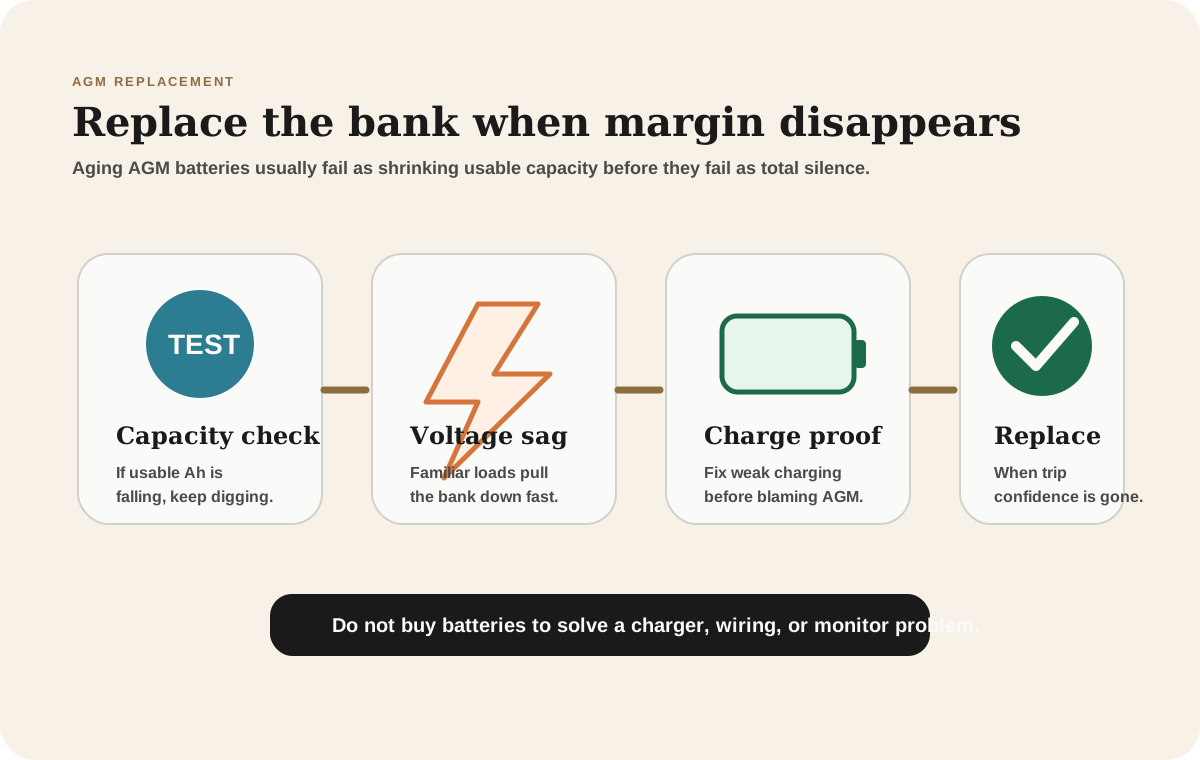
A weak converter, wrong solar-controller profile, loose cable, corroded connection, or parasitic draw can make a good battery look bad. Fix the system diagnosis before spending replacement money.
When replacement becomes the smart move
Replacement is usually sensible when several of these are true:
- the bank cannot support the same overnight loads it used to
- a controlled test shows materially reduced usable capacity
- voltage sag appears under normal loads, not only extreme loads
- the bank struggles to recover after correct charging
- the batteries have a known history of deep discharge, heat, or undercharging
- the rest of the charging and wiring system checks out
- normal trips now revolve around protecting the bank
You do not need to wait until the batteries are completely dead. In RV use, a bank can be technically alive and still no longer good enough for boondocking.
Replace before the high-consequence trip
The replacement threshold should be lower when the next trip has fewer safety nets.
A tired AGM bank might be tolerable for a campground weekend with hookups nearby. The same bank can be the wrong choice for a cold boondocking trip, a remote work week, or a desert stay where the next legal reset is far away.
Use the trip to set the risk level:
- campground with hookups: monitor the trend and plan replacement soon
- mild weekend boondocking: test first, then decide if the margin still feels acceptable
- cold-weather boondocking: replace earlier if furnace reserve is already questionable
- remote-work travel: replace before the bank threatens meetings or morning startup
- remote public-land stay: do not carry a known weak bank as the only house reserve
This is not fear-based buying. It is consequence-based maintenance. A battery that is "probably fine" can be acceptable when help and shore power are close. It is less acceptable when the trip depends on battery reserve for heat, communications, food storage, or work.
What to record before buying the next bank
Before ordering replacements, write down what the old bank taught you.
Useful notes include:
- amp-hours used on a normal night
- lowest rested morning voltage
- furnace-blower behavior in cold weather
- inverter loads that created the worst sag
- solar or converter settings that may need adjustment
- whether battery location, cable length, or ventilation limits the next choice
Those notes prevent a lazy like-for-like replacement when the real problem is that the way you travel has changed.
Replace AGM with AGM or move to lithium?
The replacement chemistry depends on the job.
Compare
Compare fast
Use one comparison matrix to scan the practical differences. Small screens stack each row; wider screens keep the first column pinned.
| Spec | Replace with AGM | Move to lithium | Pause and fix system first |
|---|---|---|---|
| Best fit | Light use, lower upfront cost, charger already matches AGM | More usable capacity, frequent boondocking, lower weight, deeper cycling | Symptoms point to charger, wiring, monitor, or parasitic draw |
| Main upside | Simple like-for-like replacement | More usable reserve from the same rated Ah | Avoids ruining new batteries with the same old problem |
| Main watchout | Less usable capacity per rated Ah | May need charger, solar, DC-to-DC, and cold-charge changes | Diagnosis takes patience before the fun purchase |
| Next step | Match size, profile, and wiring | Read the lithium upgrade and sizing guides | Use troubleshooting before buying |
If lithium is the likely move, size the next bank with the battery calculator and the battery bank sizing guide. Replacing a weak 200Ah AGM bank with an undersized lithium bank can still leave you short if the real load grew.
Final thought
AGM replacement is not about punishing a battery for being old. It is about whether the bank still gives you enough usable reserve for the trips you actually take.
Once the pattern is clear, and charging or wiring lookalikes are ruled out, replacement before the next trip is often cheaper than letting a tired bank keep deciding where you can camp.
Frequently asked
Questions RVers usually ask next.
How do I know if my AGM RV batteries need replacement?
Look for a repeated pattern: weaker overnight reserve, voltage sag under normal loads, slower recovery after proper charging, and less usable capacity during a controlled test. One odd reading is not enough; the trend matters.
Should I replace AGM batteries just because they are old?
Age is a clue, not a verdict. Storage, heat, discharge depth, charging profile, and real capacity matter more than the calendar by itself.
Could the charging system be the real problem instead of the batteries?
Yes. Weak charging, wrong AGM settings, loose connections, bad monitor assumptions, and parasitic draw can all imitate battery failure. Rule those out before buying a new bank.
Do AGM batteries need to be fully dead before replacement?
No. For boondocking, replacement often makes sense when the bank no longer provides dependable usable capacity for normal trips, even if it still technically powers small loads.
Freshness note
Last checked April 21, 2026
This topic can change when products, plans, prices, campsite rules, or fit guidance move. These notes show what was reviewed most recently.
This review included
- Checked AGM battery manufacturer manuals for charging, depth-of-discharge, storage, and capacity-test guidance.
- Expanded the guide with replacement decision thresholds, a 200Ah aged-bank example, voltage caveats, and charger-lookalike diagnostics.
Recent change log
April 21, 2026
Expanded the AGM replacement guide with official source checks, a decision visual, comparison tables, and capacity-loss math.
Broader editorial corrections are tracked on the Corrections and Updates page.
