Official electrical references
These references were checked on April 21, 2026. Use them for design principles, then follow the exact manuals for the inverter, charger, battery, and converter you install.
Pre-arrival checks
Manuals beat rules of thumb
Cable size, fuse class, battery series/parallel limits, inverter current, and charger compatibility must come from the installed component manuals.
24V is a system decision
A 24V bank affects inverter, solar controller, DC-to-DC charging, shore charging, and every 12V coach load that still needs power.
12V or 24V: the short answer
Most RVers should stay with a 12V battery bank unless the finished system has a clear reason to move to 24V. A 12V bank matches common RV loads, is easier to service, and keeps the upgrade path familiar. A 24V bank becomes attractive when inverter demand, current, cable size, voltage drop, solar-controller headroom, or future expansion make a large 12V system feel strained.
The question is not whether 24V is more professional.
The question is whether the whole RV system benefits enough to justify the extra design work.
If you have not sized the battery bank yet, start with the battery bank sizing guide and battery calculator. Voltage choice gets much easier once daily watt-hours, inverter loads, and reserve targets are not guesses.
System voltage snapshot
Use this as a planning filter before buying batteries, inverter, charger, or solar controller hardware.
Best default
12V
Best for most weekend, moderate, and first serious lithium RV upgrades because coach integration stays simple.
Best large-system lane
24V
Best when the system is clearly heading toward larger inverter loads, bigger solar, shorter high-current runs, and a more custom electrical platform.
Main 12V issue
High current
A 2,000W or 3,000W inverter on 12V can require very large battery-to-inverter current before losses.
Main 24V issue
Coach conversion
The RV still has 12V lights, fans, pumps, controls, and boards that need a clean DC-DC conversion plan.
The current math is why 24V exists
Watts are volts times amps.
That means amps are watts divided by volts.
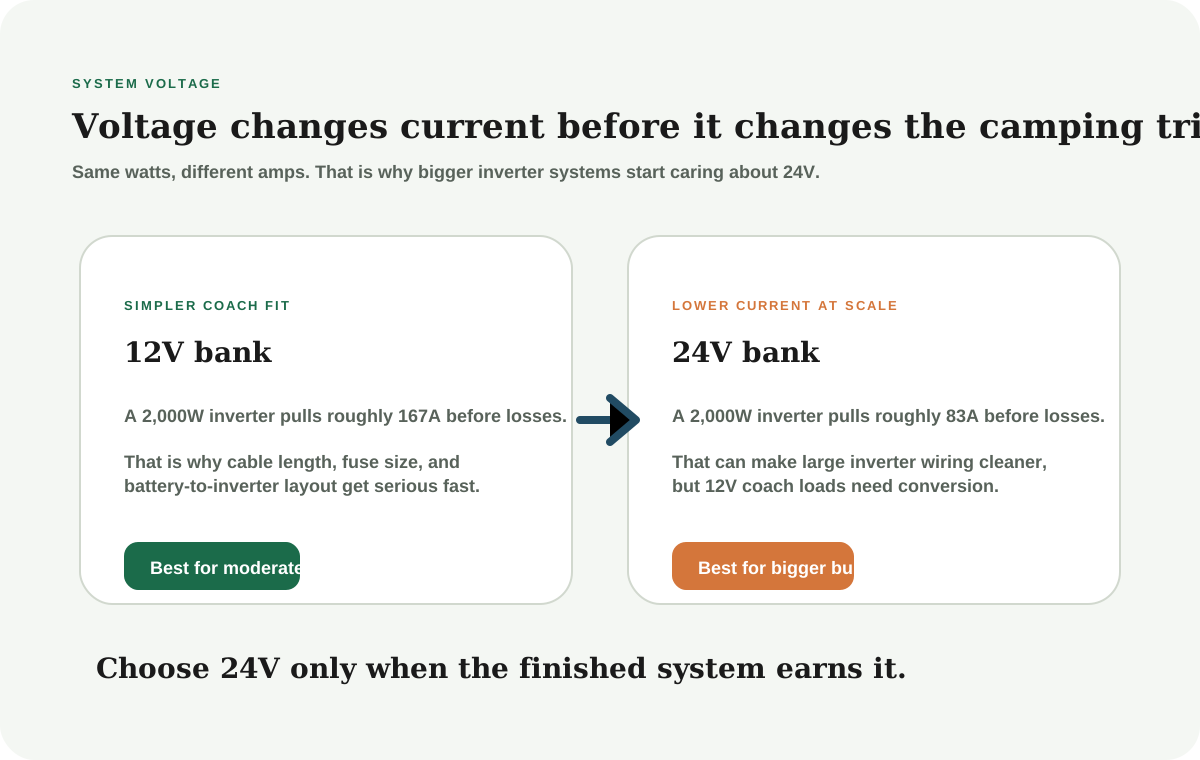
A 2,000W inverter load on a 12V bank is roughly:
2,000W / 12V = 167A before inverter losses
The same 2,000W load on a 24V bank is roughly:
2,000W / 24V = 83A before inverter losses
A 3,000W inverter load on 12V is roughly:
3,000W / 12V = 250A before losses
On 24V, it is roughly:
3,000W / 24V = 125A before losses
Those are not tiny differences. They affect cable size, fuse class, busbar layout, inverter placement, voltage drop, heat, and how unforgiving the battery-to-inverter run becomes.
This is the strongest argument for 24V. It does not magically create more energy. It reduces current for the same power.
12V versus 24V decision points
Compare
12V versus 24V RV battery bank decision points.
Use one comparison matrix to scan the practical differences. Small screens stack each row; wider screens keep the first column pinned.
| Spec | 12V bank | 24V bank |
|---|---|---|
| Best fit | Most RV upgrades, moderate systems, and beginner-to-intermediate builds | Larger inverter systems, custom builds, and growth-oriented full-time rigs |
| Coach integration | Natural fit for lights, fans, pumps, controls, and many RV accessories | Needs DC-DC conversion or a planned 12V distribution branch for native coach loads |
| Inverter current | Higher current at the same wattage | About half the current at the same wattage |
| Cable pressure | Can get heavy quickly above 2,000-3,000W inverter classes | Usually cleaner for bigger inverter and controller layouts |
| Learning curve | More examples, simpler service conversations, easier RV parts familiarity | More custom design, fewer off-the-shelf RV assumptions |
| Main mistake | Trying to push a very large system through undersized 12V wiring | Moving to 24V before the build actually benefits from it |
Why 12V remains the default for many RVs
Most RVs are already built around 12V DC.
That usually includes:
- lights
- fans
- water pump
- furnace controls
- refrigerator controls
- tank monitors
- slides and jacks on many rigs
- control boards and accessory circuits
When the battery bank is also 12V, integration is straightforward. The converter, fuse panel, monitoring expectations, and troubleshooting language are familiar. For a first lithium upgrade or a moderate off-grid setup, that simplicity is valuable.
There is nothing weak about a well-built 12V system. A 200Ah, 300Ah, or 400Ah 12V lithium bank can be excellent if cable runs are short, protection is correct, the inverter is not oversized for the wiring, and the system is designed around realistic loads.
If the rig is mostly lights, fans, a 12V fridge, laptop charging, modest inverter time, and normal boondocking loads, 12V is usually still the cleaner answer.
Why people move to 24V
People move to 24V when the system stops feeling moderate.
The trigger is usually one of these:
- a 3,000W-class inverter
- long battery-to-inverter cable runs that cannot be shortened
- a large solar array that pushes controller limits at 12V
- a custom lithium bank built from 24V modules or series pairs
- heavy full-time loads with repeated high-current AC use
- a desire to reduce current in the main DC bus
At that point, 24V can make the high-power side of the system calmer. Smaller current for the same power can mean more manageable cabling, less voltage-drop pressure, and better controller headroom.
But 24V is not free. The coach still needs 12V. The owner must plan a DC-DC converter, branch distribution, spare-parts strategy, and service documentation so future troubleshooting does not become a guessing game.
Solar controller fit can change the decision
System voltage also affects solar-controller capacity.
Many MPPT controllers can support more total solar wattage at 24V than at 12V because output current is the limiting factor. That is why controller spec sheets often list different solar limits for 12V and 24V battery systems.
For example, a controller limited by output current may support a moderate 12V array but a larger 24V array. That does not mean every RV should jump to 24V. It means big roof arrays and growth plans should be checked against controller limits before the battery voltage is chosen.
Use the RV solar charge controller guide and the solar calculator before buying batteries if the finished array may grow beyond starter-kit size.
The DC conversion question
A 24V RV battery bank needs a clean way to keep 12V loads alive.
That usually means a DC-DC converter sized for the coach loads. The converter should be protected, serviceable, and documented. It also needs to handle the loads that run at the same time, not just the average load.
Think through:
- water pump startup
- furnace fan/control behavior
- refrigerator control board
- lighting circuits
- slides, jacks, or leveling systems if applicable
- tank heaters or 12V heat pads
- router or fan loads
Some high-current RV devices may not belong behind a small converter. Some may need a separate plan. This is where 24V stops being a simple battery choice and becomes a real electrical design.
Do not strand the coach loads
A 24V bank can make the inverter side cleaner, but the RV still needs dependable 12V power. If the 12V conversion path is undersized or poorly documented, the advanced system becomes harder to live with than the simple one.
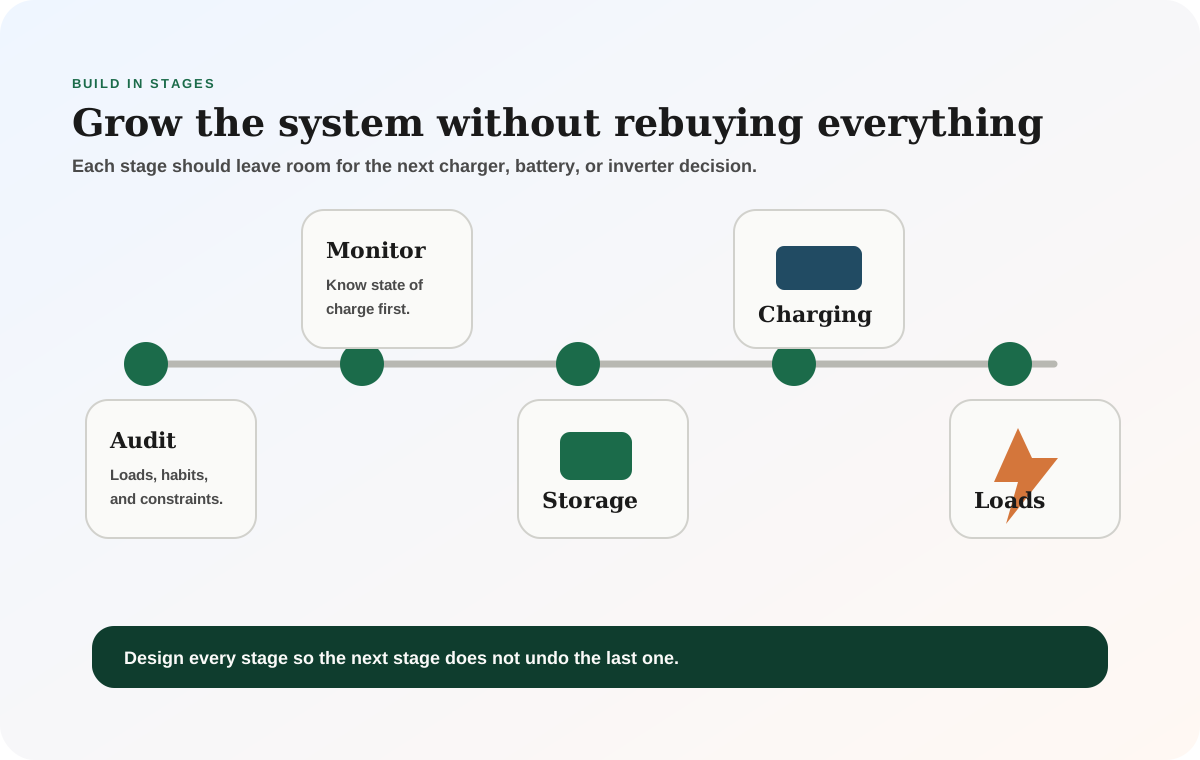
Staged builds should be careful
If you are building in phases, voltage choice deserves extra caution.
Going 24V too early can add complexity before the benefits show up. Staying at 12V too long can make a future large-system transition clumsier. The right move depends on whether the future build is clear.
Stay 12V if:
- the final system is likely moderate
- the inverter will stay modest
- coach integration simplicity matters most
- you are still learning your loads
- you want easier service and examples
Consider 24V if:
- a larger inverter is definitely part of the plan
- solar will expand significantly
- the battery-to-inverter run cannot be made short enough
- you are comfortable with custom electrical design
- the 12V conversion path is already planned
If this is part of a phased upgrade, tie the decision to the staged off-grid build roadmap, not just the next sale price on batteries.
Worked examples
Weekend lithium upgrade
The rig has a 200Ah to 300Ah LiFePO4 bank, a 1,000W to 2,000W inverter, normal 12V coach loads, and mostly weekend or short-trip use.
Stay 12V. The benefits of simple coach integration usually outweigh the 24V wiring advantages.
Full-time remote-work build
The rig has a 400Ah-plus lithium target, a 3,000W inverter, Starlink or router loads, laptops, a compressor fridge, and future solar expansion.
This is where 24V deserves a real design pass. It is not automatic, but the current reduction and controller headroom may be worth the conversion complexity.
Large inverter kitchen build
The owner wants frequent induction cooking, microwave use, coffee appliances, and a large inverter bank.
Do not choose voltage from appliance dreams alone. First decide whether those loads are realistic for battery capacity, charging, wiring, and campsite behavior. If they are, 24V may make the high-power layout cleaner. If they are occasional luxuries, a well-designed 12V system may still be simpler.
Final thought
There is nothing inherently more serious about a premature 24V system. There is also nothing outdated about a well-designed 12V system.
Good voltage choice is about fit.
A clean 12V system beats a complicated 24V system that solves a problem the RV does not have. A well-planned 24V platform beats a strained oversized 12V build once the loads, inverter, solar, and expansion plan truly demand it.
Choose the voltage that fits the finished system, not the one that sounds better in a forum thread.
Frequently asked
Questions RVers usually ask next.
Is 24V better than 12V for an RV battery bank?
Not automatically. A 24V bank can be better for larger inverter systems because it reduces current for the same wattage, but 12V is simpler and usually better for many RV upgrades because the coach already uses 12V loads.
When should an RV use a 24V battery bank?
Consider 24V when the build clearly includes a larger inverter, high current pressure, bigger solar expansion, long battery-to-inverter runs, or a custom full-time electrical platform. Plan the 12V conversion path first.
Can a 24V battery bank run 12V RV lights and appliances?
Not directly. The RV's 12V loads need a properly sized DC-DC converter or other planned 12V distribution path. That converter must be protected, serviceable, and sized for real simultaneous loads.
Should beginners choose 24V to future-proof an RV?
Usually not unless the final large-system plan is already clear. For many beginners, a clean 12V system is easier to learn, service, expand moderately, and troubleshoot.
Freshness note
Last checked April 21, 2026
This topic can change when products, plans, prices, campsite rules, or fit guidance move. These notes show what was reviewed most recently.
This review included
- Checked Victron Wiring Unlimited and MPPT calculator references for current, cable, voltage-drop, and controller-sizing context.
- Checked Battle Born lithium charging/support guidance for practical 12V RV bank assumptions and BMS coordination.
- Rebuilt the guide with a custom 12V/24V decision visual, official source grid, exact inverter-current examples, and clearer RV coach-integration guidance.
Recent change log
April 21, 2026
Expanded the 12V vs. 24V RV bank guide with current math, official electrical references, a custom voltage visual, conversion tradeoffs, and staged-build guidance.
April 17, 2026
Published 12V vs. 24V battery bank comparison covering wiring, inverter fit, and cost tradeoffs.
Broader editorial corrections are tracked on the Corrections and Updates page.