Official checks before you stretch a stay
Waste rules vary by land manager and site. Use official guidance for the area you are visiting before assuming gray water, portable toilets, catholes, or dump timing are handled the same everywhere.
Pre-arrival checks
Before arrival
Know the next legal dump station, potable refill option, local waste rules, and whether gray or black capacity is the likely trip limiter.
Fast waste-capacity check
Use these as planning flags before you assume a five-night stay will feel as easy as a two-night stay.
Gray-tank pressure
Showers and dishes
A 2.0 gpm showerhead can put 8 gallons into gray from only four minutes of water-on time.
Black-tank pressure
People and routine
Crew size and toilet habits matter more than the tank label once the RV is the main bathroom.
Legal pressure
Dump access
A bigger tank does not help if the route has no legal reset point when the tank fills.
Best control
Repeatable habits
Simple routines beat heroic restrictions that everyone resents by night three.
Waste management is one of the quiet limits of off-grid travel
When people imagine longer boondocking stays, they usually think about solar, batteries, or fresh water first. Those are important, but waste is the constraint that can make a good campsite feel suddenly finished.
Bathroom strategy deserves the same respect as power strategy because it decides how long the rig can stay self-contained without becoming unpleasant or irresponsible.
The goal is not to make the trip feel like a set of rules. The goal is to keep the RV comfortable, keep the site clean, and leave with enough margin that departure is a choice instead of a tank emergency.
If you are planning the whole stay-length problem, pair this guide with the boondocking stay-length calculator, the water conservation guide, and the broader how long can you boondock guide.
Gray and black tanks solve different problems
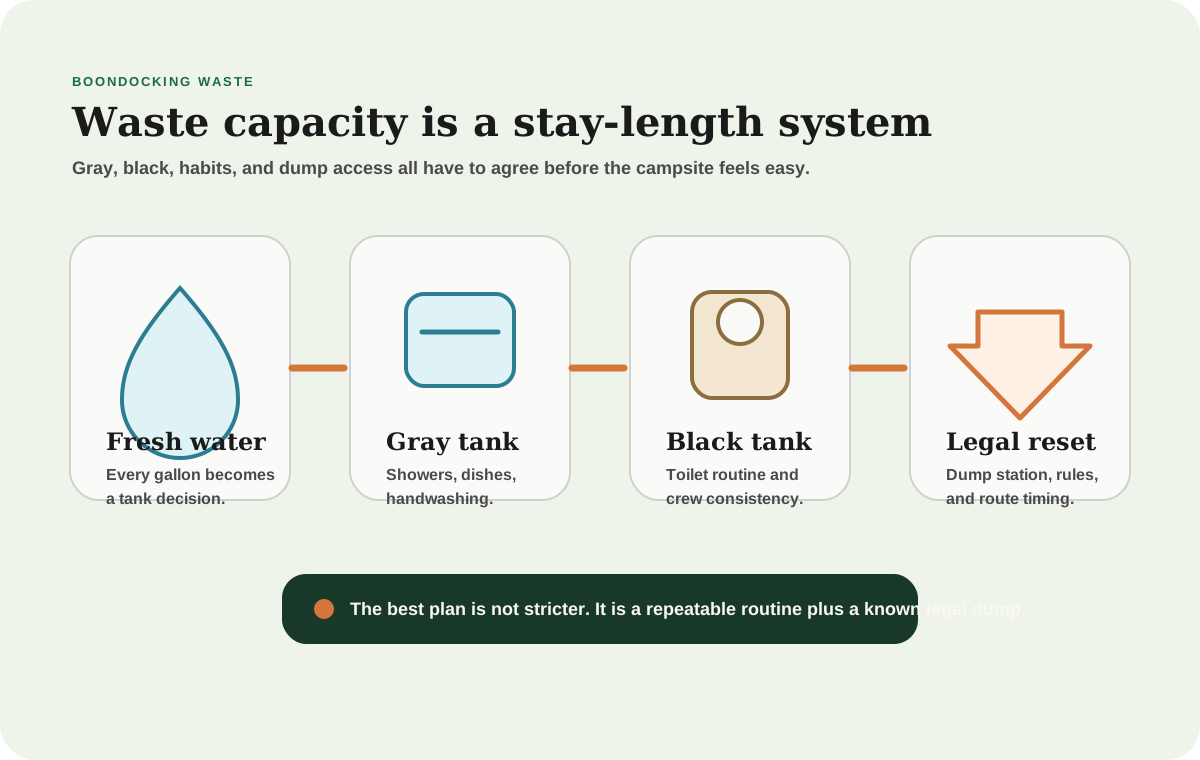
Gray and black tanks get lumped together, but they are controlled by different habits.
Gray tank pressure is mostly sink and shower behavior:
- shower water-on time
- dishwashing style
- handwashing flow
- food cleanup
- how often people rinse, wash, or wipe things casually
Black tank pressure is mostly bathroom routing:
- how many people use the RV toilet
- how often the RV toilet is used instead of public or campground facilities
- how much flush water the crew uses
- whether the black tank starts the trip properly managed
- whether the next dump station is known before the tank is urgent
Many RVers assume black is always the first limiter because it feels more sensitive. In practice, gray can fill first when showers and dishes run like they would on hookups.
Compare
Compare fast
Use one comparison matrix to scan the practical differences. Small screens stack each row; wider screens keep the first column pinned.
| Spec | What fills it | What stretches it | What not to do |
|---|---|---|---|
| Gray tank | Showers, dishes, handwashing, food cleanup | Navy showers, basin dishes, wipe-first cooking cleanup | Assume a full fresh tank means the gray tank can accept every gallon |
| Black tank | Toilet use, flush water, crew size, trip length | Consistent crew routine, correct tank treatment, planned dump timing | Wait until the tank is urgent before finding the next legal dump |
| Portable toilet or cassette | Small-volume emergency or alternate bathroom use | Short trips, small rigs, simple dump access | Treat it as a magic solution if disposal access is still unclear |
| Composting or separating toilet | Liquid bottle, solids container, fan/venting, user routine | Good fit when the crew accepts the maintenance rhythm | Remove the factory toilet before proving the liquids and solids workflow works |
Do the gray-tank math before the trip feels tight
A gray tank fills through ordinary routines, not one dramatic mistake.
Use a simple shower example. EPA WaterSense uses 2.0 gallons per minute as the efficient showerhead benchmark. In an RV, a four-minute water-on shower at that flow rate is about 8 gallons. Two people doing that once each can put about 16 gallons into the gray tank from showers alone.
That may be fine in a rig with a large gray tank and a short trip. It is very different in a smaller trailer with a 25 to 35 gallon gray tank, especially if dishes and handwashing are also happening indoors.
The practical lesson is not "never shower." It is to separate shower length from water-on time:
- wet down
- water off
- soap and scrub
- quick rinse
- stop before the gray tank becomes the trip boss
The same logic applies to dishes. A basin wash, wipe-first pans, and low-mess meals can save more gray capacity than one person trying to be perfect in the shower.
Black-tank strategy is mostly a crew agreement
Black tank planning gets awkward when everyone quietly assumes a different rule.
One person may think the RV toilet is for everything because that is why the rig has a bathroom. Another may think town stops and public restrooms should be used whenever convenient. Neither assumption is wrong by itself. The problem is when those assumptions collide on night four.
A good plan answers three questions before camp:
- Will the RV toilet be the main bathroom or the backup bathroom?
- Are travel-day and town-stop restrooms part of the plan?
- Where is the next legal dump if the black tank fills early?
For a weekend trip, "use the RV normally and dump on the way home" may be perfectly reasonable. For a longer public-land stay, the same habit may shorten the site by several days.
If you are considering a waterless or separating toilet, use the best composting toilet for RVs as a reality check first. Those systems can be useful, but they replace one tank-management problem with liquids handling, solids access, fan venting, and user compliance.
Legal disposal is part of the system
The fastest way to ruin a campsite for everyone is to treat gray water, wipes, food scraps, or human waste as someone else's problem.
Do not assume dispersed camping means informal disposal is acceptable. Land managers can set different rules for gray water, portable toilets, catholes, vault toilets, dump stations, and sensitive areas. Dry washes, desert soils, crowded sites, alpine water sources, and high-use corridors often require more care than a generic internet rule suggests.
Use official land-manager guidance for the specific area. The practical boondocking standard is simple:
- pack out trash and hygiene waste
- keep waste away from water, trails, and camps
- use dump stations when tanks or portable systems need emptying
- verify local rules before relying on catholes or gray-water dispersal
- do not dump gray or black tanks on the ground
A full tank is not an emergency exception
If the next legal dump is too far away, the plan was too optimistic. Build the reset into the route before the tank is close to full.
Pick the strategy by trip length
Bathroom strategy changes with stay length. A routine that works for two nights can feel sloppy by night six.
Compare
Compare fast
Use one comparison matrix to scan the practical differences. Small screens stack each row; wider screens keep the first column pinned.
| Spec | 2-3 nights | 4-7 nights | Longer stays |
|---|---|---|---|
| Best mindset | Keep it simple | Manage the trend | Plan the reset |
| Gray focus | Avoid careless sink use | Use basin dishes and water-off showers | Track gray level daily and move before it controls the trip |
| Black focus | Normal RV use may be fine | Use town stops strategically if they fit the day | Know dump distance before the tank passes comfortable margin |
| Best upgrade | Clear departure checklist | Better water routine and tank awareness | Larger reset plan, portable backup, or a different toilet system |
Meal planning is waste planning
Food choices change water and tank pressure.
A meal that uses several pans, sticky sauces, and lots of rinsing is not just a food decision. It is a gray-tank decision. A low-cleanup meal is not glamorous, but it can be the reason the second half of the stay still feels easy.
The best boondocking meals often share a few traits:
- wipe-clean cookware
- fewer greasy pans
- fewer tiny bowls and prep dishes
- planned leftovers
- paper use only when trash storage and fire rules make sense
- no assumption that rinsing solves everything
This does not mean eating badly. It means recognizing that cleanup water becomes tank volume.
Multi-person rigs need visible norms
The more people in the RV, the less useful private discipline becomes. One careful person cannot compensate forever for a crew that never agreed on the plan.
Use plain language before the trip:
- "We are doing water-off showers."
- "We are using town restrooms when we naturally stop."
- "If gray hits two-thirds, we stop acting surprised and plan the reset."
- "No wipes go into the black tank unless the tank and product are explicitly built for that."
That conversation can feel silly in the driveway. It feels much less silly than discovering at camp that everyone was using a different playbook.
The cleanest routine
A strong boondocking bathroom routine usually looks like this:
- Start with empty waste tanks and a known dump option.
- Track gray and black separately instead of treating "waste" as one blob.
- Use water-off showers and basin dishes by default.
- Keep hygiene trash packed out and separate.
- Use public restrooms naturally when they fit the route.
- Move or dump before the tank is urgent.
That is not extreme. It is just enough structure to keep the campsite from getting smaller every day.
Final thought
The best waste strategy is the one you can repeat without resentment.
If the plan is so strict that everyone hates it, it will not last. If it is so loose that the tanks become a problem constantly, it is not a plan.
The useful middle ground is boring in the best way: legal, clean, predictable, and aligned with the trip you are actually taking.
Frequently asked
Questions RVers usually ask next.
What usually fills first while boondocking, gray or black?
It depends on the rig and crew, but gray often fills faster than people expect because showers, dishes, and sink use add up quickly. Black can still be the limiter with larger crews or when the RV toilet is the only bathroom for a longer stay.
Can I dump gray water on the ground while boondocking?
Do not assume that is allowed. Rules vary by land manager, site, and season, and many areas require wastewater to be contained and dumped in approved facilities. Check official local guidance before the trip.
Is a composting toilet better for boondocking?
It can be better for some rigs, but only if liquids handling, solids removal, venting, and crew habits fit the RV. It does not eliminate disposal responsibility; it changes the workflow.
What is the easiest way to stretch waste capacity?
The easiest win is usually gray-water control: shorter water-on shower time, basin dishwashing, and wiping pans before washing. Those habits save fresh water and slow gray-tank fill at the same time.
Freshness note
Last checked April 21, 2026
This topic can change when products, plans, prices, campsite rules, or fit guidance move. These notes show what was reviewed most recently.
This review included
- Checked official Leave No Trace and public-land waste guidance for human waste, water-source setbacks, and pack-out expectations.
- Checked EPA WaterSense flow-rate references used for shower and faucet water-use examples.
- Expanded the guide with tank-pressure examples, legal disposal routing, gray-vs-black tradeoffs, and crew routines.
Recent change log
April 21, 2026
Expanded the waste strategy guide with official source routing, tank math, a decision visual, and practical routines for gray and black tanks.
Broader editorial corrections are tracked on the Corrections and Updates page.
