Official cold-weather lithium checks
Use the manual for the exact battery and charger you install. Low-temperature behavior changes by model, heater design, BMS, and charge source.
Pre-arrival checks
Before winter charging
Confirm low-temperature charge cutoff, heater behavior, charger settings, battery location, and what happens when solar starts before cells are warm.
Cold-weather lithium discussions are usually too simplistic
You will often hear one of two extreme positions:
- lithium is the obvious answer for every serious RV build
- lithium is a bad idea anywhere temperatures drop
Neither is useful on its own.
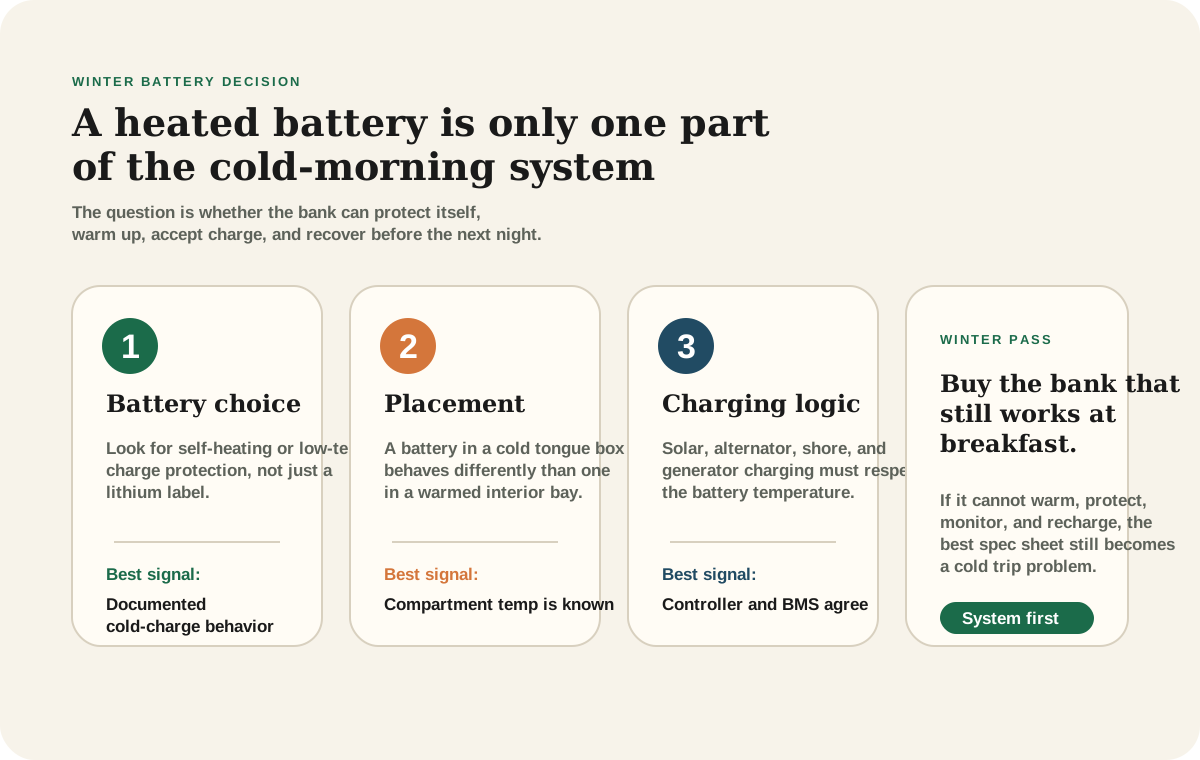
Lithium can be excellent in RVs, including four-season rigs, but only when the cold-weather realities are understood. The important question is not whether lithium works in winter at all. The better question is how the battery behaves when temperatures fall and what the system needs to prevent poor charging decisions.
If you are still comparing chemistry at the broad level, start with lithium vs. AGM RV batteries before narrowing the winter details. If you already know lithium is likely, the cold-weather lithium battery buying guide helps separate useful winter features from feature-sheet decoration.
The key distinction: charging vs. using the battery
One reason this topic gets muddled is that people talk about "cold-weather performance" as if it is one single issue. In reality, there are two different concerns:
- how the battery behaves while powering loads
- how the battery should be charged when it is cold
For many RVers, the more important restriction is on charging. A battery may still help power the rig in cold weather, but charging behavior is where the real protective rules come into play.
That means your winter planning should revolve around:
- where the battery lives
- whether it can warm before charging begins
- what the charge controller or battery management system does in low temperatures
- how your solar and shore-charging routine behaves on cold mornings
Battery location can solve half the problem
Before comparing product features, think about placement.
A lithium battery inside a conditioned or semi-conditioned interior compartment lives a very different life than one mounted in a cold exterior space. Many winter frustrations come not from the chemistry itself, but from placing the battery where it consistently starts the day far below the comfort zone for charging.
Better locations usually mean:
- protected from direct exterior cold
- easier to monitor
- less temperature swing overnight
- more realistic warming during occupied use
Exterior compartments are not automatically wrong, but they demand more deliberate planning.
What built-in low-temperature protections actually do
Many lithium batteries include a battery management system that helps prevent charging under unsuitable conditions. That is valuable, but it should be understood correctly.
These protections are not a magic winter mode. They are guardrails.
What they often do is stop charging when the cell temperature is too low. That protects the battery, but it also means your system may not recharge when you expect it to. On a cold bright morning, the panels may be ready long before the battery is.
That is not necessarily a failure. It is the system behaving safely. The planning question becomes: are you comfortable with that behavior, or do you need a setup that warms the battery into its charging range sooner?
Battery heating can be useful, but it should match the travel pattern
Heated lithium batteries or battery-heating strategies are often discussed as the obvious fix. Sometimes they are. Sometimes they are more feature than necessity.
They are most helpful when:
- the battery regularly spends nights in genuinely cold conditions
- morning solar recovery matters
- the rig is used in shoulder seasons or winter for multiple days at a time
- the battery lives in a space that does not passively warm quickly
They matter less when:
- the battery is interior-mounted
- travel is mostly mild-season
- the rig is not relying on early-morning charging
- shore power is commonly available during cold snaps
The best decision depends on how often the cold problem is real, not how dramatic the worst-case scenario sounds on a product page.
Compare
Cold-weather battery planning lanes
Use one comparison matrix to scan the practical differences. Small screens stack each row; wider screens keep the first column pinned.
| Spec | Interior lithium | Exterior heated lithium | AGM fallback |
|---|---|---|---|
| Charging risk | Lower if the compartment warms with the living space | Depends on heater behavior and whether the battery reaches charge temperature in time | Simpler cold charging behavior, but still needs correct charging and capacity margin |
| System complexity | Placement and cable routing are the main questions | Battery heat, charger timing, compartment exposure, and BMS behavior all matter | Often simpler electrically, but heavier and less usable per rated Ah |
| Best fit | Mild to shoulder-season travelers with protected battery space | Winter travelers who rely on morning recharge and can verify heater details | Budget-limited or simple systems where lithium cold behavior is not worth managing |
| What to verify | Ventilation, mounting, cable length, and service access | Heater trigger, current draw, low-temp cutoff, charger compatibility, and manual limits | Usable capacity, weight, voltage sag, and recharge time |
Winter usability starts with behavior, not chemistry alone
If you know how the rig is used on cold mornings, whether the battery warms inside the coach, and how quickly charging needs to begin, the lithium decision becomes much less emotional and much more practical.
Lithium still offers meaningful advantages in RVs
Cold-weather caution should not erase lithium's real strengths.
For many RVers, lithium remains attractive because of:
- usable capacity
- weight savings
- stable voltage behavior under load
- long-cycle value when used properly
- cleaner match for larger off-grid electrical systems
These strengths matter even more in rigs with inverters, remote-work loads, or extended off-grid stays. That is why many RVers still choose lithium despite winter travel plans. They are not ignoring the cold issue; they are deciding the broader system benefits are still worth managing around it.
Where winter travelers get burned
Problems usually show up when expectations and system behavior do not match.
Common examples include:
- expecting solar to recharge immediately on freezing mornings
- storing batteries in a cold compartment without a clear warming strategy
- assuming all lithium options behave the same
- designing around ideal-weather charge patterns
- forgetting that winter days are shorter even before cold behavior enters the picture
Notice that several of these are design or planning problems rather than product problems.
AGM is not automatically the better winter answer
Lithium vs. AGM in cold weather often gets framed as if AGM is therefore the obvious winter winner. That is too broad.
AGM may feel simpler in some winter scenarios, especially when the system is small, the budget is tighter, or the owner wants less setup nuance. But AGM also brings tradeoffs in usable capacity, weight, voltage sag, and total system behavior under heavier loads.
That means winter travelers should not ask only:
which chemistry is less annoying when it is cold?
They should also ask:
which chemistry better supports the whole way we camp, work, charge, and size the rig?
For some travelers, that answer still ends up being lithium.
Matching the battery choice to the traveler
Mild-climate traveler with occasional cold nights
Lithium can still be an easy fit, especially if the battery lives inside the coach and the system is not depending on immediate dawn charging after freezing nights.
Shoulder-season traveler who moves often
Lithium can work well, but morning charging behavior matters more. Placement and low-temperature protection features become more important.
Dedicated winter camper
Lithium may still make sense, but the decision needs to be treated as a system design question, not a simple chemistry preference. Heating, placement, charge timing, and realistic sun conditions all matter.
Budget-limited beginner
If the system is small and winter use is uncertain, starting with a simpler or smaller setup may be smarter than overbuilding around the fear of extreme cold.
How to plan the rest of the system around winter lithium
Cold-weather success is about integration. The battery does not live alone.
Think through:
- whether the solar controller supports the battery well
- where charging sources appear first in the day
- whether alternator, shore, or solar charging dominates your travel pattern
- what the rig's overnight temperature profile actually looks like
- whether the battery monitor gives you enough visibility
A winter-ready system is one where these answers are clear before the first cold trip, not learned the hard way at a frozen campsite.
The battery plan should also match the larger cold-weather routine. Heat, condensation, water protection, and morning recovery all show up together in the cold-weather boondocking guide.
Do not assume sunny equals charge-ready
In winter, a bright morning does not necessarily mean the battery is ready to accept charge immediately. Temperature, not sunlight alone, shapes what safe charging looks like.
A better decision framework
Instead of asking whether lithium is good or bad in the cold, ask:
- Where will the battery live?
- How often do we actually camp below freezing?
- Do we need early-day charging to recover well?
- Does the rest of the electrical system justify lithium's advantages?
- Are we willing to manage the winter behavior deliberately?
If the answers line up, cold-weather lithium can be a strong fit. If they do not, the smarter move may be a different chemistry, a different install location, or a more modest system until your travel pattern becomes clearer.
That is what good RV system design looks like: choosing the battery that fits the real use case, not the loudest forum opinion.
Frequently asked
Questions RVers usually ask next.
Does cold weather make lithium RV batteries unusable?
No. The more important issue is safe charging behavior in cold conditions. Lithium can still work very well in RVs, but winter travelers need to plan for where the battery lives and how charging is managed on cold mornings.
Is a heated lithium battery always necessary for RVs?
Not always. Heated batteries are most valuable when the battery regularly starts the day cold and prompt charging matters. Interior-mounted batteries or mild-climate travel patterns may not need that feature as urgently.
Is AGM better for winter RV use?
Sometimes it is the simpler fit, but it is not automatically the better overall system choice. AGM brings its own tradeoffs in usable capacity, weight, and electrical performance under heavier loads.
What matters most if I want lithium for four-season RV travel?
Battery location, low-temperature charging protection, charging-source behavior, and realistic winter usage patterns matter more than broad chemistry claims alone.
Freshness note
Last checked April 17, 2026
This topic can change when products, plans, prices, campsite rules, or fit guidance move. These notes show what was reviewed most recently.
This review included
- Verified temperature thresholds, heating element specs, and BMS cold-cutoff behavior for leading heated lithium battery options.
- Checked official product pages for current availability and pricing.
Recent change log
April 17, 2026
Published cold-weather lithium battery coverage with spec-verified temperature guidance.
Broader editorial corrections are tracked on the Corrections and Updates page.

