Shortlist first
Use this to find the winner first, then compare the alternates only if their tradeoffs fit your rig better.
Shortlist labels are editorial recommendations, not popularity rankings. Fit score still matters, but the label tells you why each pick made this guide.
How fit scores work
Scores are editorial fit scores, not user-review averages. The rubric weighs stated RV-use fit, verified specs and limits, whole-rig friction, visible downsides or support risk, and value for the specific job in this guide. Read the full scoring rubric.
If you need one baseline option before reading the full guide, start with Battle Born 100Ah Heated Battery Kit for premium winter support.
The first option to evaluate if you want the strongest all-around fit for this guide. Check the other cards only if their award label matches your constraint better.
| Product | Why shortlisted | Fit score | Key spec | Best for | Skip if | Actions |
|---|---|---|---|---|---|---|
| Battle Born 100Ah Heated Battery Kit Links to: Battle Born 100Ah 12V Heated LiFePO4 Deep Cycle Battery Kit | Best overall The first option to evaluate if you want the strongest all-around fit for this guide. | 4.8 / 5 fit scoreScore rubric | 100Ah heated LiFePO4 kit, official Battle Born product page, support-first premium lane | Premium winter support | You are building the largest possible bank on the lowest dollar-per-Ah budget. | Read Battle Born 100Ah Heated Battery Kit notesCheck listing at Battle BornMerchant link - direct listing. Verify price and specs at Battle Born. |
| Renogy 12V 100Ah Pro Self-Heating Links to: Renogy 12V 100Ah Pro Smart LiFePO4 Battery with Bluetooth and Self-Heating | Best value The pick that balances capability and cost pressure best for this decision. | 4.6 / 5 fit score | 100Ah, Bluetooth, self-heating, IP67, low-temp charge/discharge behavior on official page | Feature-heavy value lane | You want the most established premium RV support ecosystem. | Read Renogy 12V 100Ah Pro Self-Heating notesCheck listing at RenogyMerchant link - direct listing. Verify price and specs at Renogy. |
| Epoch 12V 105Ah Heated Bluetooth Essentials Links to: Epoch 12V 105Ah Essential Series Battery | Also great A strong alternate when its specific tradeoffs fit your rig better than the winner. | 4.5 / 5 fit score | 105Ah heated Bluetooth LiFePO4 Essentials lane; check current availability before planning the install date | Balanced heated Bluetooth pick | You need immediate stock confirmation or want every component from the most familiar RV battery brand. | Read Epoch 12V 105Ah Heated Bluetooth Essentials notesCheck listing at EpochMerchant link - direct listing. Verify price and specs at Epoch. |
What is the best cold-weather lithium RV battery?
The best cold-weather lithium RV battery is the one that protects itself from unsafe charging, can warm before accepting charge, fits the RV's battery compartment, and still leaves enough usable capacity for a winter night. For most RV shoppers, start with the Battle Born 100Ah heated kit if premium support matters most, the Renogy 100Ah Pro self-heating battery if feature value matters most, and the Epoch 105Ah heated Bluetooth Essentials battery if you want a balanced middle lane and can confirm current availability.
Official source checks
These pages were checked on April 21, 2026. Battery pricing, availability, heating behavior, and warranty language can change, so verify the exact product page before buying.
Pre-arrival checks
Exact unit matters
Do not assume every battery in a brand family has the same heater, Bluetooth, BMS, discharge limit, warranty, or low-temperature behavior.
Install location matters
A heated battery in a freezing exterior compartment still needs enough charger current and time to warm before meaningful charging begins.
Cold-weather battery-bank snapshot
These are planning lanes, not promises. Use the exact battery manual and charger settings for the installed model.
200Ah winter starter
About 2.5kWh nominal
Usually enough for disciplined weekend loads, furnace controls, lights, fans, device charging, and modest inverter use if daily recharge is realistic.
300Ah winter bank
About 3.8kWh nominal
A calmer fit for remote work, compressor fridge use, cold-night furnace draw, and a cloudy-morning reserve.
Main risk
Charging while cold
LiFePO4 batteries need low-temperature charge protection or a warming strategy before solar, alternator, generator, or shore charging pushes current in.
Best companion
Shunt monitor
A real battery monitor shows whether the bank recovered, how much furnace/internet load overnight consumed, and whether the winter plan is honest.
Why cold-weather lithium shopping is different
Cold-weather lithium shopping is not the same as normal lithium shopping with a heater checkbox added.
In mild weather, a lithium RV battery decision mostly revolves around capacity, price, warranty, brand support, and current limits. In winter, the decision adds a harder question: what happens when charging arrives before the battery is ready?
That can happen easily. Solar wakes up when the sun hits the panel. A DC-to-DC charger starts when the truck starts. A generator or shore charger may begin pushing current as soon as the rig is plugged in. If the battery is below its safe charging temperature and the system is not designed correctly, the BMS has to protect the cells or the charger has to be temperature-aware.
That is why the right winter battery is not just "a heated lithium." It is a battery and charging plan that still behaves predictably after a cold night.
The common winter failure pattern looks like this:
- The battery compartment drops below freezing overnight.
- The furnace, fridge controls, lights, router, or Starlink gear consume reserve.
- Morning sun or alternator charging begins before the battery is warm.
- The battery blocks charging, warms slowly, or accepts less current than expected.
- The owner thinks the solar system is broken when the real issue is cold-battery behavior.
Good winter systems avoid that mystery. They combine low-temperature charge protection, a heating or placement strategy, visible state-of-charge data, and charge sources that fit the travel pattern.
Shortlist comparison
Compare
Cold-weather lithium battery picks checked against official product pages on April 21, 2026.
Use one comparison matrix to scan the practical differences. Small screens stack each row; wider screens keep the first column pinned.
| Spec | Battle Born Heated 100Ah | Renogy 100Ah Pro Self-Heating | Epoch 105Ah Heated Bluetooth |
|---|---|---|---|
| Best role | Premium support lane | Feature-heavy value lane | Balanced heated Bluetooth lane |
| Published capacity lane | 100Ah | 100Ah | 105Ah |
| Cold-weather signal | Heated battery kit on official Battle Born product page | Self-heating plus low-temperature operation behavior on official Renogy product page | Heated Bluetooth Essentials product target; verify stock timing before planning the install |
| Best bank example | 2-3 batteries when premium support matters | 2-4 batteries when feature value matters | 2-3 batteries when a slightly larger 105Ah module fits the space |
| Main watchout | Premium support can cost more when multiplied across a 300Ah or 400Ah bank | Value features still need clean wiring, temperature-aware charging, and support expectations checked | Availability and current product-page status should be confirmed before scheduling the build |
Whole-bank math matters more than one battery label
A single 100Ah-class LiFePO4 battery is roughly a 1.2-1.3kWh nameplate unit. In practical planning, most RVers do not want every winter night to depend on running that battery to empty.
That makes the bank size more important than the one-battery headline.
A 200Ah lithium bank is the common winter starter. It can work for a disciplined couple using LED lighting, propane furnace controls, water pump, fans, device charging, and modest inverter loads. If the fridge is propane absorption and internet use is light, 200Ah can feel reasonable.
A 300Ah lithium bank is the calmer winter lane. It gives more room for a 12V fridge, laptop work, router or Starlink use, colder furnace nights, and a cloudy morning. It also gives the battery heater or BMS more reserve to work with before the next charging window.
A 400Ah lithium bank is where winter starts feeling less fragile, but it also forces a more serious charging conversation. More battery is not useful if the rig cannot refill it. A 400Ah bank with weak solar, no alternator charging, and short generator windows can become an expensive reserve that slowly falls behind.
Before buying the second, third, or fourth battery, run the expected loads through the battery calculator, then compare the recharge side with how many solar watts your RV needs and the DC-to-DC charger guide.
Best cold-weather lithium RV batteries
- Latest product check
- Specs, fit notes, and current listing context were reviewed April 21, 2026.
- Evidence label
- Research-only: Score is based on documented research and fit analysis where direct testing or verified current specs are limited.
- Price context
- Pricing and availability can change, so confirm the merchant listing before buying.
Product facts last checked April 21, 2026
Battle Born 100Ah Heated Battery Kit
Editorial fit score
Battle Born is the premium pick because many RVers value the support ecosystem as much as the battery itself. In cold-weather builds, that matters: the questions are not only capacity and price, but heater behavior, charger settings, warranty support, and what to do when the battery does not accept charge on a cold morning.
Review verdict
- Short verdict
- The best premium cold-weather starting point when support confidence matters more than the lowest whole-bank price.
- Evidence used
- Research-only
- Checked against the official Battle Born product page on April 21, 2026; not hands-on tested by OffGridRVHub.
- Why it made the shortlist
- Best overall
- The first option to evaluate if you want the strongest all-around fit for this guide.
- Best if
- Premium support and first serious winter lithium builds
- Why not this product?
- You are trying to build the largest possible 300Ah or 400Ah bank on the lowest cost per usable watt-hour.
- Watch for
- Premium pricing can get expensive when multiplied across a larger bank.
- Product check date
- Specs, fit notes, and current listing context were last checked April 21, 2026.
Key specs
- Capacity lane
- 100Ah heated LiFePO4
- Best bank
- 2-3 batteries for most winter RV upgrades
- Best signal
- Support-first heated battery kit
- Checked
- Official Battle Born page, Apr 21 2026
Score basis
Checked against the official Battle Born product page on April 21, 2026; not hands-on tested by OffGridRVHub. These are editorial fit scores, not customer-review averages. Read the scoring rubric.
- RV-use fit
- 30% weight
- Verified specs and limits
- 25% weight
- Whole-rig friction
- 20% weight
- Downsides and support risk
- 15% weight
- Value for the job
- 10% weight
How directly the product solves the specific off-grid RV job in this guide.
Capacity, dimensions, electrical limits, protection claims, and compatibility constraints we can verify from current sources.
Install effort, storage, wiring, service access, weight, refill workflow, or daily-use hassle.
Known tradeoffs, unclear claims, warranty coverage, support risk, and wrong-buyer failure modes.
Whether the price makes sense after fit, specs, and tradeoffs still hold.
Testing limits
- Treat this as an editorial screen, not a final buy signal.
- Verify the latest manufacturer specs, owner documentation, and retailer listing before relying on this option.
Reasons to buy
- Strong support reputation for first-time lithium upgraders.
- Heated kit target fits the cold-weather use case directly.
- Good ecosystem fit when the rest of the system is being built carefully.
Watch-outs
- Premium pricing can get expensive when multiplied across a larger bank.
- A heated battery still needs a real winter charging strategy.
- May be more support than casual cold-weather campers need.
Whole-bank math
200Ah bank
2 batteries = 200Ah class
Good premium winter starter if loads are disciplined and daily recharge is realistic.
300Ah bank
3 batteries = 300Ah class
Better for colder furnace nights, work gear, router use, and cloudy-morning reserve.
Check current listing
Battle Born 100Ah 12V Heated LiFePO4 Deep Cycle Battery Kit
Use the listing after the fit notes make sense for your rig. Pricing and availability can change, so verify the merchant page before buying.
- Latest product check
- Specs, fit notes, and current listing context were reviewed April 21, 2026.
- Evidence label
- Research-only: Score is based on documented research and fit analysis where direct testing or verified current specs are limited.
- Price context
- Pricing and availability can change, so confirm the merchant listing before buying.
Product facts last checked April 21, 2026
Renogy 12V 100Ah Pro Smart LiFePO4 with Self-Heating
Editorial fit score
Renogy's Pro self-heating battery is the most feature-dense value lane in this shortlist. It is the right battery to inspect if you want Bluetooth visibility and winter-oriented behavior, but still care about how much a 200Ah or 300Ah bank costs.
Review verdict
- Short verdict
- The feature-heavy value pick for RVers who want Bluetooth, self-heating behavior, and a modern spec sheet without going fully premium.
- Evidence used
- Research-only
- Checked against the official Renogy product page on April 21, 2026; not hands-on tested by OffGridRVHub.
- Why it made the shortlist
- Best value
- The pick that balances capability and cost pressure best for this decision.
- Best if
- Feature-rich winter value builds
- Why not this product?
- You want the most established premium RV battery support story, or you prefer to keep the battery ecosystem all from one installer-recommended brand.
- Watch for
- Feature value does not remove the need for clean wiring and charger settings.
- Product check date
- Specs, fit notes, and current listing context were last checked April 21, 2026.
Key specs
- Capacity lane
- 100Ah LiFePO4
- Feature signal
- Bluetooth and self-heating on official page
- Protection behavior
- Low-temperature operation language published by Renogy
- Checked
- Official Renogy page, Apr 21 2026
Score basis
Checked against the official Renogy product page on April 21, 2026; not hands-on tested by OffGridRVHub. These are editorial fit scores, not customer-review averages. Read the scoring rubric.
- RV-use fit
- 30% weight
- Verified specs and limits
- 25% weight
- Whole-rig friction
- 20% weight
- Downsides and support risk
- 15% weight
- Value for the job
- 10% weight
How directly the product solves the specific off-grid RV job in this guide.
Capacity, dimensions, electrical limits, protection claims, and compatibility constraints we can verify from current sources.
Install effort, storage, wiring, service access, weight, refill workflow, or daily-use hassle.
Known tradeoffs, unclear claims, warranty coverage, support risk, and wrong-buyer failure modes.
Whether the price makes sense after fit, specs, and tradeoffs still hold.
Testing limits
- Treat this as an editorial screen, not a final buy signal.
- Verify the latest manufacturer specs, owner documentation, and retailer listing before relying on this option.
Reasons to buy
- Strong feature list for the money.
- Bluetooth visibility is useful during cold-weather troubleshooting.
- Good candidate for 200Ah and 300Ah banks when cost discipline matters.
Watch-outs
- Feature value does not remove the need for clean wiring and charger settings.
- Support expectations should be checked before committing to a large bank.
- Self-heating still requires enough current and time to matter on cold mornings.
Whole-bank math
200Ah bank
2 batteries = 200Ah class
A practical value winter starter for light-to-moderate RV loads.
300Ah bank
3 batteries = 300Ah class
Often the better lane for winter remote work, fridge loads, and overnight furnace reserve.
Check current listing
Renogy 12V 100Ah Pro Smart LiFePO4 Battery with Bluetooth and Self-Heating
Use the listing after the fit notes make sense for your rig. Pricing and availability can change, so verify the merchant page before buying.
- Latest product check
- Specs, fit notes, and current listing context were reviewed April 21, 2026.
- Evidence label
- Research-only: Score is based on documented research and fit analysis where direct testing or verified current specs are limited.
- Price context
- Pricing and availability can change, so confirm the merchant listing before buying.
Product facts last checked April 21, 2026
Epoch 12V 105Ah Heated Bluetooth Essentials
Editorial fit score
Epoch's 105Ah heated Bluetooth Essentials battery sits in the middle: a little more nominal capacity than a strict 100Ah module, winter-oriented product positioning, and Bluetooth visibility. It belongs on the shortlist, but availability should be checked before building an install schedule around it.
Review verdict
- Short verdict
- A balanced heated Bluetooth lane if the current product-page availability fits your build timeline.
- Evidence used
- Research-only
- Checked against the official Epoch product page on April 21, 2026; not hands-on tested by OffGridRVHub.
- Why it made the shortlist
- Also great
- A strong alternate when its specific tradeoffs fit your rig better than the winner.
- Best if
- Balanced heated Bluetooth builds
- Why not this product?
- You need immediate stock certainty, want the lowest bank price, or prefer the most established premium support lane.
- Watch for
- Current availability should be verified before planning the install.
- Product check date
- Specs, fit notes, and current listing context were last checked April 21, 2026.
Key specs
- Capacity lane
- 105Ah LiFePO4
- Feature signal
- Heated Bluetooth Essentials product target
- Best bank
- 2-3 batteries when the size fits the compartment
- Checked
- Official Epoch page, Apr 21 2026
Score basis
Checked against the official Epoch product page on April 21, 2026; not hands-on tested by OffGridRVHub. These are editorial fit scores, not customer-review averages. Read the scoring rubric.
- RV-use fit
- 30% weight
- Verified specs and limits
- 25% weight
- Whole-rig friction
- 20% weight
- Downsides and support risk
- 15% weight
- Value for the job
- 10% weight
How directly the product solves the specific off-grid RV job in this guide.
Capacity, dimensions, electrical limits, protection claims, and compatibility constraints we can verify from current sources.
Install effort, storage, wiring, service access, weight, refill workflow, or daily-use hassle.
Known tradeoffs, unclear claims, warranty coverage, support risk, and wrong-buyer failure modes.
Whether the price makes sense after fit, specs, and tradeoffs still hold.
Testing limits
- Treat this as an editorial screen, not a final buy signal.
- Verify the latest manufacturer specs, owner documentation, and retailer listing before relying on this option.
Reasons to buy
- Slightly larger 105Ah module can help in multi-battery bank math.
- Bluetooth visibility is useful for winter-state troubleshooting.
- Good middle lane between strict value shopping and premium-only support.
Watch-outs
- Current availability should be verified before planning the install.
- Support and ecosystem expectations should be checked for your region.
- Still requires a complete cold-weather charging and compartment plan.
Whole-bank math
210Ah bank
2 batteries = 210Ah class
A little more nominal reserve than a 2 x 100Ah starter bank.
315Ah bank
3 batteries = 315Ah class
A strong middle lane for winter travelers who need more than starter-bank reserve.
Check current listing
Epoch 12V 105Ah Essential Series Battery
Use the listing after the fit notes make sense for your rig. Pricing and availability can change, so verify the merchant page before buying.
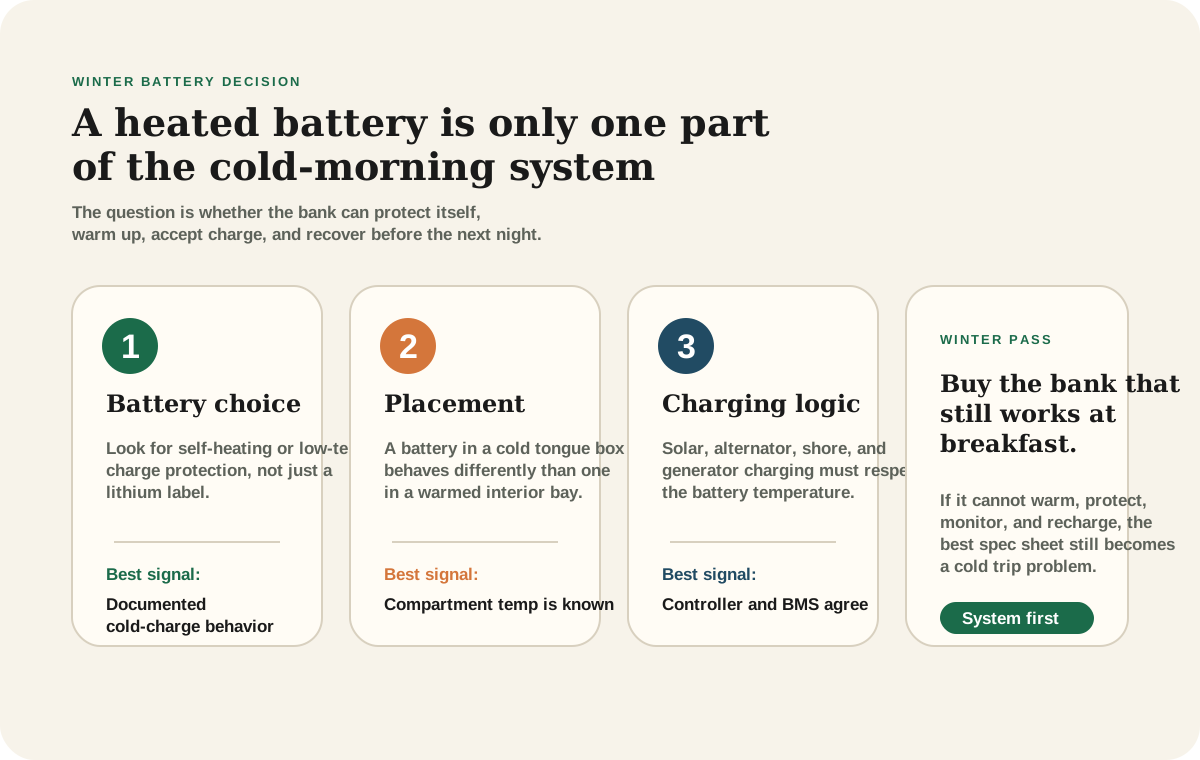
Battery placement can matter as much as the brand
The same battery behaves differently depending on where it lives.
An interior battery bay that stays above freezing is the easiest lithium environment. A pass-through bay may be workable if it is insulated or warmed by the coach. A tongue box or exterior compartment is more demanding because it can track outside temperature overnight.
Before buying, measure the real compartment:
- battery length, width, and height
- cable exit direction
- service access for fuses and disconnects
- whether the compartment sees road spray
- how cold it gets on a normal winter night
- whether the battery can be removed without dismantling the system
- whether a heater, vent, or insulation change is realistic
This is also where Bluetooth can be useful. Built-in Bluetooth is not a replacement for a shunt-based monitor, but it can help confirm battery temperature and BMS state when something behaves oddly. For whole-rig energy tracking, still use a shunt-based monitor from the RV battery monitor guide.
Charger settings decide whether winter feels calm
A cold-weather lithium bank should not be paired with a charger that blindly treats every morning as mild weather.
Check the whole charging stack:
- converter or inverter-charger lithium profile
- solar charge controller temperature logic
- DC-to-DC charger settings and current limit
- battery BMS low-temperature charge behavior
- alternator charging path
- whether the system has a shunt and display
The goal is simple: the battery should block or delay unsafe charge, the charger should not fight the BMS, and the owner should be able to see what happened.
If your winter travel includes short driving windows, short sun windows, or generator-only recovery, the bank needs more than a heater. It needs enough charging power to recover before the next night. Pair this page with the RV battery charging source guide before buying a large winter bank.
Cold-weather confidence is really charging confidence
A heated lithium battery can still disappoint if the charger is wrong, the compartment is too cold, the bank is undersized, or the owner cannot see what the BMS is doing. Buy the winter system, not only the battery.
A winter install sequence that avoids rework
Start with the battery location, not the product page. Measure the bay, confirm cable exits, decide where the disconnect and fuse will live, and check whether the compartment can be warmed or insulated without trapping moisture or blocking service access.
Next, choose the final bank size. If the finished answer is three batteries, design the cables, busbars, fusing, and monitor around three batteries from the start. A winter bank that grows one battery at a time often ends up with awkward cable lengths, poor service access, and a monitor installed in the wrong place.
Then confirm the charge sources. Shore converter, inverter-charger, solar controller, DC-to-DC charger, and generator charger should all support the battery chemistry and cold-temperature behavior. If one source is not compatible, the system needs a disable switch, settings change, or replacement before it becomes a cold-weather surprise.
Finally, test the bank on a real cold morning before trusting it on a long trip. Note compartment temperature, battery temperature if available, state of charge, whether the heater activated, whether charging started, and how long recovery took. That test is more valuable than another product spec comparison because it shows how the installed system behaves in the actual RV.
When lithium may still be the wrong winter move
Lithium is not always the right answer just because it is better on paper.
If the battery compartment is fully exposed, the charger cannot be configured correctly, the owner does not want to monitor the bank, or the trips are mostly plugged-in campground stays, a simpler lead-acid or AGM setup may be less efficient but easier to live with. Cold-weather lithium rewards system discipline. It punishes "drop-in" expectations when the rest of the RV is not ready.
That does not mean you should avoid lithium. It means you should buy it when you are also ready to handle placement, protection, monitoring, and recharge. A heated battery is a good tool. It is not a substitute for a winter electrical plan.
Which battery should you buy?
Choose the Battle Born heated kit if this is your first serious cold-weather lithium build and you want the premium support lane. It is the safest editorial starting point for RVers who would rather pay more than troubleshoot a winter bank alone.
Choose the Renogy Pro self-heating battery if the feature set and pricing matter more than premium-brand reassurance. It is the value-oriented battery to inspect when Bluetooth, self-heating, and a modern package are priorities.
Choose the Epoch heated Bluetooth Essentials battery if you want a balanced 105Ah module and the official product page shows availability that fits your timeline. It is a good fit for shoppers who want more than a basic value battery but do not want the most expensive support lane.
Skip all three if the bigger problem is not battery choice. If the battery compartment is exposed, the converter is not lithium-ready, the alternator charging path is missing, or the solar system cannot recover the winter loads, fix the system design first.
Common cold-weather battery mistakes
The first mistake is assuming heated batteries remove the cold-weather problem. They reduce one part of the problem. They do not eliminate charger settings, compartment placement, monitoring, or bank sizing.
The second mistake is sizing from summer use. A winter RV often runs more furnace controls, more lighting, more indoor time, and more work gear. Shorter days also mean weaker solar recovery.
The third mistake is skipping the monitor. Voltage is a poor way to understand lithium state of charge, especially when the BMS is protecting itself or the battery heater is using energy.
The fourth mistake is buying one battery first and planning the bank later. If the end state is 300Ah or 400Ah, the battery model, cable layout, busbars, fusing, and compartment plan should be chosen for that final shape.
Final thought
Cold-weather lithium can work very well in an RV, but only when the bank is treated like winter infrastructure.
The winning setup is not the battery with the loudest cold-weather label. It is the battery bank that can wake up cold, protect itself, warm correctly, accept charge safely, and still carry the loads that matter before the next charging window.
If you are unsure, size the overnight loads first, choose the battery count second, and design the charging/monitoring stack before checkout.
Frequently asked
Questions RVers usually ask next.
Do I need a heated lithium battery for winter RV camping?
You need either a heated battery, a warmed battery compartment, or a charging system that reliably prevents unsafe cold charging. Heated batteries are most useful when the bank regularly starts below freezing and morning charging matters.
Can lithium RV batteries discharge in cold weather?
Many LiFePO4 batteries can discharge below freezing within their published limits, but charging below the safe temperature is the bigger concern. Always follow the exact battery manual and BMS guidance.
Is 200Ah enough for a cold-weather RV lithium bank?
It can be enough for disciplined weekend use with modest loads and reliable recharge. Frequent furnace use, compressor fridges, inverter cooking, Starlink, or remote work usually makes 300Ah or more feel calmer.
Should I buy one heated lithium battery now and add more later?
Only if the future bank layout is planned from the start. Cable length, fusing, busbars, compartment space, charger capacity, and battery matching all get harder if the first battery is bought without the final bank in mind.
Freshness note
Last checked April 21, 2026
This topic can change when products, plans, prices, campsite rules, or fit guidance move. These notes show what was reviewed most recently.
This review included
- Checked current official Battle Born, Renogy, and Epoch product pages for cold-weather lithium battery positioning, heating or low-temperature protection behavior, capacity, and availability notes.
- Checked Victron lithium battery operating guidance for low-temperature charging cautions and charger/BMS coordination.
- Rebuilt the guide from a scenario overview into a product-backed cold-weather battery decision guide with a custom winter-bank visual, exact bank math, quick picks, and skip conditions.
Recent change log
April 21, 2026
Expanded the cold-weather lithium battery guide with official product checks, a custom system visual, product cards, winter charging guidance, and worked 200Ah/300Ah bank examples.
April 17, 2026
Published cold-weather lithium battery guide with low-temperature specs and winter-bank planning criteria.
Broader editorial corrections are tracked on the Corrections and Updates page.


