How long will a 100Ah battery last in an RV?
A 100Ah RV battery can last from a few appliance-heavy hours to a light-use weekend. A realistic 100Ah LiFePO4 battery plan usually gives about 1,000-1,150 usable watt-hours. A 100Ah AGM plan usually gives about 500-600 usable watt-hours if you avoid deep cycling. Build your exact load list in the battery calculator before sizing the bank.
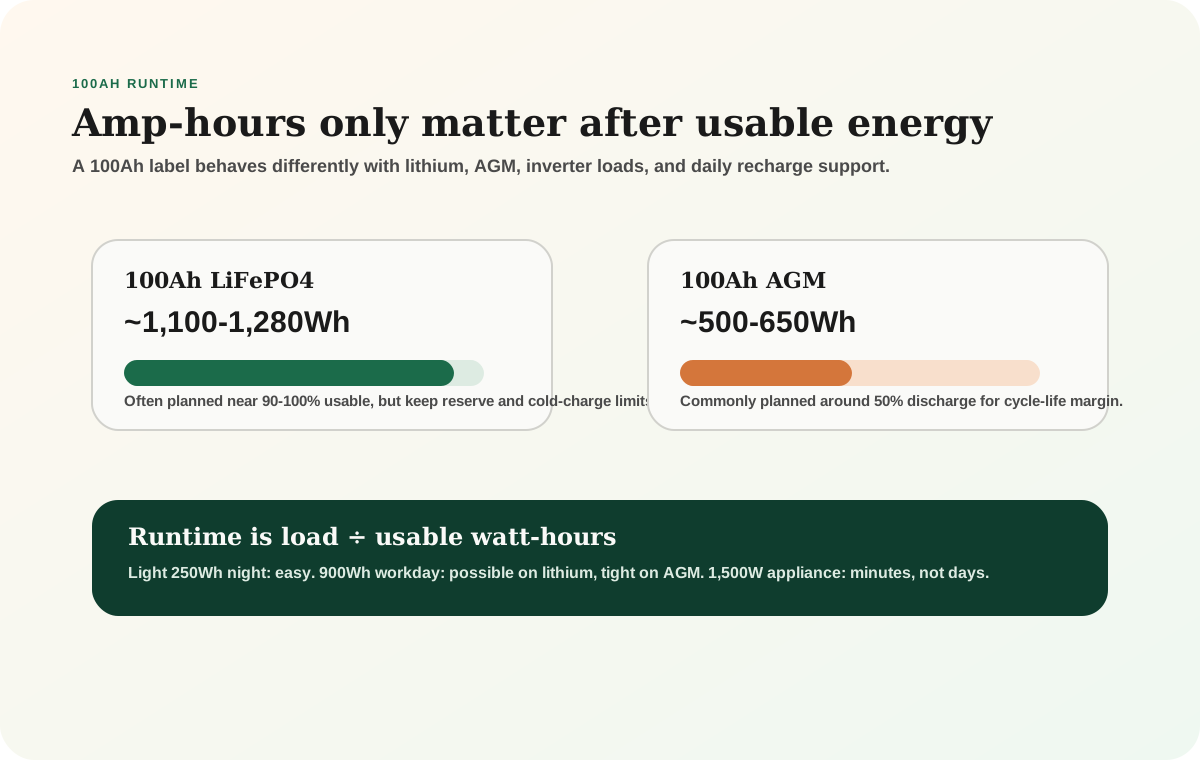
100Ah runtime snapshot
Use these as planning bands, not lab promises. The actual result depends on battery condition, temperature, inverter efficiency, and recharge support.
LiFePO4 planning reserve
About 1,000-1,150Wh usable
A 12.8V 100Ah lithium battery is roughly 1,280Wh nameplate. Planning around 80-90% usable leaves a practical reserve instead of running to zero.
AGM planning reserve
About 500-600Wh usable
A 12V 100Ah AGM battery is roughly 1,200Wh nameplate, but many RVers plan around 50% depth of discharge to protect cycle life.
Big hidden drain
Inverter habits
A 1,500W microwave for 10 minutes can use about 250Wh before inverter losses. That is a meaningful bite from a single 100Ah battery.
Best next step
List watt-hours, not appliances
A fridge, router, laptop, fan, and lights should become a daily watt-hour budget before you decide whether 100Ah is enough.
Battery assumptions checked
Battery makers publish different limits, warranties, and charging profiles. Use these sources to understand the assumptions, then follow the exact manual for your battery.
Pre-arrival checks
Use your battery manual
The numbers here are planning assumptions. The battery's own manual and charger profile decide the safe operating limits.
Do not mix chemistry rules
AGM, flooded lead-acid, gel, and LiFePO4 batteries do not want the same charge profile or discharge routine.
Account for age and temperature
Cold batteries, older lead-acid batteries, and batteries that have been deeply cycled repeatedly may deliver less than the planning number.
The short answer depends on usable watt-hours
Amp-hours are only useful after you convert them into energy.
The simple formula is:
volts x amp-hours = watt-hours
So a 12.8V 100Ah LiFePO4 battery is roughly:
12.8 x 100 = 1,280Wh
A 12V 100Ah AGM battery is roughly:
12 x 100 = 1,200Wh
Those two nameplate numbers look close. The usable planning numbers are not.
Compare
Planning math for a single 100Ah RV battery.
Use one comparison matrix to scan the practical differences. Small screens stack each row; wider screens keep the first column pinned.
| Spec | 100Ah LiFePO4 | 100Ah AGM | Why it matters |
|---|---|---|---|
| Nameplate energy | About 1,280Wh | About 1,200Wh | The sticker number is only the starting point. |
| Planning depth of discharge | Often planned around 80-90% | Often planned around 50% | Lithium can usually use more of its label without the same cycle-life penalty. |
| Practical usable energy | About 1,000-1,150Wh | About 500-600Wh | The same 100Ah label can feel like almost double the usable reserve. |
| Voltage behavior | Flatter voltage through most of the discharge | Voltage sags more noticeably as charge falls | Some inverters and appliances feel AGM voltage drop sooner. |
| Charging profile to verify | Commonly around 14.2-14.6V absorption, depending on battery | Commonly around 14.4-14.8V absorption for many AGM examples | The converter, solar controller, and DC-to-DC charger must match the battery. |
| Cycle-life expectation | Often thousands of cycles when used within spec | Often hundreds of cycles at deeper cycling | Cycle life is one reason lithium feels expensive up front but calmer over repeated off-grid use. |
100Ah lithium and 100Ah AGM are not equal in practice
A 200Ah AGM bank planned around 50% usable gives about 100Ah usable. A 200Ah LiFePO4 bank planned around 80-90% usable gives about 160-180Ah usable. That is why chemistry changes the real trip plan even when the amp-hour labels look similar.
Load examples make the answer real
The battery does not know whether a load feels important. It only sees watts over time.
Use this formula:
watts x hours = watt-hours
Then compare the total against the usable battery number.
Compare
Common RV loads and the kind of daily energy they can create.
Use one comparison matrix to scan the practical differences. Small screens stack each row; wider screens keep the first column pinned.
| Spec | Load | Typical planning range | What it means for 100Ah |
|---|---|---|---|
| LED lights | 10-30W total for 4 hours = 40-120Wh | Easy load | A single 100Ah battery usually handles lights without drama. |
| Vent fan | 10-35W for 8 hours = 80-280Wh | Noticeable overnight load | A fan can matter on AGM if it runs all night with other loads. |
| 12V compressor fridge | Roughly 500-900Wh/day depending on heat and duty cycle | Major daily load | This can consume most of a 100Ah AGM plan and a large share of a 100Ah lithium plan. |
| Laptop work | 45-90W for 5 hours = 225-450Wh | Workday load | A normal work block can be half of an AGM day by itself. |
| Router or small internet gear | 10-25W for 10 hours = 100-250Wh | Quiet background load | Easy to forget because it is small but constant. |
| Starlink-class internet | About 50-75W while running = 500-750Wh for 10 hours | Large remote-work load | A single 100Ah battery becomes a short-stay solution unless charging is strong. |
| Microwave through inverter | 1,500W for 10 minutes = about 250Wh before losses | Short but heavy load | A few kitchen bursts can erase the margin from a small battery. |
Three realistic 100Ah scenarios
1. Light overnight setup
Assume:
- 80Wh of LED lighting
- 120Wh of fan use
- 50Wh of phone charging
- 50Wh of water pump, controls, and small background loads
That is about 300Wh.
A healthy 100Ah LiFePO4 battery still has plenty of reserve. A healthy 100Ah AGM battery also looks fine if it starts full. This is why some weekend RVers honestly say 100Ah works well for them.
2. Fridge, fan, laptop, and router day
Assume:
- 700Wh for a 12V compressor fridge in warm weather
- 180Wh for fan use
- 350Wh for laptop work
- 180Wh for router or hotspot gear
- 100Wh for lights, pump, and device charging
That is about 1,510Wh.
A single 100Ah LiFePO4 battery cannot cover that full day without recharge. A single 100Ah AGM battery is not close. The solution is not arguing about the label; it is adding battery capacity, daily solar recovery, alternator charging, generator support, or cutting loads.
This is where the battery bank sizing guide and boondocking power management guide become more useful than a generic runtime chart.
3. Inverter-heavy morning
Assume:
- coffee appliance or kettle for 8 minutes
- microwave for 8 minutes
- laptop charger running through the inverter
- inverter idle draw left on for half the day
The appliance minutes may look harmless, but inverter loads are concentrated. A 1,500W appliance running for 16 total minutes is about 400Wh before inverter losses. Add inverter inefficiency and idle draw, and the morning can take a serious chunk out of a 100Ah battery before the day really starts.
If that sounds like your routine, read the lithium vs. AGM comparison before you decide whether to add another AGM, switch chemistry, or rebuild the bank around the loads.
Overnight behavior is the best field test
The practical question is not "How many days can I get?"
The better question is:
Can the battery cover sunset to the next useful charging window with reserve left?
That matters because most RVers notice battery stress in the morning. If the fridge, fan, propane furnace controls, router, and parasitic loads keep pulling all night, the battery can look fine at dinner and feel uncomfortable before breakfast.
Use a battery monitor if you have one. If not, start with conservative planning:
- LiFePO4: avoid planning every trip around 100% discharge, even if the battery can tolerate deep use.
- AGM: avoid planning around repeated deep discharge if you want decent cycle life.
- Any chemistry: leave reserve for cold mornings, cloudy starts, and inverter mistakes.
Charging support changes the answer
A 100Ah battery with strong daily recharge is a very different experience from a 100Ah battery asked to survive unsupported.
For solar, the rough recovery math is:
solar watts x usable sun hours x 0.70-0.80 = daily harvest
So a 200W portable panel in 4 usable sun hours may recover roughly:
200 x 4 x 0.75 = 600Wh
That can refill much of a disciplined AGM day or about half of a used-up lithium day. A cloudy site under trees may do far less.
This is why battery runtime and solar sizing should be planned together. If you are deciding whether 100Ah is enough because you are adding panels, use how many solar watts your RV needs and then run the final numbers in the solar calculator.
When one 100Ah battery is enough
One 100Ah battery can be enough when:
- trips are short
- the refrigerator is propane absorption instead of a large electric load
- fans, lights, and device charging are the main demands
- inverter use is rare
- solar, alternator, generator, or shore power regularly catches the battery back up
It is usually not enough when:
- the rig has a 12V compressor or residential fridge with no strong recharge
- remote work gear runs for many hours
- Starlink-class internet is used all day
- kitchen appliances run through the inverter often
- cold-weather furnace use is heavy
- the goal is multiple cloudy days without changing behavior
A cleaner way to decide
Use this process:
- List the loads that stay on after sunset.
- Add the loads that happen during the day.
- Convert each load to watt-hours.
- Subtract inverter losses where AC power is involved.
- Compare the total to usable battery capacity, not nameplate capacity.
- Decide whether charging support can recover the daily deficit.
If the answer is close, add margin. RV batteries do not get easier to live with when every day depends on perfect math.
The best 100Ah answer is usually a threshold
If your real daily use stays under about 400-500Wh, 100Ah can feel easy. If your real daily use is 1,000Wh or more, a single 100Ah battery becomes a chemistry-and-recharge question. If your daily use is 1,500Wh or more, plan the whole bank and charging system instead of trying to make one battery carry the trip.
A simple field audit before buying more battery
Before replacing a battery or ordering a second one, run one normal night with notes. Start with the battery full, write down the evening state of charge, then write down the morning state of charge before solar or driving recovery begins. Note the overnight temperature, furnace use, fridge mode, fan hours, router hours, and whether the inverter was left on.
That one-night audit usually reveals the real problem. If the battery drops hard overnight, storage or load reduction is the issue. If it survives the night but never gets full again, charging is the issue. If the numbers look fine until a microwave, coffee maker, or Starlink day, the inverter or work setup is the issue. The fix is different in each case.
Final thought
A 100Ah battery is not too small or large in the abstract. It is simply a specific amount of usable energy inside a specific travel pattern.
For lights, fans, phones, and careful overnight use, it can be plenty. For fridge-heavy, work-heavy, inverter-heavy travel, it can feel small immediately.
Do the watt-hour math first. Then decide whether the answer is better habits, more charging, a second battery, or a bigger system.
Frequently asked
Questions RVers usually ask next.
How many watt-hours are in a 100Ah RV battery?
A 12.8V 100Ah LiFePO4 battery is roughly 1,280Wh nameplate. A 12V 100Ah AGM battery is roughly 1,200Wh nameplate. The usable planning number is lower once depth of discharge, reserve, age, temperature, and inverter losses are included.
How long will a 100Ah lithium battery run an RV fridge?
It depends on the fridge and weather, but a 12V compressor fridge can use roughly 500-900Wh per day. A single 100Ah LiFePO4 battery planned around 1,000-1,150Wh usable may cover about a day of fridge use plus modest loads, but it needs recharge support for repeated days.
How long will a 100Ah AGM battery last compared with lithium?
A 100Ah AGM battery is often planned around about 500-600Wh usable if you avoid repeated deep discharge. A 100Ah LiFePO4 battery is often planned around about 1,000-1,150Wh usable. That is why the same amp-hour label can feel very different in an RV.
Can a 100Ah battery run an inverter?
Yes, if the battery, cables, fuse, and inverter are rated for the load. Runtime is the bigger issue. High-wattage appliances can use hundreds of watt-hours in minutes, and inverter losses plus idle draw make a small battery feel smaller.
Should I add another 100Ah battery or improve charging first?
If you run out of battery overnight, more storage may help. If the battery never fully recovers during the day, charging is the bottleneck. Most off-grid RVs need the battery bank, solar, alternator charging, and load habits sized together.
Freshness note
Last checked April 21, 2026
This topic can change when products, plans, prices, campsite rules, or fit guidance move. These notes show what was reviewed most recently.
This review included
- Checked LiFePO4 usable-capacity, depth-of-discharge, and charging-voltage assumptions against current Battle Born and Victron guidance.
- Checked AGM depth-of-discharge and cycle-life guidance against Lifeline, Trojan, and Renogy battery guidance.
- Added worked 100Ah lithium vs. 100Ah AGM watt-hour math, inverter-loss examples, and linked calculator next steps.
Recent change log
April 21, 2026
Expanded the runtime guide with exact usable-capacity math, official battery references, a custom runtime visual, realistic load tables, and clearer upgrade thresholds.
April 17, 2026
Published 100Ah battery runtime guide with verified load math and DoD assumptions.
Broader editorial corrections are tracked on the Corrections and Updates page.


