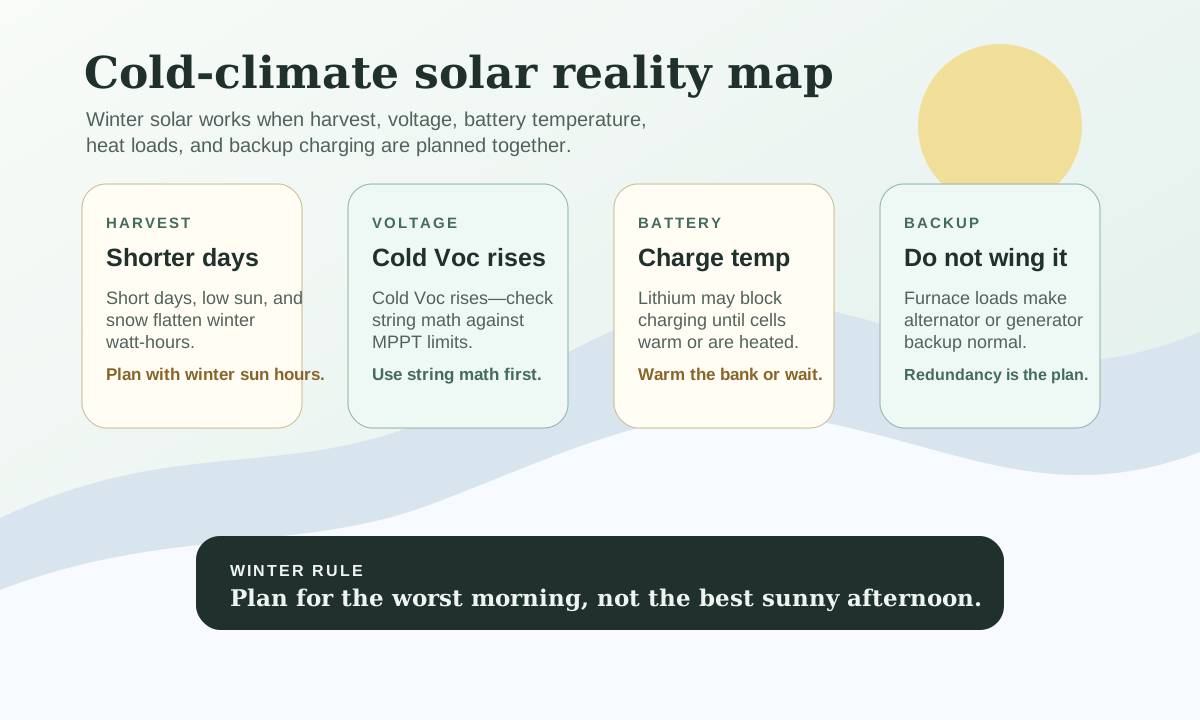
Cold solar is not automatically weak solar
Solar panels often perform efficiently in cool air, but winter RV solar still disappoints people because the other conditions get harder.
The sun is lower. Days are shorter. Tree and mountain shade stretch farther. Snow can cover the array. The furnace blower may run for hours. Lithium batteries may refuse charging if the cells are too cold. A panel can be happy in cold air while the whole rig is still energy-stressed.
That is why cold-climate solar planning should start with the whole winter system, not just the roof watts. Pair this guide with the cold-weather boondocking guide, the cold-weather lithium guide, and the furnace battery drain calculator.
Cold-climate solar snapshot
Winter solar is a system problem: harvest, storage, heat, and backup charging all overlap.
Biggest harvest issue
Low sun angle
Flat roof panels can lose a lot of winter potential even on bright days.
Biggest electrical issue
Cold Voc
Panel open-circuit voltage rises in cold conditions, so MPPT input limits need a cold-weather check.
Biggest comfort load
Furnace blower
Propane provides heat, but the 12V blower still pulls from the battery bank overnight.
Official checks for winter solar planning
These sources do not replace your component manuals, but they give the right planning boundaries before you wire a cold-weather array or rely on winter charging.
Pre-arrival checks
Run location math, not summer averages
Winter harvest in Arizona, Colorado, Maine, and Montana are different problems. Use the site and season you actually plan to camp in.
Check controller voltage at the coldest expected morning
Cold-adjusted open-circuit voltage matters most on clear cold mornings before the array warms up.
Confirm the battery will accept charge
A solar controller can be ready while a cold lithium battery is still blocking, delaying, or redirecting charge into heat.
What changes in cold climates
Compare
Winter solar planning changes
Use one comparison matrix to scan the practical differences. Small screens stack each row; wider screens keep the first column pinned.
| Spec | Mild-weather assumption | Cold-climate reality | Planning response |
|---|---|---|---|
| Sun hours | Five good hours may feel normal | Useful winter sun can be much shorter | Run lower sun-hour assumptions before sizing the array |
| Panel angle | Flat roof is often acceptable | Low winter sun punishes flat panels | Use tilt, portable support, or more wattage margin |
| Battery behavior | Battery accepts charge normally | Cold lithium may block or limit charging | Use heated batteries, warm mounting, or charge-source controls |
| Controller voltage | Series wiring looks fine at room temperature | Cold Voc can move closer to PV max voltage | Run the string-sizing check before wiring panels in series |
Start with winter loads, not summer loads
Winter changes the load list.
The refrigerator may work less hard, but that does not automatically save the system. The furnace blower, lights, laptops, internet gear, heated blankets, tank heaters, battery heaters, and longer indoor evenings can all push daily consumption up.
A propane furnace is the classic hidden load. Propane supplies the heat, but the blower is still an electrical load. If the furnace runs through the night, the battery may wake up much lower than your summer spreadsheet predicted.
Use the furnace battery drain calculator before assuming solar will refill the bank by lunch. In winter, morning recovery can be slow.
Here is the kind of load stack that surprises people:
- furnace blower cycling through a 15-degree night
- Starlink or a hotspot left on for morning weather checks
- two laptops because work moves indoors earlier
- lights running longer because sunset comes early
- heated tank pads or battery heat turning on before dawn
- inverter idle draw if 120V outlets stay live overnight
That can turn a simple 900Wh summer day into a 1,400-2,000Wh winter day before cooking or entertainment loads are included. A 400W roof array that felt generous in April may only recover part of that on a short December day, especially if the roof is flat or partially shaded.
The planning move is not panic-buying panels. It is separating must-run loads from comfort loads. Furnace blower, water pump, lights, fridge, medical devices, and required work connectivity get first claim. Electric heat, induction cooking, high-watt coffee, long inverter standby, and casual entertainment should be treated as optional unless the battery bank and backup charging plan prove they can carry them.
Low sun angle and shade are the harvest killers
Flat roof panels are convenient, but winter sun exposes their weakness. A flat array may leave a lot of potential on the table when the sun stays low.
Use the solar tilt and shade calculator to compare the flat-roof estimate against a tilted or better-aimed estimate. The goal is not to pretend every RVer will climb onto the roof daily. It is to see whether the winter shortfall is coming from wattage, angle, shade, or unrealistic sun-hour assumptions.
Portable solar can help in cold climates because you can aim it better than a fixed roof array. The tradeoff is weather and effort. Snow, wind, theft risk, cable routing, and daily setup still matter.
For a practical estimate, run three versions of the same day:
- the roof array flat, because that is what happens when you do nothing
- the same wattage tilted toward the winter sun, because that shows the upside
- a smaller portable panel aimed cleanly, because it may beat a larger shaded roof array
This comparison often reveals the real constraint. If tilt fixes the shortfall, the problem is angle. If even a tilted array falls short, the problem is load or season. If the portable panel wins, the problem may be shade or where you prefer to park the RV.
The answer may be as simple as parking the rig for warmth and wind protection while placing a portable panel in the sun. It may also be deciding that winter shade is part of the campsite and alternator or generator charging needs to carry more of the work.
Cold-panel voltage can break a copied wiring plan
Solar panel open-circuit voltage rises as temperature drops. That matters most when panels are wired in series because voltages add.
A 2S or 3S panel string that looks safe on a warm data sheet can move closer to the controller's PV voltage limit on a cold morning. That is not a reason to avoid series wiring. It is a reason to check it.
Before wiring a winter-capable array, use the solar string sizing calculator and read series vs. parallel RV solar wiring. The important number is not only panel watts. It is cold-adjusted Voc against the controller's maximum PV input voltage.
Use a real example before copying a wiring diagram. Suppose a panel lists about 24V open-circuit voltage and the temperature correction pushes that roughly 10-15 percent higher on a very cold morning. Two panels in series might still be comfortable on a 100V controller. Three panels could move from "looks fine at room temperature" to "too close for comfort" depending on the exact panel coefficient and the coldest site you actually camp in.
That is why winter string sizing should be done with:
- the panel's published Voc
- the panel's Voc temperature coefficient
- the lowest realistic ambient temperature
- the controller's absolute PV input limit
- a margin you would still trust at dawn after a clear cold night
Parallel wiring can reduce the voltage risk, but it raises current and wire-size questions. Series wiring can reduce current and improve controller wake-up behavior, but it raises cold-voltage risk. Neither is automatically right. The winter-safe answer is the one that matches the exact modules, controller, wiring distance, shade pattern, and minimum temperature.
Do not use room-temperature panel math for winter strings
Cold weather can raise panel voltage enough that a comfortable-looking series string becomes too close to the controller limit. Check the exact panel Voc, temperature coefficient, expected cold temperature, and controller max PV voltage before wiring.
Lithium charging needs a cold plan
Lithium batteries are useful in RVs because they provide more usable capacity, lower weight, and better voltage behavior than lead-acid in many builds. Cold charging is the catch.
Many lithium batteries should not accept charging current when the cells are below freezing unless they include a controlled heating or low-temperature charge-protection strategy. Some batteries block charge through the BMS. Some heated batteries draw power to warm themselves first. Some installations keep the battery compartment warm enough that the issue rarely appears.
Read the cold-weather lithium battery guide before relying on solar to charge an exterior battery compartment on a freezing morning. The controller can be ready before the battery is ready.
This is the detail that makes cold solar feel confusing in the field. You may see bright sun, strong panel voltage, and a charge controller that appears ready, but the battery BMS may still reject charging because the cell temperature is too low. If the battery has internal heaters, the first solar energy may go into warming the battery instead of refilling usable capacity.
Mounting location matters. A lithium bank inside conditioned space behaves differently from a battery tray exposed to road spray and freezing air. A heated battery in an insulated compartment behaves differently from an unheated battery in a vented exterior bay. If you need winter reliability, the battery location, temperature sensor placement, charger settings, and BMS behavior are as important as panel wattage.
For mixed systems, also confirm every charger profile. Solar, shore converter, inverter/charger, DC-DC charger, and portable charger should all respect the battery manufacturer's voltage and temperature limits. One poorly configured charging source can undo the safety logic you built into the rest of the system.
Snow and ice change the routine
Snow cover can turn a healthy array into a non-array until it clears. Even partial snow, frost, or dirty melt residue can cut production.
A winter solar routine needs safe access. If your roof is icy, steep, or not built for frequent walking, plan around that. A portable panel, lower roof expectations, more battery reserve, or a generator/shore fallback may be safer than climbing around in bad conditions.
Also watch where melted snow refreezes. Cable entries, mounts, roof seams, and sealant edges should not become places where water repeatedly sits and freezes.
A winter maintenance rhythm should be boring and repeatable:
- Check the forecast before choosing a site.
- Park so the array gets the best morning sun you can reasonably get.
- Brush accessible snow only when the roof and ladder situation are safe.
- Let unsafe roof snow become part of the energy estimate instead of risking a fall.
- Watch production after melt events because frost, grit, and refrozen edges can still cut output.
- Inspect cable glands and roof mounts after freeze-thaw cycles.
The goal is not to make the array perfect every day. The goal is to avoid pretending solar is available when the panels are covered, unsafe to reach, or parked under winter shade.
Backup charging is not failure
Winter solar is less predictable than summer solar. Backup charging is part of the design.
The backup may be:
- shore power before or after a cold stretch
- alternator charging through a DC-DC charger
- a generator used during reasonable hours
- a larger battery bank
- a portable panel aimed at winter sun
- shorter stays between resets
This is especially important for remote work, medical devices, or cold nights where heat is not optional. A winter system should be boringly redundant, not heroically pure.
For most cold-weather boondockers, the cleanest plan is a reset threshold. Decide the battery state of charge where the trip changes from "keep camping" to "charge now." That threshold might be 40 percent for a casual weekend or 60 percent for remote work and cold nights.
Then decide what happens at that threshold:
- drive long enough for the DC-DC charger to matter
- run the generator during acceptable hours
- move to shore power
- shorten the stay and reset water, waste, propane, and batteries together
- turn off optional loads before the furnace and required devices are threatened
The threshold prevents wishful thinking. If solar has a great day, stay longer. If the roof stays snowed in, the system already has a script.
A practical winter sizing example
Imagine a small motorhome or van with 400W of roof solar, 200Ah of lithium, a propane furnace, laptops, lights, a compressor fridge, and a hotspot. In mild weather, that may feel like a comfortable system. In winter, the same rig can get squeezed.
The battery bank has roughly 2,560Wh of nominal 12V lithium capacity before reserve. A conservative plan might treat 1,800-2,000Wh as usable before you want a reset. If the overnight furnace, fridge, lights, and devices use 900Wh and the workday adds another 700Wh, the day is already near 1,600Wh. Add battery heating, inverter idle draw, cloudy weather, or a covered roof and the margin disappears fast.
Now compare charging. A flat 400W roof array rarely gives 400W for hours in winter. If it averages 150-250W during a short useful window, it may return only 600-1,000Wh on a decent day. That means the bank is not fully recovered unless loads are controlled, the roof is aimed well, or another charging source helps.
This is why the best cold-climate builds are not just larger. They are clearer. They know which loads are essential, where the array will underperform, when lithium charging is blocked, and what backup charger restores the margin before the night gets cold.
Common cold-climate solar mistakes
The first mistake is using a summer solar calculator result as a winter promise. Winter sun hours, low angle, and shade can change the answer dramatically.
The second mistake is copying a series-string diagram without checking cold Voc. The controller does not care that the wiring worked for someone else in a warmer region.
The third mistake is assuming lithium batteries behave normally below freezing. Discharge and charge limits are different conversations, and the BMS may make the decision for you.
The fourth mistake is treating snow removal as easy. If clearing the roof requires icy climbing, the safer plan is more reserve or backup charging.
The fifth mistake is calling the generator or alternator a failure. In winter, redundancy is part of responsible trip design.
Final thought
Cold-climate RV solar works when you respect the whole system. Panels may like cold air, but the rig still has shorter days, lower sun, snow, furnace loads, and battery temperature limits. Plan for the worst morning, not the best afternoon.
Frequently asked
Questions RVers usually ask next.
Do solar panels work better in cold weather?
Panels can be more efficient in cooler temperatures, but winter harvest is often lower because days are shorter, the sun angle is lower, shade is longer, and snow can cover the array.
Why does cold weather matter for MPPT controller sizing?
Panel open-circuit voltage rises in cold conditions. If panels are wired in series, those voltages add together, so the cold-adjusted string voltage must stay below the controller's maximum PV input voltage.
Can solar charge lithium batteries below freezing?
Only if the battery and installation allow it safely. Many lithium batteries block or limit charging when cells are too cold unless they have a heating or low-temperature protection strategy.
Freshness note
Last checked April 21, 2026
This topic can change when products, plans, prices, campsite rules, or fit guidance move. These notes show what was reviewed most recently.
This review included
- Checked NREL PVWatts, Victron MPPT calculator guidance, Battle Born lithium cold-charge guidance, and National Weather Service winter-safety routing for cold-climate solar planning.
- Expanded the winter solar framework with a custom visual, official-source checks, a cold Voc example, a winter load example, and a practical snow/backup charging routine.
Recent change log
April 21, 2026
Expanded the cold-climate solar guide with official resources, a winter-system visual, worked voltage/load examples, and a more practical backup-charging workflow.
April 15, 2026
Published a cold-climate RV solar guide to fill the winter solar gap in the solar hub.
Broader editorial corrections are tracked on the Corrections and Updates page.

