Shortlist first
Use this to find the winner first, then compare the alternates only if their tradeoffs fit your rig better.
Shortlist labels are editorial recommendations, not popularity rankings. Fit score still matters, but the label tells you why each pick made this guide.
How fit scores work
Scores are editorial fit scores, not user-review averages. The rubric weighs stated RV-use fit, verified specs and limits, whole-rig friction, visible downsides or support risk, and value for the specific job in this guide. Read the full scoring rubric.
If you need one baseline option before reading the full guide, start with SOK SK12V100P 100Ah for best whole-bank value.
The first option to evaluate if you want the strongest all-around fit for this guide. Check the other cards only if their award label matches your constraint better.
| Product | Why shortlisted | Fit score | Key spec | Best for | Skip if | Actions |
|---|---|---|---|---|---|---|
| SOK SK12V100P 100Ah Links to: SOK SK12V100P 12V 100Ah LiFePO4 Battery | Best overall The first option to evaluate if you want the strongest all-around fit for this guide. | 4.7 / 5 fit scoreScore rubric | 3 batteries = 300Ah; 4 batteries = 400Ah | Best whole-bank value | You want premium-brand support to matter more than capacity per dollar. | Read SOK SK12V100P 100Ah notesCheck listing at SOKMerchant link - direct listing. Verify price and specs at SOK. |
| Battle Born 100Ah Links to: Battle Born 100Ah 12V LiFePO4 Deep Cycle Battery | Upgrade pick The higher-end option to justify only when its extra capability matters in your build. | 4.8 / 5 fit score | 4 batteries = 400Ah / about 5.12kWh nominal | Premium support at larger scale | The premium bank cost would delay proper inverter, monitor, or charging hardware. | Read Battle Born 100Ah notesCheck listing at Battle BornMerchant link - direct listing. Verify price and specs at Battle Born. |
| Epoch 105Ah Essentials Links to: Epoch 12V 105Ah Essential Series Battery | Also great A strong alternate when its specific tradeoffs fit your rig better than the winner. | 4.6 / 5 fit score | 3 batteries = 315Ah; 4 batteries = 420Ah | Balanced 315Ah or 420Ah bank | You want the most common 100Ah expansion path. | Read Epoch 105Ah Essentials notesCheck listing at EpochMerchant link - direct listing. Verify price and specs at Epoch. |
Official spec checks used for this large-bank guide
Large-bank pricing swings matter more because every per-battery difference is multiplied three or four times.
Pre-arrival checks
Price the fourth battery last
If the fourth battery forces you to cheap out on wiring, charging, or monitoring, the 300Ah bank may be the better value.
Check inverter and charging first
A 400Ah bank can still disappoint if the inverter path is messy or the rig cannot refill the bank in the camping rhythm you actually use.
Why value becomes the main question at 300Ah to 400Ah
A 200Ah lithium bank can survive a little brand inefficiency. A 300Ah or 400Ah bank multiplies every choice. A $100 difference per battery becomes $300 to $400. A slightly awkward case size becomes a compartment problem. A casual wiring decision becomes a harder service problem. A charger that was acceptable for a starter bank may feel painfully slow once the bank grows.
That is why this guide is about value, not cheapness. A cheap large bank is not a value if the batteries are hard to monitor, hard to protect, slow to charge, or installed in a layout nobody wants to troubleshoot. A premium large bank is not automatically wrong, but it has to leave enough budget for the rest of the system.
Before you buy anything in this lane, run the daily load through the battery calculator. Then compare the bank size against the 12V vs. 24V battery bank decision if the rig will run a large inverter. Many RVs still belong at 12V, but big inverter loads and long cable runs make the voltage conversation worth having before parts are ordered.
300Ah versus 400Ah in real storage terms
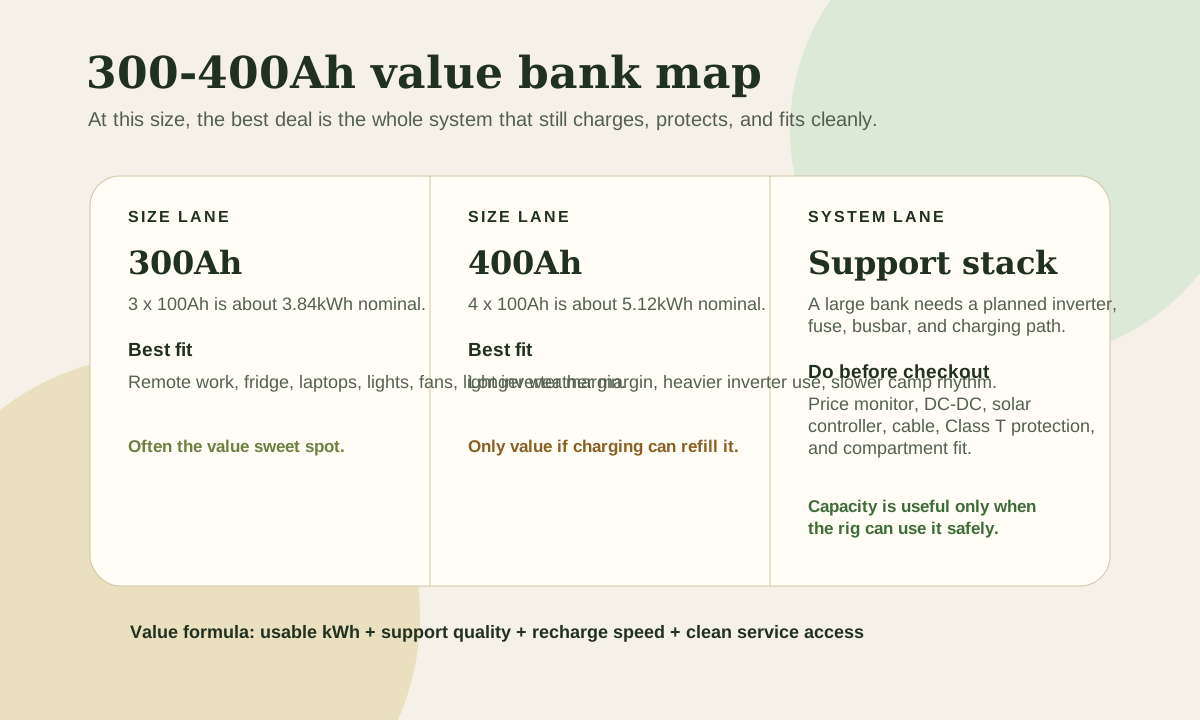
Three 100Ah LiFePO4 batteries at about 12.8V create a 300Ah bank with roughly 3,840Wh of nominal storage. Four 100Ah batteries create a 400Ah bank with roughly 5,120Wh nominal. With 105Ah batteries, three units create 315Ah, and four create 420Ah.
That sounds like a simple capacity jump, but the real question is how often the extra battery changes your trip. A 300Ah bank may already cover a compressor fridge, lights, fans, routers, laptops, device charging, light inverter use, and a cloudy-day margin. A 400Ah bank starts to make more sense when the rig has heavier remote-work days, a larger inverter, longer stays between refills, winter furnace draw, or a travel pattern where bad solar days are common.
The danger is buying the fourth battery because it feels safer while ignoring recharge speed. If the rig has 400W of roof solar and no meaningful alternator charging, a 400Ah bank can take a long time to recover after several heavy days. Capacity buys time. Charging buys repeatability.
Here is the simplest way to think about it. A 300Ah bank is often the better value when it gives you one normal day plus a useful cushion. A 400Ah bank is often the better value when it gives you a different camping style: one more bad-weather day, quieter generator habits, less anxiety during remote-work weeks, or enough reserve to stop micromanaging every small AC load.
If the fourth battery only changes the spec sheet, skip it. If the fourth battery changes where you camp, how often you run the generator, or whether workdays feel stable, it may be worth the money.
Worked examples: who should stop at 300Ah?
Consider a couple with a compressor fridge, LED lighting, roof vent fans, phone charging, one laptop, one hotspot, and occasional inverter use. Their normal day may land around 1,700Wh to 2,300Wh. A 300Ah lithium bank gives that rig enough reserve to handle a normal day and a partial-weather buffer, especially if solar or alternator charging contributes most days.
For that rig, a fourth battery may not be the best next dollar. A better next dollar may be a shunt, a DC-DC charger, a better solar controller, cleaner busbars, or a portable panel that helps in shaded camps. The trip gets better because the system becomes more repeatable, not because the label gets larger.
A 300Ah bank also makes sense when payload, compartment space, or charger size is tight. Batteries are lighter than lead-acid, but they are not weightless. More important, they still need safe mounting, cable room, ventilation around nearby electronics, and service access.
Worked examples: who should choose 400Ah?
Now consider a remote worker with a laptop, external monitor, router, Starlink or similar backup internet, camera lights, a 2000W to 3000W inverter, and a preference for quiet camps. That rig can burn through energy in a way that makes 300Ah feel tight, especially if work continues through cloudy days.
The same is true for winter camping where furnace blower draw stacks with shorter solar days, or for travelers who regularly camp under trees. A 400Ah bank does not create energy, but it gives you more time between good charging windows. That time can be the difference between a calm workday and a generator decision at 7 a.m.
The key is that the larger bank must be paired with a refill plan. A 400Ah bank that only charges slowly from a weak converter will feel impressive for the first discharge and frustrating after that. Before buying the fourth battery, make sure solar, alternator charging, shore charging, or generator charging can actually put energy back in.
Compare the three large-bank lanes
Compare
300Ah to 400Ah lithium bank lanes
Use one comparison matrix to scan the practical differences. Small screens stack each row; wider screens keep the first column pinned.
| Spec | SOK SK12V100P | Battle Born 100Ah | Epoch 105Ah Essentials |
|---|---|---|---|
| 300Ah-class bank | 3 batteries = 300Ah / about 3.84kWh | 3 batteries = 300Ah / about 3.84kWh | 3 batteries = 315Ah / about 4.03kWh |
| 400Ah-class bank | 4 batteries = 400Ah / about 5.12kWh | 4 batteries = 400Ah / about 5.12kWh | 4 batteries = 420Ah / about 5.38kWh |
| Best reason to choose it | Strongest all-bank value | Premium support confidence | Balanced feature lane with extra nominal capacity |
| Main value risk | Install still needs disciplined wiring and monitoring | Premium battery cost can crowd out system hardware | 105Ah format needs matching future units |
| Best bank size | 300Ah if cost matters; 400Ah if recharge plan is strong | 400Ah if support matters and budget is healthy | 315Ah for a middle step; 420Ah for larger feature-focused builds |
The support stack matters more as the bank grows
At 300Ah to 400Ah, the accessory list is not optional decoration. A large lithium bank should have a shunt-based monitor, a clear negative path through that shunt, a main fuse sized for the inverter and cable, a main disconnect, proper busbars, cable sized for current and run length, and charger profiles that match lithium.
If the bank will feed a 3000W inverter, the current on a 12V system can be very high. This is where undersized cable, long cable runs, cheap lugs, and vague fuse choices become expensive. The best RV inverter-chargers guide and RV battery monitor guide should be part of the large-bank shopping process, not an afterthought.
Charging deserves the same attention. A big bank can accept more current than a weak alternator, old converter, or small solar controller should provide. For travel-day recovery, compare DC-DC charging options. For roof solar, confirm array size and controller capacity with the solar watts guide. For shore charging, confirm the inverter-charger or converter is configured for the exact battery bank.
Physical service access is the detail that separates clean large banks from future headaches. You should be able to reach the main fuse, disconnect, shunt, busbars, and battery terminals without unloading half the compartment. Labels should make sense six months later. Cable runs should be short enough to understand and protected enough that vibration is not the installation plan.
Take the time to draw the battery bay before buying. Show battery orientation, cable path, fuse location, disconnect location, shunt location, charger output, inverter positive and negative, and where future expansion would land. If the drawing looks chaotic, the physical install probably will too.
A cheap large bank can become an expensive confusing system
Large-bank value disappears fast when the bank is oversized for the charging plan, underspecified for the inverter, or physically messy enough that future troubleshooting feels miserable.
When a 300Ah bank is the better value
Choose 300Ah when your daily use lands around 1.8 to 2.6kWh and you mostly need a calm buffer rather than maximum reserve. This is common for remote workers with laptops, routers, fans, lights, a compressor fridge, and modest inverter use. It is also a good lane when the roof solar, alternator charging, or shore charger is not ready to refill 400Ah quickly.
A 300Ah bank also leaves more room in the budget for the parts that make the bank behave well. If the choice is 300Ah plus a good shunt, proper main protection, cleaned-up battery bay, and a DC-DC charger versus 400Ah with vague wiring and no monitor, I would choose the cleaner 300Ah system almost every time.
When a 400Ah bank earns its keep
Choose 400Ah when the extra battery changes the actual camping rhythm. That might mean two remote workers, frequent inverter use, winter furnace loads, a longer no-generator preference, or a rig that routinely camps under partial shade and needs more stored reserve between sunny windows.
The fourth battery is easiest to justify when the rest of the rig is already ready for it. The battery compartment fits the bank. The busbar and fuse layout are not improvised. The inverter path is protected. The solar and alternator charging can recover meaningful energy. The monitor tells the truth. In that context, 400Ah can feel like freedom instead of expensive ballast.
Our large-bank picks
- Latest product check
- Specs, fit notes, and current listing context were reviewed April 21, 2026.
- Evidence label
- Spec-verified: Score is based on current published specs, official documentation, pricing context, compatibility, and RV-use fit analysis.
- Price context
- Pricing and availability can change, so confirm the merchant listing before buying.
Product facts last checked April 21, 2026
SOK SK12V100P 100Ah
Editorial fit score
SOK makes the most sense when the goal is real usable lithium capacity without draining the budget that should also pay for monitoring, charging, fusing, and clean wiring.
Review verdict
- Short verdict
- The clearest large-bank value lane when you are building around 300Ah or 400Ah.
- Evidence used
- Spec-verified
- Score is based on current published specs, official documentation, pricing context, compatibility, and RV-use fit analysis.
- Why it made the shortlist
- Best overall
- The first option to evaluate if you want the strongest all-around fit for this guide.
- Best if
- Best whole-bank value
- Why not this product?
- You want premium-brand support to matter more than capacity per dollar.
- Watch for
- Support feel may not match premium brands
- Product check date
- Specs, fit notes, and current listing context were last checked April 21, 2026.
Key specs
- Capacity
- 100Ah each
- 300Ah bank
- 3 batteries / about 3.84kWh
- 400Ah bank
- 4 batteries / about 5.12kWh
- Pricing
- Value direct-sale listing
Score basis
Score is based on current published specs, official documentation, pricing context, compatibility, and RV-use fit analysis. These are editorial fit scores, not customer-review averages. Read the scoring rubric.
- RV-use fit
- 30% weight
- Verified specs and limits
- 25% weight
- Whole-rig friction
- 20% weight
- Downsides and support risk
- 15% weight
- Value for the job
- 10% weight
How directly the product solves the specific off-grid RV job in this guide.
Capacity, dimensions, electrical limits, protection claims, and compatibility constraints we can verify from current sources.
Install effort, storage, wiring, service access, weight, refill workflow, or daily-use hassle.
Known tradeoffs, unclear claims, warranty coverage, support risk, and wrong-buyer failure modes.
Whether the price makes sense after fit, specs, and tradeoffs still hold.
Testing limits
- This is not a hands-on endurance or lab test unless the review explicitly says so.
- Specs, pricing, bundles, and availability can change, so confirm the current listing and manual before buying.
Reasons to buy
- Best capacity-per-dollar lane in this shortlist
- Simple 100Ah building-block math
- Leaves budget for the parts that make a large bank usable
Watch-outs
- Support feel may not match premium brands
- DIY discipline matters more as the bank grows
- Availability and direct price should be rechecked before purchase
Whole-bank math
Value sweet spot
300Ah / about 3.84kWh nominal
Often enough for moderate remote work and longer weekend boondocking.
Full value bank
400Ah / about 5.12kWh nominal
Strong reserve if charging and wiring are planned well.
Budget discipline
Leave money for shunt, DC-DC, busbars, and protection
The value argument only works when the whole system is clean.
Related parts and setup checks
Victron SmartShunt 500A
A large value bank still needs accurate current and state-of-charge tracking.
Open Victron SmartShunt 500ADC-DC charger sizing
Travel-day recharge should be sized before the fourth battery is ordered.
Open DC-DC charger sizingInverter-charger comparison
Useful when the bank is expected to support serious AC loads.
Open Inverter-charger comparisonCheck current listing
SOK SK12V100P 12V 100Ah LiFePO4 Battery
Use the listing after the fit notes make sense for your rig. Pricing and availability can change, so verify the merchant page before buying.
- Latest product check
- Specs, fit notes, and current listing context were reviewed April 21, 2026.
- Evidence label
- Spec-verified: Score is based on current published specs, official documentation, pricing context, compatibility, and RV-use fit analysis.
- Price context
- Pricing and availability can change, so confirm the merchant listing before buying.
Product facts last checked April 21, 2026
Battle Born 100Ah
Editorial fit score
Battle Born is expensive in a three- or four-battery bank, but it remains compelling when support, documentation, and conservative RV-use confidence matter more than raw capacity per dollar.
Review verdict
- Short verdict
- The premium-support lane for RVers who want a larger bank with fewer brand-confidence questions.
- Evidence used
- Spec-verified
- Score is based on current published specs, official documentation, pricing context, compatibility, and RV-use fit analysis.
- Why it made the shortlist
- Upgrade pick
- The higher-end option to justify only when its extra capability matters in your build.
- Best if
- Premium support at larger scale
- Why not this product?
- The premium battery spend would force compromises on inverter, monitor, cable, fuse, or charging hardware.
- Watch for
- Very expensive once multiplied three or four times
- Product check date
- Specs, fit notes, and current listing context were last checked April 21, 2026.
Key specs
- Capacity
- 100Ah each
- 300Ah bank
- 3 batteries / about 3.84kWh
- 400Ah bank
- 4 batteries / about 5.12kWh
- Pricing
- Direct listing checked at $679
Score basis
Score is based on current published specs, official documentation, pricing context, compatibility, and RV-use fit analysis. These are editorial fit scores, not customer-review averages. Read the scoring rubric.
- RV-use fit
- 30% weight
- Verified specs and limits
- 25% weight
- Whole-rig friction
- 20% weight
- Downsides and support risk
- 15% weight
- Value for the job
- 10% weight
How directly the product solves the specific off-grid RV job in this guide.
Capacity, dimensions, electrical limits, protection claims, and compatibility constraints we can verify from current sources.
Install effort, storage, wiring, service access, weight, refill workflow, or daily-use hassle.
Known tradeoffs, unclear claims, warranty coverage, support risk, and wrong-buyer failure modes.
Whether the price makes sense after fit, specs, and tradeoffs still hold.
Testing limits
- This is not a hands-on endurance or lab test unless the review explicitly says so.
- Specs, pricing, bundles, and availability can change, so confirm the current listing and manual before buying.
Reasons to buy
- Strong support and documentation model
- Clean 100Ah expansion math
- Confidence lane for buyers who dislike unknowns
Watch-outs
- Very expensive once multiplied three or four times
- Premium cost can crowd out equally important system hardware
- May be overkill for moderate-use rigs
Whole-bank math
Premium 300Ah
300Ah / about 3.84kWh nominal
Good when support matters but the fourth battery is not justified.
Premium 400Ah
400Ah / about 5.12kWh nominal
A high-confidence but high-cost large-bank lane.
Best spending order
Do not sacrifice system hardware
Premium batteries still need premium-quality installation discipline.
Related parts and setup checks
Check current listing
Battle Born 100Ah 12V LiFePO4 Deep Cycle Battery
Use the listing after the fit notes make sense for your rig. Pricing and availability can change, so verify the merchant page before buying.
- Latest product check
- Specs, fit notes, and current listing context were reviewed April 21, 2026.
- Evidence label
- Spec-verified: Score is based on current published specs, official documentation, pricing context, compatibility, and RV-use fit analysis.
- Price context
- Pricing and availability can change, so confirm the merchant listing before buying.
Product facts last checked April 21, 2026
Epoch 105Ah Essentials
Editorial fit score
Epoch gives buyers a slightly different building block: 105Ah instead of 100Ah. That creates useful middle-bank math, especially for 315Ah builds that may be enough before jumping to four batteries.
Review verdict
- Short verdict
- A balanced-feature route for 315Ah or 420Ah banks when the 105Ah format fits the expansion plan.
- Evidence used
- Spec-verified
- Score is based on current published specs, official documentation, pricing context, compatibility, and RV-use fit analysis.
- Why it made the shortlist
- Also great
- A strong alternate when its specific tradeoffs fit your rig better than the winner.
- Best if
- Balanced 315Ah or 420Ah bank
- Why not this product?
- You want the most common 100Ah battery format for every future expansion step.
- Watch for
- Less universal expansion format than 100Ah batteries
- Product check date
- Specs, fit notes, and current listing context were last checked April 21, 2026.
Key specs
- Capacity
- 105Ah each
- 315Ah bank
- 3 batteries / about 4.03kWh
- 420Ah bank
- 4 batteries / about 5.38kWh
- Feature lane
- Heated Bluetooth Essentials listing
Score basis
Score is based on current published specs, official documentation, pricing context, compatibility, and RV-use fit analysis. These are editorial fit scores, not customer-review averages. Read the scoring rubric.
- RV-use fit
- 30% weight
- Verified specs and limits
- 25% weight
- Whole-rig friction
- 20% weight
- Downsides and support risk
- 15% weight
- Value for the job
- 10% weight
How directly the product solves the specific off-grid RV job in this guide.
Capacity, dimensions, electrical limits, protection claims, and compatibility constraints we can verify from current sources.
Install effort, storage, wiring, service access, weight, refill workflow, or daily-use hassle.
Known tradeoffs, unclear claims, warranty coverage, support risk, and wrong-buyer failure modes.
Whether the price makes sense after fit, specs, and tradeoffs still hold.
Testing limits
- This is not a hands-on endurance or lab test unless the review explicitly says so.
- Specs, pricing, bundles, and availability can change, so confirm the current listing and manual before buying.
Reasons to buy
- Useful 315Ah middle step
- Slightly more nominal reserve per battery
- Good fit for feature-conscious value shoppers
Watch-outs
- Less universal expansion format than 100Ah batteries
- Not the cheapest or most premium lane
- Availability of matching future units matters
Whole-bank math
Middle bank
315Ah / about 4.03kWh nominal
A useful step when 300Ah feels slightly tight but 400Ah is too much.
Larger bank
420Ah / about 5.38kWh nominal
A feature-conscious full-reserve lane.
Expansion caution
Keep future units matched
Do not mix casually just because the amp-hour label is close.
Related parts and setup checks
Cold-weather lithium guide
Useful if heated-battery behavior is part of the reason to choose this lane.
Open Cold-weather lithium guideBattery sizing guide
Confirm whether 315Ah solves the need before buying the fourth battery.
Open Battery sizing guideSolar watts guide
Make sure the array can recover the larger bank.
Open Solar watts guideCheck current listing
Epoch 12V 105Ah Essential Series Battery
Use the listing after the fit notes make sense for your rig. Pricing and availability can change, so verify the merchant page before buying.
The mistake most large-bank buyers make
The most common mistake is buying the largest bank the compartment can hold and then treating the support system as cleanup work. That is backwards. A large bank should be designed around current, heat, protection, charging time, and service access before the batteries arrive.
Walk the system before checkout. Where will the batteries sit? How short can the inverter cables be? Where will the Class T fuse or main protection live? Where will the shunt sit so solar, shore, alternator, and inverter current all pass through the measured path? Can you reach the main disconnect without unloading the compartment? Can a mobile tech understand the system from your labels and photos?
If those answers are messy, buy fewer batteries and build the foundation better. The best large bank is not the one with the largest label. It is the one you can charge, use, monitor, protect, and troubleshoot with confidence.
The second mistake is treating price per amp-hour as the only value metric. Support matters when a battery throws a code. Availability matters if you need a matching fourth battery later. Case dimensions matter in a tight compartment. Communication features matter only if you will actually use them. A warranty matters only if you understand the claim process and installation requirements.
The best value bank balances all of that. It saves money where savings are real, but it does not save money by hiding risk in the parts you will depend on during a hot, cold, wet, or work-heavy trip.
Final thought
A 300Ah to 400Ah lithium bank can transform an RV, but only when the bank is part of a complete system. Choose SOK if the strongest whole-bank value matters most, Battle Born if premium support is worth the multiplier, and Epoch if the 315Ah or 420Ah feature lane fits your rhythm. Then spend as much attention on charging, monitoring, fusing, and service access as you spend on the battery names.
Frequently asked
Questions RVers usually ask next.
Is 300Ah enough lithium for full-time RV living?
It can be enough for efficient full-time rigs with moderate inverter use, good charging, and realistic daily loads. Rigs with two remote workers, electric cooking, winter furnace draw, or longer no-sun stretches often justify 400Ah or more.
Is a 400Ah lithium bank always better than 300Ah?
No. A 400Ah bank is better only when the extra reserve changes the trip and the rig can recharge it. A cleaner 300Ah system with a shunt, proper protection, and real charging can be a better value than a poorly supported 400Ah bank.
Should I switch to 24V for a 400Ah RV battery bank?
Not automatically. Many RV house systems are still simpler at 12V, but large inverter loads and long cable runs make the 12V versus 24V decision worth reviewing before buying batteries and inverter hardware.
What should I buy before the fourth battery?
Buy or plan the monitor, proper main protection, busbars, cable, disconnects, and charging upgrades first. If those are not funded or designed yet, the fourth battery is probably not the next best purchase.
Freshness note
Last checked April 21, 2026
This topic can change when products, plans, prices, campsite rules, or fit guidance move. These notes show what was reviewed most recently.
This review included
- Checked official Battle Born, SOK, and Epoch 100Ah-class lithium listings for current large-bank pricing context, capacity math, and product availability.
- Checked Victron SmartShunt and Victron Wiring Unlimited references for monitoring, busbar, and cable-planning guidance used in larger battery-bank recommendations.
- Expanded the guide into a full 300Ah to 400Ah value-bank workflow with quick picks, product cards, system math, charging cautions, and official-source checks.
Recent change log
April 21, 2026
Added decision visual, official-source checks, quick-pick table, product cards, 300Ah versus 400Ah math, and larger-bank wiring and charging guidance.
April 17, 2026
Published best 300-400Ah value bank guide with current pricing and manufacturer spec verification.
Broader editorial corrections are tracked on the Corrections and Updates page.

