Shortlist first
Use this to find the winner first, then compare the alternates only if their tradeoffs fit your rig better.
Shortlist labels are editorial recommendations, not popularity rankings. Fit score still matters, but the label tells you why each pick made this guide.
How fit scores work
Scores are editorial fit scores, not user-review averages. The rubric weighs stated RV-use fit, verified specs and limits, whole-rig friction, visible downsides or support risk, and value for the specific job in this guide. Read the full scoring rubric.
If you need one baseline option before reading the full guide, start with Victron MultiPlus-II 12/3000/120-50 for premium integrated build.
The first option to evaluate if you want the strongest all-around fit for this guide. Check the other cards only if their award label matches your constraint better.
| Product | Why shortlisted | Fit score | Key spec | Best for | Actions |
|---|---|---|---|---|---|
| Victron MultiPlus-II 12/3000/120-50 Links to: Victron MultiPlus-II 12/3000/120-50 | Best overall The first option to evaluate if you want the strongest all-around fit for this guide. | 4.9 / 5 fit scoreScore rubric | Dealer-priced | 2400W cont. | 120A charger | 50A transfer | Premium integrated build | Read Victron MultiPlus-II 12/3000/120-50 notesCheck listing at VictronMerchant link - direct listing. Verify price and specs at Victron. |
| Xantrex Freedom XC Pro 3000 Links to: Xantrex Freedom XC Pro 3000 | Best value The pick that balances capability and cost pressure best for this decision. | 4.7 / 5 fit score | Dealer-priced | 3000W cont. | 150A charger | 40A continuous transfer | Balanced RV power center | Read Xantrex Freedom XC Pro 3000 notesCheck listing at XantrexMerchant link - direct listing. Verify price and specs at Xantrex. |
| Renogy REGO 3000W HF Inverter Charger Links to: Renogy REGO 3000W 12V HF Pure Sine Wave Inverter Charger | Also great A strong alternate when its specific tradeoffs fit your rig better than the winner. | 4.6 / 5 fit score | $1,797.99 | 3000W cont. | 150A charger | >92% efficiency | Split-phase-ready feature build | Read Renogy REGO 3000W HF Inverter Charger notesCheck listing at RenogyMerchant link - direct listing. Verify price and specs at Renogy. |
These are exact inverter chargers, not vague product classes
The phrase "RV inverter charger" hides several different buying questions:
- how much AC output the coach actually needs
- how aggressive the charging lane should be
- whether the install needs clean ecosystem integration or just dependable one-box function
- how much space, heat, and cable management you can tolerate
That is why this page compares exact 3000W models instead of talking in brand categories.
Price note
Specs and price signals below were re-verified against official manufacturer pages and datasheets on June 5, 2026, and were unchanged. Victron and Xantrex are dealer-driven brands, so they do not present one simple direct-cart US price the way Renogy does.
What matters before brand loyalty
Charger output changes how quickly the bank recovers
A 3000W inverter section looks impressive, but the charger side is what often decides whether the coach actually recovers well after shore-power, generator, or hybrid use.
Transfer behavior matters if the rig uses AC daily
If the RV is constantly moving between battery inversion and shore or generator input, the transfer-switch rating and the wiring simplicity matter just as much as the inverter number.
Monitoring and ecosystem fit decide how calm the system feels later
Some owners want app visibility and system integration. Others just want a dependable RV power center with less learning curve. Those are different buying jobs.
Compare
Compare fast
Use one comparison matrix to scan the practical differences. Small screens stack each row; wider screens keep the first column pinned.
| Spec | Victron MultiPlus-II 12/3000/120-50 | Xantrex Freedom XC Pro 3000 | Renogy REGO 3000W HF Inverter Charger |
|---|---|---|---|
| Price checked | Dealer-priced; varies by seller | Dealer-priced; varies by seller | $1,797.99 |
| Continuous inverter output | 3000VA / 2400W at 25 C | 3000W at 40 C | 3000W |
| Surge output | 5500W peak | 6000W for up to 5 seconds | 9000VA for 100 ms / 4500VA for 5 seconds |
| Maximum charge current | 120A | 150A | 150A |
| Transfer switch | 50A | 50A surge / 40A continuous | 50A bypass |
| Efficiency | 93% max | 91% peak | >92% |
| Monitoring path | VE.Bus integration | Optional Bluetooth remote panel + RV-C/NMEA/J1939 | Built-in Bluetooth + wired remote |
| Weight | 48 lb | 18.6 lb | 22.7 lb |
| Dimensions | 23 x 11 x 6 in | 15.4 x 10.8 x 4.9 in | 19.37 x 13.11 x 5.31 in |
| Best fit | Premium ecosystem build | Balanced RV-first all-in-one | Feature-rich split-phase-ready install |
Why inverter chargers are harder to buy than standalone inverters
A standalone inverter has one main job: turn battery power into AC power. An inverter charger has to do that job, then switch between power sources, charge the battery bank from shore or generator input, respect battery charge limits, and behave predictably when the RV is moving between camp modes. That extra coordination is the reason inverter chargers can feel wonderful when chosen well and miserable when guessed.
The buying mistake is treating a 3000W inverter charger as if it is just a 3000W inverter with a bonus charger attached. The charger section matters just as much as the inverter section. A 120A or 150A charger can recover a large lithium bank quickly, but only if shore or generator input, wiring, battery acceptance, and settings support that behavior. If the bank is small, cold, lead-acid, or limited by the battery manual, that big charger number may need to be dialed back.
Transfer behavior matters too. The RV may pass shore power through the unit, switch selected circuits to inverter power, or interact with a generator. That means the inverter charger belongs in a broader AC and DC plan, not just on a shopping list. If the installer, quote, or DIY plan cannot explain transfer switching, charging profile, cable sizing, overcurrent protection, and ventilation, the product decision is not ready yet.
Worked example: 400Ah lithium with regular generator resets
Imagine a full-time or long-trip rig with a 400Ah 12V lithium bank, a 3000W inverter target, and occasional generator or shore-power resets. The owner wants to run kitchen loads, charge laptops, support a Starlink or router lane, and recover the bank quickly when weather or shade interrupts solar.
In that scenario, inverter-charger choice is not only about the 3000W output. The charger current changes the reset day. A 120A charger can theoretically put meaningful energy back into a lithium bank during a generator window, but real recovery still depends on battery acceptance, generator headroom, charge profile, and whether other AC loads are running. A 150A charger can be even faster, but it also asks more from the input source and installation.
This is where the Victron MultiPlus-II makes sense as a premium system-first choice. It is not the smallest or simplest unit, but it fits builds where the owner wants the inverter charger to act like infrastructure inside a larger Victron-style electrical system.
The Xantrex Freedom XC Pro 3000 fits a different owner. It is still serious, but it feels more RV-native and less like an ecosystem project. The 3000W output and 150A charging lane are strong, while the package remains compact enough to be realistic in many coach installs.
The Renogy REGO is the feature-heavy option. It can be attractive when split-phase readiness or Renogy ecosystem fit matters, but it is physically larger and should not be bought only because the spec list is long. The rig still has to support the feature set.
When a smaller or simpler answer is better
Not every RV that wants inverter power needs a 3000W inverter charger.
Choose a smaller or simpler path when:
- the only AC loads are laptops, TV, router, and small chargers
- the owner rarely uses shore power or generator charging
- the existing converter already handles battery charging well enough
- the rig has a modest battery bank that cannot use a large charger
- the install space cannot support heat, clearance, cable routing, and service access
- the budget would be safer with a smaller inverter plus better monitoring and protection
There is no shame in staying smaller. A well-installed 1000W to 2000W inverter can be more useful than a 3000W inverter charger that strains the battery bank, creates confusing transfer behavior, or leaves the owner afraid to touch the system.
Use the RV inverter guide if the charger side is not part of the problem. Use the battery-not-charging troubleshooting guide if the current charging system is already confusing before an upgrade is added.
Quote questions before approving an inverter-charger install
An inverter charger quote should be specific. It should not simply list a model number and a labor line.
Ask these questions:
- Which AC circuits will be powered by the inverter?
- How will shore power, generator input, and inverter output transfer?
- What battery chemistry and charge profile will be programmed?
- What maximum charger current will be used in the real install?
- Does the battery bank allow that charge current?
- What cable size, fuse or breaker, disconnect, and busbar plan is included?
- What ventilation and mounting clearances are required?
- How will the owner monitor charging, inverter load, alarms, and fault states?
- What settings should be documented before the installer leaves?
- What behavior should trigger a qualified technician call instead of owner troubleshooting?
If the quote does not include those answers, the inverter charger may still be a good model, but the project is under-specified. These boxes sit at the intersection of AC power, DC battery current, charging behavior, and user habits. They deserve more than a quick product recommendation.
Which one should you buy?
Buy the Victron MultiPlus-II 12/3000/120-50 when the inverter charger is part of a larger, deliberate lithium and solar system. It is the premium infrastructure choice, especially when monitoring, future expansion, and ecosystem behavior matter.
Buy the Xantrex Freedom XC Pro 3000 when you want a strong RV-first all-in-one without making the whole rig revolve around one premium ecosystem. It is the balanced choice for many owners who need serious output and charging in a compact package.
Buy the Renogy REGO 3000W HF Inverter Charger when the feature set, split-phase readiness, and Renogy system path are the reason for the purchase. Do not buy it just because the spec list is long; buy it when the install plan can actually use those features.
The shortlist
- Latest product check
- Specs, fit notes, and current listing context were reviewed June 5, 2026.
- Evidence label
- Spec-verified: Score is based on current published specs, official documentation, pricing context, compatibility, and RV-use fit analysis.
- Price context
- Pricing and availability can change, so confirm the merchant listing before buying.
Product facts last checked June 5, 2026
Victron MultiPlus-II 12/3000/120-50
Editorial fit score
Victron's official datasheet puts the MultiPlus-II 12/3000/120-50 at 3000VA / 2400W continuous output, 5500W peak power, 120A charging, 50A transfer switching, and 93% maximum efficiency. The 48-pound enclosure is not tiny, but the integration story is excellent when the rest of the electrical system is already serious.
Review verdict
- Short verdict
- The best premium RV inverter charger when you want the all-in-one box to behave like infrastructure inside a bigger lithium and solar build.
- Evidence used
- Spec-verified
- Score is based on current published specs, official documentation, pricing context, compatibility, and RV-use fit analysis.
- Why it made the shortlist
- Best overall
- The first option to evaluate if you want the strongest all-around fit for this guide.
- Best if
- Premium integrated build
- Why not this product?
- If you mainly want an RV-first all-in-one without leaning on deeper system integration, Xantrex may feel simpler.
- Watch for
- Heaviest unit in this comparison
- Product check date
- Specs, fit notes, and current listing context were last checked June 5, 2026.
Key specs
- Price checked
- Dealer-priced; varies
- Continuous output
- 3000VA / 2400W
- Peak power
- 5500W
- Charge current
- 120A
Score basis
Score is based on current published specs, official documentation, pricing context, compatibility, and RV-use fit analysis. These are editorial fit scores, not customer-review averages. Read the scoring rubric.
- RV-use fit
- 30% weight
- Verified specs and limits
- 25% weight
- Whole-rig friction
- 20% weight
- Downsides and support risk
- 15% weight
- Value for the job
- 10% weight
How directly the product solves the specific off-grid RV job in this guide.
Capacity, dimensions, electrical limits, protection claims, and compatibility constraints we can verify from current sources.
Install effort, storage, wiring, service access, weight, refill workflow, or daily-use hassle.
Known tradeoffs, unclear claims, warranty coverage, support risk, and wrong-buyer failure modes.
Whether the price makes sense after fit, specs, and tradeoffs still hold.
Testing limits
- This is not a hands-on endurance or lab test unless the review explicitly says so.
- Specs, pricing, bundles, and availability can change, so confirm the current listing and manual before buying.
Reasons to buy
- Best overall integration story in this group
- Strong 120A charging lane and 50A transfer rating
- Makes the most sense when the whole electrical system is being designed intentionally
Watch-outs
- Heaviest unit in this comparison
- Dealer-priced instead of clear direct-cart pricing
- Premium value only shows up when the rest of the system is also serious
Whole-bank math
Why it wins
System-first behavior
It is the easiest recommendation when the inverter charger needs to fit into a larger, future-aware solar and lithium plan.
Best buyer
Builder already thinking in ecosystems
Especially strong if the rig already uses Victron monitoring, solar controllers, or GX hardware.
When to skip it
Simple upgrade-only jobs
If you mainly want an RV-first all-in-one without leaning on deeper system integration, Xantrex may feel simpler.
Related parts and setup checks
Battery-bank sizing guide
Use this first so the inverter charger and the reserve target stay matched to the same runtime expectation.
Open Battery-bank sizing guideCharge-source strategy guide
Helpful if you still need to decide how much shore, generator, alternator, and solar recovery the rig should carry.
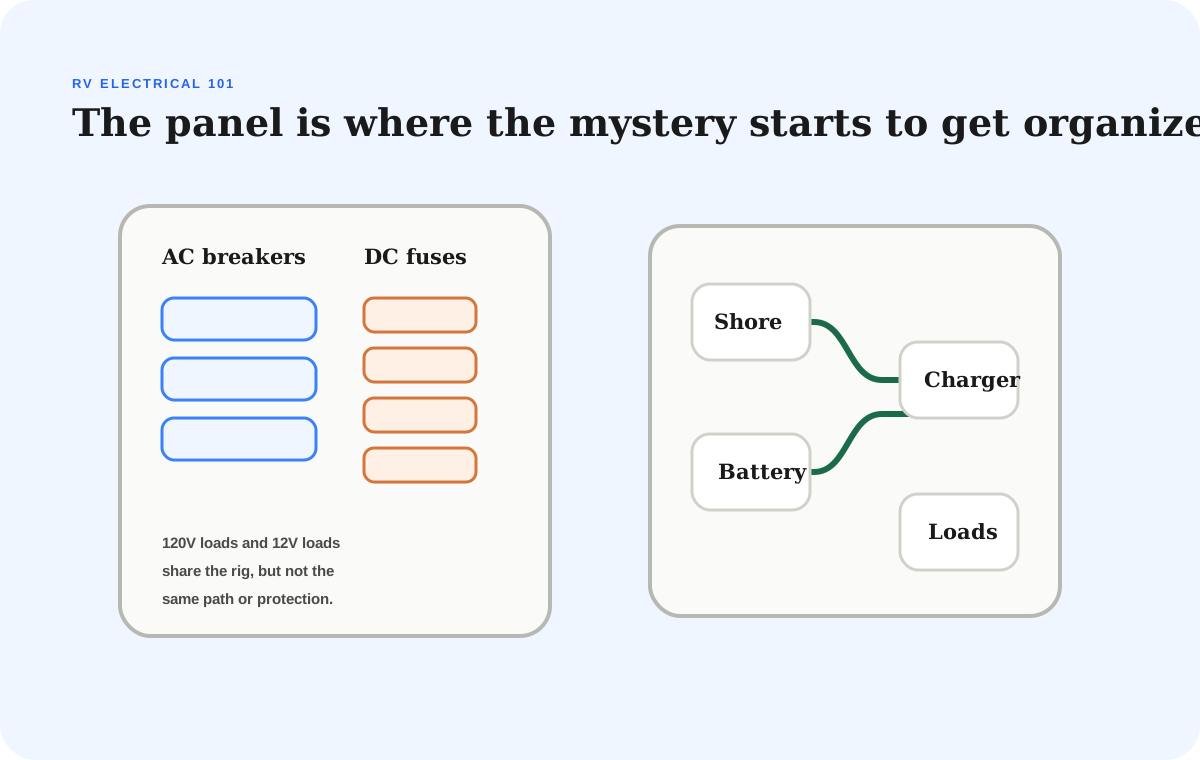
Open Charge-source strategy guideRV electrical 101
A good primer if the rest of the wiring plan is not locked in yet and this box still feels like magic.
Open RV electrical 101Check current listing
Victron MultiPlus-II 12/3000/120-50
Use the listing after the fit notes make sense for your rig. Pricing and availability can change, so verify the merchant page before buying.
- Latest product check
- Specs, fit notes, and current listing context were reviewed June 5, 2026.
- Evidence label
- Spec-verified: Score is based on current published specs, official documentation, pricing context, compatibility, and RV-use fit analysis.
- Price context
- Pricing and availability can change, so confirm the merchant listing before buying.
Product facts last checked June 5, 2026
Xantrex Freedom XC Pro 3000
Editorial fit score
Xantrex lists the Freedom XC Pro 3000 at 3000W continuous output at 40 C, 6000W surge for up to 5 seconds, 150A charging, 40A continuous transfer capability, and a compact 18.6-pound enclosure. It is one of the cleanest answers for owners who want real capacity without turning the whole coach into a premium-system project.
Review verdict
- Short verdict
- The best balanced RV inverter charger when you want strong output, serious charging, and a more RV-native all-in-one feel without committing to a deeper ecosystem build.
- Evidence used
- Spec-verified
- Score is based on current published specs, official documentation, pricing context, compatibility, and RV-use fit analysis.
- Why it made the shortlist
- Best value
- The pick that balances capability and cost pressure best for this decision.
- Best if
- Balanced RV power center
- Why not this product?
- Victron usually makes more sense when advanced monitoring and wider ecosystem expansion are core priorities.
- Watch for
- Official site does not provide one clear retail price
- Product check date
- Specs, fit notes, and current listing context were last checked June 5, 2026.
Key specs
- Price checked
- Dealer-priced; varies
- Continuous output
- 3000W at 40 C
- Surge output
- 6000W for 5 sec
- Charge current
- 150A
Score basis
Score is based on current published specs, official documentation, pricing context, compatibility, and RV-use fit analysis. These are editorial fit scores, not customer-review averages. Read the scoring rubric.
- RV-use fit
- 30% weight
- Verified specs and limits
- 25% weight
- Whole-rig friction
- 20% weight
- Downsides and support risk
- 15% weight
- Value for the job
- 10% weight
How directly the product solves the specific off-grid RV job in this guide.
Capacity, dimensions, electrical limits, protection claims, and compatibility constraints we can verify from current sources.
Install effort, storage, wiring, service access, weight, refill workflow, or daily-use hassle.
Known tradeoffs, unclear claims, warranty coverage, support risk, and wrong-buyer failure modes.
Whether the price makes sense after fit, specs, and tradeoffs still hold.
Testing limits
- This is not a hands-on endurance or lab test unless the review explicitly says so.
- Specs, pricing, bundles, and availability can change, so confirm the current listing and manual before buying.
Reasons to buy
- Strong 3000W / 150A feature set in a compact enclosure
- Feels purpose-built for RV all-in-one use
- Bluetooth app path and communications support are useful in more modern coaches
Watch-outs
- Official site does not provide one clear retail price
- Not as deep an ecosystem story as Victron
- Still demands a serious battery and cabling plan to feel satisfying
Whole-bank math
Why it wins
Strong balance of output and simplicity
It covers a lot of real RV use cases without requiring the owner to buy into an entire monitoring ecosystem.
Best buyer
RVer upgrading to a true all-in-one
A very good middle ground for people moving beyond a simple inverter but not redesigning the full electrical strategy around one brand.
When to skip it
Highly integrated premium builds
Victron usually makes more sense when advanced monitoring and wider ecosystem expansion are core priorities.
Related parts and setup checks
Standalone inverter comparison
Use this if you are still deciding whether you need a charger/transfer switch in the same box at all.
Open Standalone inverter comparisonBattery sizing guide
A 150A charger is only useful if the battery bank and cable plan make that recovery speed worthwhile.
Open Battery sizing guideCharge-source guide
Helpful when the RV still needs a clear split between shore recovery, generator use, and the solar lane.
Open Charge-source guideCheck current listing
Xantrex Freedom XC Pro 3000
Use the listing after the fit notes make sense for your rig. Pricing and availability can change, so verify the merchant page before buying.
- Latest product check
- Specs, fit notes, and current listing context were reviewed June 5, 2026.
- Evidence label
- Spec-verified: Score is based on current published specs, official documentation, pricing context, compatibility, and RV-use fit analysis.
- Price context
- Pricing and availability can change, so confirm the merchant listing before buying.
Product facts last checked June 5, 2026
Renogy REGO 3000W 12V HF Inverter Charger
Editorial fit score
Renogy's official REGO product page lists the HF inverter charger at $1,797.99 with 3000W continuous output, 9000VA short surge, 150A charging, more than 92% efficiency, built-in Bluetooth, and a 19.37 x 13.11 x 5.31-inch chassis. It is the right conversation when the feature stack matters more than shaving size or cost.
Review verdict
- Short verdict
- The best feature-rich inverter charger here when you specifically want split-phase compatibility, Bluetooth monitoring, and a high-frequency design in one package.
- Evidence used
- Spec-verified
- Score is based on current published specs, official documentation, pricing context, compatibility, and RV-use fit analysis.
- Why it made the shortlist
- Also great
- A strong alternate when its specific tradeoffs fit your rig better than the winner.
- Best if
- Split-phase-ready feature build
- Why not this product?
- If the rig just needs a calmer all-in-one inverter charger, the Xantrex often gets there with less complexity.
- Watch for
- Highest direct price in this comparison
- Product check date
- Specs, fit notes, and current listing context were last checked June 5, 2026.
Key specs
- Price checked
- $1,797.99
- Continuous output
- 3000W
- Surge output
- 9000VA short surge
- Charge current
- 150A
Score basis
Score is based on current published specs, official documentation, pricing context, compatibility, and RV-use fit analysis. These are editorial fit scores, not customer-review averages. Read the scoring rubric.
- RV-use fit
- 30% weight
- Verified specs and limits
- 25% weight
- Whole-rig friction
- 20% weight
- Downsides and support risk
- 15% weight
- Value for the job
- 10% weight
How directly the product solves the specific off-grid RV job in this guide.
Capacity, dimensions, electrical limits, protection claims, and compatibility constraints we can verify from current sources.
Install effort, storage, wiring, service access, weight, refill workflow, or daily-use hassle.
Known tradeoffs, unclear claims, warranty coverage, support risk, and wrong-buyer failure modes.
Whether the price makes sense after fit, specs, and tradeoffs still hold.
Testing limits
- This is not a hands-on endurance or lab test unless the review explicitly says so.
- Specs, pricing, bundles, and availability can change, so confirm the current listing and manual before buying.
Reasons to buy
- Strong charging spec with built-in Bluetooth and remote-control support
- Split-phase capability is genuinely useful for the right rig
- Very complete feature story on the official product page
Watch-outs
- Highest direct price in this comparison
- Bigger enclosure than the Xantrex
- Best value depends on actually needing the split-phase and feature stack
Whole-bank math
Why it wins
Feature density
This is the one to buy when the coach really benefits from the split-phase-ready design and the broader integrated feature list.
Best buyer
Owner with a specific install goal
It works best when the purchase is tied to a known wiring plan, not when you are still guessing about the system architecture.
When to skip it
Straightforward RV upgrades
If the rig just needs a calmer all-in-one inverter charger, the Xantrex often gets there with less complexity.
Related parts and setup checks
Battery-bank sizing guide
Important here because a 3000W all-in-one only feels good when the bank and cable plan can support real AC use.
Open Battery-bank sizing guideAlternator / shore / solar charge strategy
Helpful if you are still deciding how this box should fit alongside the other charging lanes in the coach.
Open Alternator / shore / solar charge strategyElectrical fundamentals guide
Use this before buying if split-phase input language still feels abstract or overly optimistic for the rig.
Open Electrical fundamentals guideCheck current listing
Renogy REGO 3000W 12V HF Pure Sine Wave Inverter Charger
Use the listing after the fit notes make sense for your rig. Pricing and availability can change, so verify the merchant page before buying.
Field note
Field fit note
Inverter chargers are most satisfying when they replace confusion, not when they create it. The right one makes the coach feel easier to live with on shore power, generator time, and battery power. The wrong one becomes a very expensive reminder that the battery bank, cable plan, and AC wish list were never aligned.
The common buying mistake
The classic mistake is choosing the inverter charger by the inverter number alone.
The better sequence is:
- settle the AC load list
- size the battery bank and recharge expectations
- confirm cable routing and install space
- then choose the all-in-one box that supports the whole system cleanly
For roof-air-conditioner projects, the best inverter for an RV air conditioner guide gives the narrower surge, soft-start, and battery-current comparison before you commit to an all-in-one box.
Final thought
The best RV inverter charger is the one that makes the whole power system calmer, not just more impressive. Compare the exact 3000W models by charging behavior, transfer switching, footprint, and monitoring path, then buy the unit that still fits the rig after the excitement wears off.
Frequently asked
Questions RVers usually ask next.
What size inverter charger is best for most off-grid RVs?
A 3000W-class inverter charger is a common serious-upgrade size because it can support meaningful AC use while still fitting many lithium and solar systems. It only works well when the battery bank and cabling are sized honestly.
Is Victron better than Xantrex for RV inverter chargers?
Victron usually wins the premium ecosystem conversation, while Xantrex often wins the simpler RV-first all-in-one conversation. The better fit depends on how integrated the rest of your electrical system needs to be.
When does a standalone inverter stop making sense?
Usually when the RV also needs strong shore charging, automatic transfer behavior, and a cleaner all-in-one power center. That is where inverter chargers begin to justify their cost and complexity.
What matters most when comparing RV inverter chargers?
Continuous output, charger amperage, transfer-switch capability, install footprint, monitoring path, and how well the unit fits the rest of the coach's battery and charging plan.
Freshness note
Last checked June 5, 2026
This topic can change when products, plans, prices, campsite rules, or fit guidance move. These notes show what was reviewed most recently.
This review included
- Rechecked the current exact-model lineup, charger-output specs, and transfer-switch details on the official manufacturer pages.
- Reviewed the dealer-priced versus direct-cart positioning so the cost guidance stays honest.
- Updated the whole-system fit notes around charging speed, ecosystem integration, and install footprint.
Recent change log
June 5, 2026
Freshness re-verify against official sources — all three units current with no spec or price change: Victron MultiPlus-II 12/3000/120-50 (2400W continuous at 25C, 120A charger, 50A transfer; victronenergy.com), Xantrex Freedom XC Pro 3000 (3000W continuous, 150A charger; transfer relay rated 50A surge / 40A continuous per xantrex.com), and Renogy REGO 3000W HF ($1,797.99, 3000W continuous, 150A charger — price confirmed via authorized retailers; currently backordered at Renogy-direct).
April 9, 2026
Refreshed exact 3000W inverter-charger comparison, pricing context, and whole-system fit guidance.
Broader editorial corrections are tracked on the Corrections and Updates page.