Shortlist first
Use this to find the winner first, then compare the alternates only if their tradeoffs fit your rig better.
Shortlist labels are editorial recommendations, not popularity rankings. Fit score still matters, but the label tells you why each pick made this guide.
How fit scores work
Scores are editorial fit scores, not user-review averages. The rubric weighs stated RV-use fit, verified specs and limits, whole-rig friction, visible downsides or support risk, and value for the specific job in this guide. Read the full scoring rubric.
If you need one baseline option before reading the full guide, start with Andersen Camper Leveler for fast towable side-to-side leveling.
The first option to evaluate if you want the strongest all-around fit for this guide. Check the other cards only if their award label matches your constraint better.
| Product | Why shortlisted | Fit score | Key spec | Best for | Actions |
|---|---|---|---|---|---|
| Camco FasTen RV Leveling Ramps Links to: Camco FasTen RV Leveling Ramps | Also great A strong alternate when its specific tradeoffs fit your rig better than the winner. | 4.6 / 5 fit score | $42.99 | SKU 44535 | secure tire curve + AccuPark ridge | Simple ramp leveling | Read Camco FasTen RV Leveling Ramps notesCheck listing at CamcoMerchant link - direct listing. Verify price and specs at Camco. |
| Andersen Camper Leveler Links to: Andersen Camper Leveler | Best overall The first option to evaluate if you want the strongest all-around fit for this guide. | 4.8 / 5 fit scoreScore rubric | $54.99 | SKU 3604 | 1/2 in to 4 in leveling range | Fast towable side-to-side leveling | Read Andersen Camper Leveler notesCheck listing at AndersenMerchant link - direct listing. Verify price and specs at Andersen. |
| Lippert Ground Control TT Links to: Lippert Ground Control TT Automatic Travel Trailer Leveling System | Upgrade pick The higher-end option to justify only when its extra capability matters in your build. | 4.7 / 5 fit score | $5,171.95 | SKU 672136 | 5-point auto leveling | 10,000 lb GVWR max | Premium auto-level travel trailer setup | Read Lippert Ground Control TT notesCheck listing at LippertMerchant link - direct listing. Verify price and specs at Lippert. |
Official leveling checks
Leveling gear is easy to buy too casually. Verify fit, tire size, frame restrictions, published limits, and the exact setup workflow before trusting a product on rough ground.
Pre-arrival checks
Match the rig before the site
Travel trailer, fifth wheel, motorhome, tandem axle, tire size, and frame type can make a good product wrong for your coach.
Separate leveling from stabilizing
Leveling corrects attitude. Stabilizing reduces movement. Wheel support, jack pads, and stabilizers are related but not identical jobs.
Plan for the worst repeated ground
Loose sand, crowned forest roads, rocky pads, and sloped desert pullouts expose products that only feel easy on flat pavement.
These are exact products, not generic leveling ideas
Off-grid leveling advice often stays too broad:
- blocks
- curved levelers
- automatic leveling
But once the rig is actually on uneven ground, those broad categories stop being enough.
The real buying decision is about exact products:
- how the wheel lands on the ramp
- how precise the adjustment range is
- whether the system is even compatible with your frame
- how much setup time you are willing to repeat on every stop
That is why this guide compares three exact current products instead of treating leveling as a single generic chore.
Price note
Prices below were checked against current Camco, Andersen, and Lippert product pages on April 21, 2026. Use them as a comparison snapshot, not a forever promise.
Field note
Field fit note
Leveling gear feels most valuable on the bad sites, not the easy ones. The right product is the one that still feels worth using when you are tired, the light is fading, and the ground is rough enough to expose every shortcut.
What matters before you buy any leveling system
Rig type
Towables and motorhomes do not shop this category the same way. The best answer for a travel trailer may be irrelevant for a self-leveling motorhome or totally wrong for a fifth wheel.
Terrain variability
The rougher and less predictable your camps, the more you should value versatility and grip over cosmetic neatness.
Setup effort
Leveling is one of those camp chores where a small annoyance compounds quickly over time. Speed matters.
Match the product to the failure mode
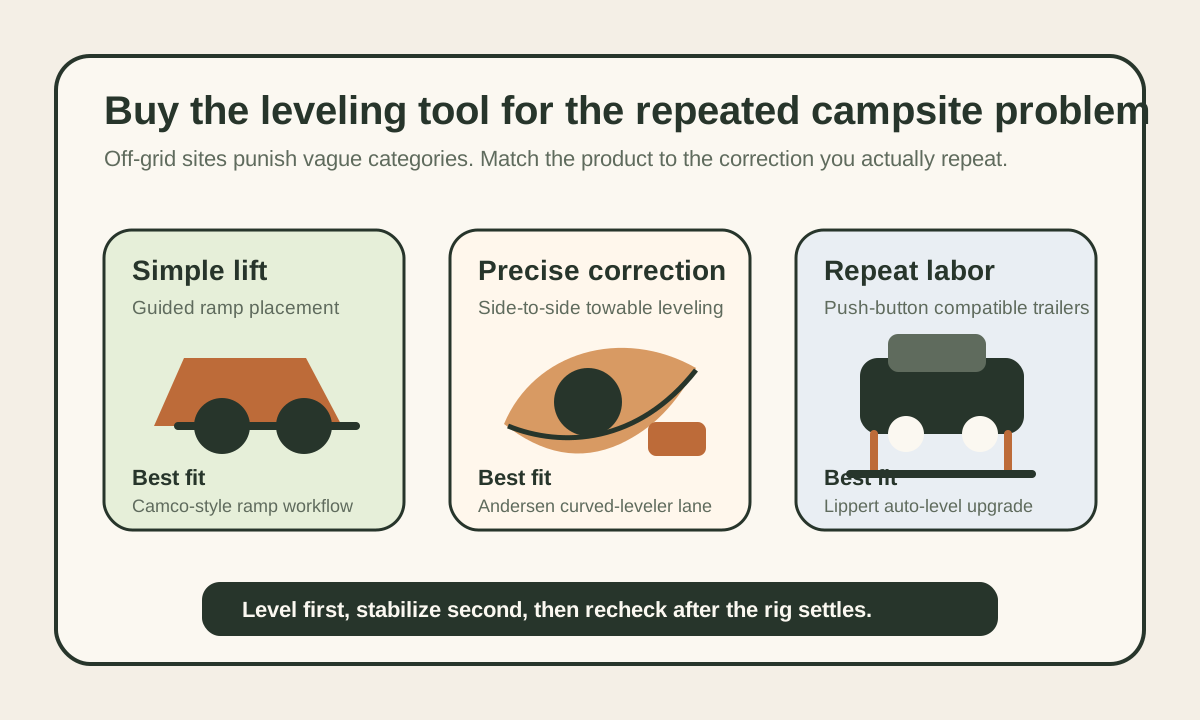
Buy ramps when the problem is basic lift and repeatability.
Ramp-style products make the most sense when the current routine is improvised, slow, or imprecise but the campsite slopes are not extreme. The Camco FasTen lane is about giving the tire a guided target instead of forcing the driver and spotter to negotiate a loose stack of blocks. That can matter on the travel days when the light is fading and nobody wants to rebuild the stack three times.
The tradeoff is precision. A ramp is easier than a random block stack, but it is not the same as a curved leveler that lets the tire settle anywhere along a continuous arc. If the site is consistently just a little off and you want the fastest controlled side-to-side adjustment, a curved leveler usually feels more satisfying.
Buy curved levelers when the problem is side-to-side guessing.
The Andersen lane is strongest when the RV is a towable and the most annoying part of arrival is creeping up, backing off, adding blocks, and trying again. The curved shape lets the trailer rise gradually, then the chock holds the position after the bubble says the rig is level.
That is why this is the easiest manual recommendation for many travel trailers and fifth wheels. It solves the repetitive frustration directly. It does not eliminate all campsite work. You still need to think about stabilizers, tongue height, chocks, soft ground, and whether the wheels are supported safely.
Buy automatic leveling when the problem is repeated labor, not one bad campsite.
The Lippert Ground Control TT is a different purchase class. It is not competing with a pair of manual levelers on price. It is competing with years of setup friction on a compatible travel trailer. That only makes sense when the trailer fits the published restrictions, the owner plans to keep it long enough, and the camping rhythm makes push-button leveling genuinely valuable.
If the travel trailer is a short-term rig, if the frame is not compatible, if the budget is still needed for tires or suspension, or if rough-site access is more important than convenience, the premium automatic system can be the wrong upgrade even though it looks like the nicest answer.
The off-grid arrival workflow
A good leveling product should fit into a repeatable arrival sequence.
First, park slightly short of the final position and read the site before committing. Look for slope direction, buried rocks, soft sand, drainage paths, low branches, and where the door, steps, awning, solar panels, and hookups will land. Leveling gear cannot fix a fundamentally bad placement if the rig is pointed into runoff or the entry door opens over a washout.
Second, decide whether the correction is side-to-side, front-to-back, or both. Towable owners often handle side-to-side with the wheels and front-to-back with the tongue or landing gear. Motorhomes and trailers with leveling systems have a different sequence, but the principle is the same: identify the correction before deploying gear randomly.
Third, support the tire contact patch correctly. A tire should not hang half on and half off a narrow support. That matters more on loose ground where the product can settle. If a ramp, curved leveler, or block setup leaves the tire poorly supported, the rig may technically read level while the tire is loaded in a way that makes you uncomfortable for a long stay.
Fourth, stabilize after leveling. Stabilizer jacks are not usually meant to lift the whole RV into level. Their job is to reduce movement after the rig is already sitting correctly. This distinction is the source of a lot of bent jacks, wobbly camps, and frustrated arrivals.
Finally, recheck after the rig settles. Sand, gravel, wet soil, and soft forest duff can compress after people move inside, slides extend, or water tanks shift load. A quick bubble check after the first few minutes can catch a site that looked finished but is slowly changing.
What rough ground changes
Off-grid camps often make leveling harder because the ground is rarely a poured pad.
Desert sites may be hard-packed on top and soft underneath. Forest sites can be crowned, rutted, or covered in organic material that compresses after the tire settles. Gravel pads can hide rocks that tilt the support. BLM pullouts can be sloped for drainage in ways that look subtle until the refrigerator door refuses to stay put.
That does not mean every off-grid traveler needs an expensive system. It means the product should be chosen for the ground that repeats. If most camps are simple gravel pads, a guided ramp or curved leveler may be plenty. If the RV moves every few days and the owner hates repeated setup, convenience has real value. If the sites are uneven enough that manual products regularly run out of safe correction, the answer may be a better campsite choice rather than more hardware.
Leveling gear should not encourage risky placements. A campsite that requires heroic stacking, unstable side support, or jacks extended near their limits is often a sign to move the rig, not a sign to buy a taller tower of accessories.
When the cheaper answer is better
The best leveling solution is sometimes the one that leaves money for tires, chocks, jack pads, suspension service, or a better inspection.
That is especially true on older travel trailers. If the tires are aged out, the spring hangers are suspect, the stabilizer jacks are bent, or the frame has rust and repairs that need attention, a premium leveling upgrade is out of order. Start with the safety and support pieces. Then buy the product that makes the repeated campsite workflow easier.
For new boondockers, the manual path is also educational. A few trips with ramps or curved levelers teaches how the rig behaves on real ground. After that, the decision to upgrade or stay simple is based on experience instead of showroom annoyance.
Compare
Compare fast
Use one comparison matrix to scan the practical differences. Small screens stack each row; wider screens keep the first column pinned.
| Spec | Camco FasTen RV Leveling Ramps | Andersen Camper Leveler | Lippert Ground Control TT |
|---|---|---|---|
| Price checked | $42.99 | $54.99 | $5,171.95 |
| Best rig fit | Towables wanting simple tire-ramp help | Travel trailers and fifth wheels | Travel trailers with I-beam frames only |
| Leveling method | Ramp + ridge parking | Curved incremental side-to-side leveling | 5-point automatic electric leveling |
| Published weight / capacity note | Retail page emphasizes feature set over weight rating | Works on trailers up to 30,000 lbs, tires up to 32 in | For travel trailers up to 10,000 lb GVWR |
| Workflow note | Fast simple ramp placement | Precise 1/2 in to 4 in leveling without block stacking | Push-button auto level in under three minutes |
| Best fit | Simple ramp-style leveling | Fast towable side-to-side correction | Premium auto-level setup |
The shortlist
- Latest product check
- Specs, fit notes, and current listing context were reviewed June 6, 2026.
- Evidence label
- Spec-verified: Score is based on current published specs, official documentation, pricing context, compatibility, and RV-use fit analysis.
- Price context
- Pricing and availability can change, so confirm the merchant listing before buying.
Product facts last checked June 6, 2026
Camco FasTen RV Leveling Ramps
Editorial fit score
Camco's FasTen RV Leveling Ramps are the practical middle-ground option. The current product page highlights the secure tire curve, AccuPark ridge, built-in T-handle, compatibility with FasTen Camper Leveling Blocks, and made-in-the-USA construction. That makes them a better conversation than vague 'leveling blocks' when the real goal is quick, repeatable tire placement.
Review verdict
- Short verdict
- The best simple ramp-style leveling solution when you want a lower-cost answer that still feels more guided than random blocks on bad ground.
- Evidence used
- Spec-verified
- Score is based on current published specs, official documentation, pricing context, compatibility, and RV-use fit analysis.
- Why it made the shortlist
- Also great
- A strong alternate when its specific tradeoffs fit your rig better than the winner.
- Best if
- Simple ramp leveling
- Why not this product?
- If your main frustration is the back-and-forth guessing game of leveling a towable wheel, the Andersen path is usually better.
- Watch for
- Still a manual setup path
- Product check date
- Specs, fit notes, and current listing context were last checked June 6, 2026.
Key specs
- Price checked
- $42.99
- SKU
- 44535
- Format
- Set of two leveling ramps
- Key feature
- Secure tire curve + AccuPark ridge
Score basis
Score is based on current published specs, official documentation, pricing context, compatibility, and RV-use fit analysis. These are editorial fit scores, not customer-review averages. Read the scoring rubric.
- RV-use fit
- 30% weight
- Verified specs and limits
- 25% weight
- Whole-rig friction
- 20% weight
- Downsides and support risk
- 15% weight
- Value for the job
- 10% weight
How directly the product solves the specific off-grid RV job in this guide.
Capacity, dimensions, electrical limits, protection claims, and compatibility constraints we can verify from current sources.
Install effort, storage, wiring, service access, weight, refill workflow, or daily-use hassle.
Known tradeoffs, unclear claims, warranty coverage, support risk, and wrong-buyer failure modes.
Whether the price makes sense after fit, specs, and tradeoffs still hold.
Testing limits
- This is not a hands-on endurance or lab test unless the review explicitly says so.
- Specs, pricing, bundles, and availability can change, so confirm the current listing and manual before buying.
Reasons to buy
- Clearer and more repeatable than improvised block stacks
- AccuPark ridge helps take guesswork out of stopping position
- Better fit for buyers who want simple, direct leveling hardware
Watch-outs
- Still a manual setup path
- Not the same thing as precise curved-leveler adjustment
- Not a premium auto-level replacement for heavier or higher-budget rigs
Whole-bank math
Why it wins
Simple without feeling flimsy
It is the best recommendation when you want a more structured manual answer without jumping to premium automatic hardware.
Best buyer
Towable owner wanting faster setup
Especially good for campers who want better tire placement and easier repeatability on imperfect ground.
When to skip it
Need precise side-to-side adjustment
If your main frustration is the back-and-forth guessing game of leveling a towable wheel, the Andersen path is usually better.
Related parts and setup checks
Desert boondocking checklist
Useful if this leveling purchase is tied to rougher, looser camps where setup friction shows up fast.
Open Desert boondocking checklistBoondocking beginner's guide
Helpful if you are still building a first campsite workflow and need the leveling gear to stay simple.
Open Boondocking beginner's guideUsed RV off-grid upgrade checklist
A good companion if you are also sorting through tire, jack, or suspension realities on an older rig.
Open Used RV off-grid upgrade checklistCheck current listing
Camco FasTen RV Leveling Ramps
Use the listing after the fit notes make sense for your rig. Pricing and availability can change, so verify the merchant page before buying.
- Latest product check
- Specs, fit notes, and current listing context were reviewed June 6, 2026.
- Evidence label
- Spec-verified: Score is based on current published specs, official documentation, pricing context, compatibility, and RV-use fit analysis.
- Price context
- Pricing and availability can change, so confirm the merchant listing before buying.
Product facts last checked June 6, 2026
Andersen Camper Leveler
Editorial fit score
Andersen's Camper Leveler is still the easiest curved-leveler recommendation for many towable owners because the product page makes the fit story so clear: it works on trailers up to 30,000 pounds, tires up to 32 inches, includes a Tuff Chock, and gives precise leveling from 1/2 inch to 4 inches. That clarity is why it keeps earning its place in this conversation.
Review verdict
- Short verdict
- The best towable leveling tool when the goal is faster side-to-side adjustment with less stacking and guessing.
- Evidence used
- Spec-verified
- Score is based on current published specs, official documentation, pricing context, compatibility, and RV-use fit analysis.
- Why it made the shortlist
- Best overall
- The first option to evaluate if you want the strongest all-around fit for this guide.
- Best if
- Fast towable side-to-side leveling
- Why not this product?
- If the goal is to stop kneeling and adjusting manually altogether, the Lippert auto-level path is the real upgrade.
- Watch for
- Still only solves part of the overall campsite setup job
- Product check date
- Specs, fit notes, and current listing context were last checked June 6, 2026.
Key specs
- Price checked
- $54.99
- SKU
- 3604
- Weight rating
- Trailers up to 30,000 lbs
- Tire fit
- Up to 32 in diameter
Score basis
Score is based on current published specs, official documentation, pricing context, compatibility, and RV-use fit analysis. These are editorial fit scores, not customer-review averages. Read the scoring rubric.
- RV-use fit
- 30% weight
- Verified specs and limits
- 25% weight
- Whole-rig friction
- 20% weight
- Downsides and support risk
- 15% weight
- Value for the job
- 10% weight
How directly the product solves the specific off-grid RV job in this guide.
Capacity, dimensions, electrical limits, protection claims, and compatibility constraints we can verify from current sources.
Install effort, storage, wiring, service access, weight, refill workflow, or daily-use hassle.
Known tradeoffs, unclear claims, warranty coverage, support risk, and wrong-buyer failure modes.
Whether the price makes sense after fit, specs, and tradeoffs still hold.
Testing limits
- This is not a hands-on endurance or lab test unless the review explicitly says so.
- Specs, pricing, bundles, and availability can change, so confirm the current listing and manual before buying.
Reasons to buy
- Best precision-adjustment answer in this comparison
- Cuts down the block-stacking trial-and-error that frustrates towable owners
- Strong fit story with high published trailer capacity and lifetime warranty
Watch-outs
- Still only solves part of the overall campsite setup job
- Best value shows up for towables, not every RV type
- Not the same thing as full automatic leveling convenience
Whole-bank math
Why it wins
Precision with low fuss
It gives towable owners the cleanest fast-leveling workflow short of going fully automatic.
Best buyer
Towable owner tired of stacking blocks
Especially good if side-to-side leveling is the campsite step that consistently wastes time or creates bad first attempts.
When to skip it
Need push-button leveling
If the goal is to stop kneeling and adjusting manually altogether, the Lippert auto-level path is the real upgrade.
Related parts and setup checks
Boondocking beginner's guide
Useful if your bigger goal is making each stop feel less chaotic, not just buying a new leveling gadget.
Open Boondocking beginner's guideDesert boondocking checklist
Helpful if you are specifically solving side-to-side frustration on sloped or rough travel-trailer sites.
Open Desert boondocking checklistUsed RV off-grid upgrade checklist
Read this if an older towable also needs suspension, tire, or jack attention before any leveling product will feel satisfying.
Open Used RV off-grid upgrade checklistCheck current listing
Andersen Camper Leveler
Use the listing after the fit notes make sense for your rig. Pricing and availability can change, so verify the merchant page before buying.
- Latest product check
- Specs, fit notes, and current listing context were reviewed June 6, 2026.
- Evidence label
- Spec-verified: Score is based on current published specs, official documentation, pricing context, compatibility, and RV-use fit analysis.
- Price context
- Pricing and availability can change, so confirm the merchant listing before buying.
Product facts last checked June 6, 2026
Lippert Ground Control TT Automatic Travel Trailer Leveling System
Editorial fit score
Lippert's Ground Control TT is the fully serious upgrade in this comparison. Lippert's product page lists a $5,171.95 reference price (dealer-variable), a 5-point configuration, I-beam-frame-only fit, 10,000-pound maximum GVWR, OneControl compatibility, and a sub-three-minute auto-level claim. That makes it the right recommendation only when the trailer and budget actually justify automatic leveling.
Review verdict
- Short verdict
- The premium travel-trailer answer when you want the campsite leveling job to become a push-button routine instead of a repeated manual process.
- Evidence used
- Spec-verified
- Score is based on current published specs, official documentation, pricing context, compatibility, and RV-use fit analysis.
- Why it made the shortlist
- Upgrade pick
- The higher-end option to justify only when its extra capability matters in your build.
- Best if
- Premium auto-level travel trailer setup
- Why not this product?
- If you are still building a basic off-grid setup or learning your campsite routine, start with a manual system first.
- Watch for
- Very expensive compared with every manual option here
- Product check date
- Specs, fit notes, and current listing context were last checked June 6, 2026.
Key specs
- Price checked
- $5,171.95
- SKU
- 672136
- Configuration
- 5-point automatic electric leveling
- Frame fit
- I-beam frames only
Score basis
Score is based on current published specs, official documentation, pricing context, compatibility, and RV-use fit analysis. These are editorial fit scores, not customer-review averages. Read the scoring rubric.
- RV-use fit
- 30% weight
- Verified specs and limits
- 25% weight
- Whole-rig friction
- 20% weight
- Downsides and support risk
- 15% weight
- Value for the job
- 10% weight
How directly the product solves the specific off-grid RV job in this guide.
Capacity, dimensions, electrical limits, protection claims, and compatibility constraints we can verify from current sources.
Install effort, storage, wiring, service access, weight, refill workflow, or daily-use hassle.
Known tradeoffs, unclear claims, warranty coverage, support risk, and wrong-buyer failure modes.
Whether the price makes sense after fit, specs, and tradeoffs still hold.
Testing limits
- This is not a hands-on endurance or lab test unless the review explicitly says so.
- Specs, pricing, bundles, and availability can change, so confirm the current listing and manual before buying.
Reasons to buy
- Only true push-button leveling path in this comparison
- Clear upgrade in campsite convenience for the right trailer
- Published fit, hardware, and setup-speed details are strong enough to evaluate seriously
Watch-outs
- Very expensive compared with every manual option here
- Only fits the right travel-trailer/frame use case
- Overkill if the trailer or ownership horizon does not justify the spend
Whole-bank math
Why it wins
Reclaims campsite setup time
This is what you buy when manual leveling has become a quality-of-life tax you are ready to stop paying.
Best buyer
Long-term travel-trailer owner
Especially strong for people keeping the same trailer for a while and camping often enough that repeated setup friction really compounds.
When to skip it
Need a simple practical first solution
If you are still building a basic off-grid setup or learning your campsite routine, start with a manual system first.
Related parts and setup checks
Used RV off-grid upgrade checklist
Worth reading first if you are trying to decide whether the trailer deserves a major premium hardware investment yet.
Open Used RV off-grid upgrade checklistBoondocking beginner's guide
Useful for seeing how much of your campsite pain is really leveling versus stabilization, ground prep, and overall arrival workflow.
Open Boondocking beginner's guideDesert boondocking checklist
Helpful if the system is being considered because repeat rough-site setup is wearing thin.
Open Desert boondocking checklistCheck current listing
Lippert Ground Control TT Automatic Travel Trailer Leveling System
Use the listing after the fit notes make sense for your rig. Pricing and availability can change, so verify the merchant page before buying.
The most common mistake
The biggest mistake is buying the most attractive leveling concept on paper without checking whether it fits the rig and the actual campsite friction.
If your camps are often:
- sandy
- rocky
- irregular
- sloped
then versatility matters more than showroom elegance.
Leveling and stabilizing are not the same thing
A rig can feel steady and still be poorly leveled. Off-grid comfort improves when you treat leveling, wheel support, and stabilizing as separate jobs instead of one vague setup step.
The simplest good setup by rig type
Travel trailers usually benefit most from a curved leveler or ramp for side-to-side correction, plus solid chocks and separate stabilizer pads after the trailer is level. The tongue jack handles front-to-back attitude, but it should not be asked to solve poor wheel support.
Fifth wheels are similar on the wheel side, but pin weight and landing-gear behavior make the setup feel different. The landing gear needs stable contact, the tires need proper support, and the owner should be careful not to confuse a level coach with a stabilized one. A fifth wheel can feel heavy enough to ignore small errors until a soft site settles under one side.
Motorhomes need a different conversation because many already have leveling jacks or automatic systems. Manual tire ramps may still help in some cases, but the first check is the coach manual and the leveling system limits. Jack extension, wheel lift, frame twist, and soft ground can matter more than the accessory aisle.
Truck campers and smaller rigs often need less gear but more judgment. A small footprint can fit into rougher pullouts, which means the site may be more uneven. In that case, lightweight blocks, traction mats, or a simpler ramp routine can be smarter than buying a product sized around larger trailers.
No matter the rig, the best setup is the one you can repeat without rushing. If the arrival routine requires shouting, guesswork, unstable stacks, or a second person standing in a risky spot, the system needs to be simplified.
Final thought
The best RV leveling solution for off-grid camps is the exact product that makes your repeated sites feel manageable. Buy for the rig you actually own and the terrain you repeat, not the prettiest campsite in a product ad.
Frequently asked
Questions RVers usually ask next.
What is the best leveling option for a travel trailer?
For many travel trailers, the Andersen Camper Leveler is the best manual side-to-side tool, while the Lippert Ground Control TT is the premium automatic answer when the trailer and budget justify it.
Are leveling ramps still worth buying?
Yes. Ramp-style products like Camco's FasTen Ramps are still one of the best practical options when you want a simple, lower-cost leveling tool that works well for repeated towable setup.
Is the Lippert Ground Control TT worth it?
It can be, but only for the right travel trailer. It is a real premium convenience upgrade, not a casual accessory purchase, and it only makes sense when the trailer fits the system and you value push-button setup enough to pay for it.
What matters most in an off-grid RV leveling solution?
Match the exact product to your rig type, campsite conditions, and how much setup effort you are willing to repeat on every stop.
Freshness note
Last checked June 6, 2026
This topic can change when products, plans, prices, campsite rules, or fit guidance move. These notes show what was reviewed most recently.
This review included
- Re-verified pricing on 2026-06-06 from the live product pages: Camco FasTen ramps $42.99 (unchanged), Andersen Camper Leveler corrected to $54.99 (was $52.49), and the Lippert Ground Control TT page is live but no longer shows a public price (dealer-gated), so its prior $5,171.95 figure is retained as approximate dealer pricing.
- Rechecked the current Camco, Andersen, and Lippert product pages for pricing, fit notes, published weight/GVWR limits, and leveling-system details.
- Expanded the guide with a custom off-grid leveling map, official-source checks, campsite workflow guidance, and manual-versus-automatic buying context.
- Reviewed the towable-only fit, tire diameter, weight-rating, I-beam-frame, and auto-level restrictions so the recommendations stay specific instead of generic.
Recent change log
June 6, 2026
Freshness re-verify: corrected the Andersen Camper Leveler price from $52.49 to $54.99 (drift caught on the live product page); confirmed Camco FasTen ramps unchanged at $42.99; the Lippert Ground Control TT page is live but no longer shows a public price, so the $5,171.95 figure is retained as approximate dealer pricing.
April 21, 2026
Expanded the leveling guide with official source checks, a custom campsite-fit visual, deeper setup workflow, and clearer manual versus automatic guidance.
April 10, 2026
Refreshed exact leveling-product comparison, fit restrictions, and off-grid setup workflow.
Broader editorial corrections are tracked on the Corrections and Updates page.