Shortlist first
Use this to find the winner first, then compare the alternates only if their tradeoffs fit your rig better.
Shortlist labels are editorial recommendations, not popularity rankings. Fit score still matters, but the label tells you why each pick made this guide.
How fit scores work
Scores are editorial fit scores, not user-review averages. The rubric weighs stated RV-use fit, verified specs and limits, whole-rig friction, visible downsides or support risk, and value for the specific job in this guide. Read the full scoring rubric.
If you need one baseline option before reading the full guide, start with Battle Born 100Ah for first lithium upgrade with premium support.
The first option to evaluate if you want the strongest all-around fit for this guide. Check the other cards only if their award label matches your constraint better.
| Product | Why shortlisted | Fit score | Key spec | Best for | Skip if | Actions |
|---|---|---|---|---|---|---|
| Battle Born 100Ah Links to: Battle Born 100Ah 12V LiFePO4 Deep Cycle Battery | Best overall The first option to evaluate if you want the strongest all-around fit for this guide. | 4.8 / 5 fit scoreScore rubric | 2 batteries = 200Ah / about 2.56kWh nominal | First lithium upgrade with premium support | You are optimizing only for lowest bank cost. | Read Battle Born 100Ah notesCheck listing at Battle BornMerchant link - direct listing. Verify price and specs at Battle Born. |
| SOK SK12V100P 100Ah Links to: SOK SK12V100P 12V 100Ah LiFePO4 Battery | Best value The pick that balances capability and cost pressure best for this decision. | 4.7 / 5 fit score | Value direct-sale listing; verify current checkout price | Value-focused 200Ah starter banks | You want the most polished premium support lane. | Read SOK SK12V100P 100Ah notesCheck listing at SOKMerchant link - direct listing. Verify price and specs at SOK. |
| Epoch 105Ah Essentials Links to: Epoch 12V 105Ah Essential Series Battery | Also great A strong alternate when its specific tradeoffs fit your rig better than the winner. | 4.6 / 5 fit score | 2 batteries = 210Ah / about 2.69kWh nominal | Balanced features and a little extra reserve | You want every future battery in the bank to be a common 100Ah unit. | Read Epoch 105Ah Essentials notesCheck listing at EpochMerchant link - direct listing. Verify price and specs at Epoch. |
Official spec checks used for this shortlist
Battery listings and prices move. These are the official pages to recheck before buying a matched pair.
Pre-arrival checks
Buy matched batteries
A starter bank is simplest when both batteries are the same model, age, capacity, and charge state before installation.
Verify charger profiles
Confirm shore charger, solar controller, and alternator charging are set for the battery chemistry before relying on the new bank.
Why 200Ah is such a common first lithium target
For many RVers, 200Ah is the first battery size that changes daily behavior. A single 100Ah lithium battery can be useful, but it still asks you to watch every fan, laptop, fridge cycle, and cloudy morning. A 200Ah bank gives the rig enough reserve that normal off-grid living starts to feel planned instead of improvised.
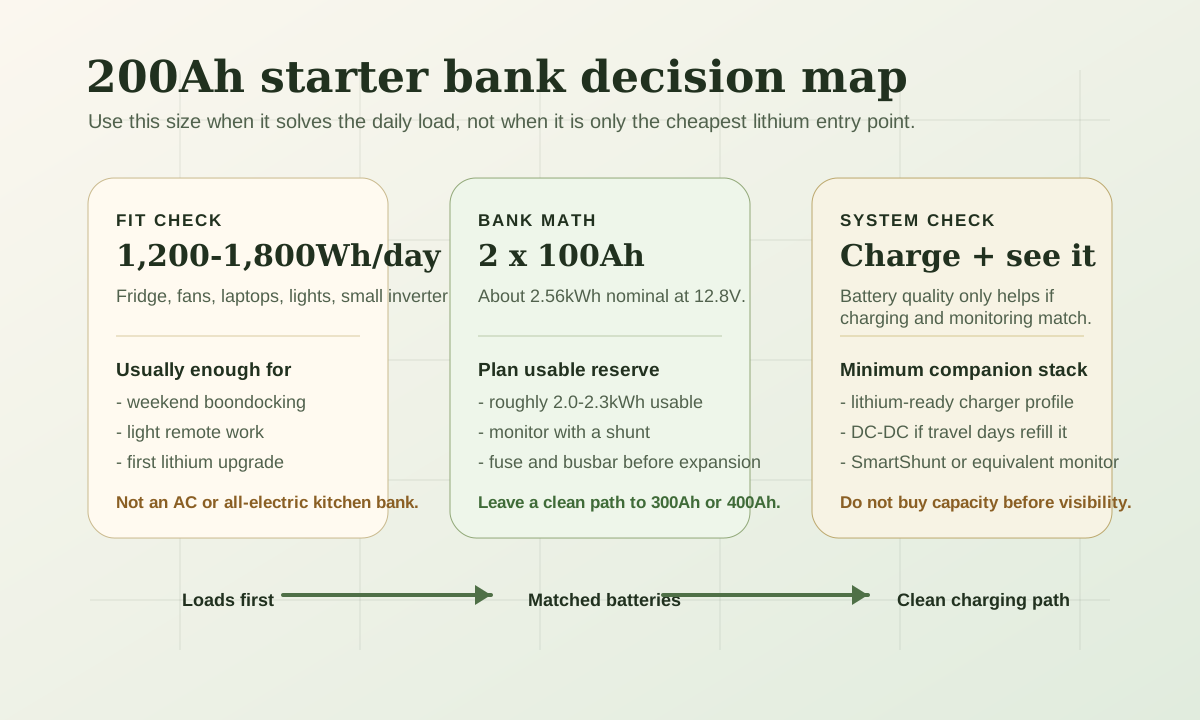
The math is simple. Two 100Ah LiFePO4 batteries at about 12.8V equal about 2,560Wh of nominal storage. In real planning, you should not treat every watt-hour as free to spend. Leave margin for battery protection, cold mornings, charging inefficiency, inverter overhead, and the reality that your loads are never exactly what the spreadsheet predicted. A practical planning range is roughly 2.0 to 2.3kWh of usable daily reserve from a healthy 200Ah lithium bank.
That is usually enough for a compressor fridge, lights, roof vent fans, phones, tablets, a router or hotspot, laptop charging, water pump use, and some small inverter time. It is not the bank I would choose for running an RV air conditioner, a microwave-heavy kitchen, electric heat, or two remote workers with large monitor setups and no refill plan.
If you are still not sure the 200Ah lane is right, start with the RV battery bank sizing guide and then run the numbers through the battery calculator. This article assumes 200Ah already looks plausible and helps you choose the cleanest starter build.
Compare the three practical starter-bank lanes
Compare
200Ah starter-bank product lanes
Use one comparison matrix to scan the practical differences. Small screens stack each row; wider screens keep the first column pinned.
| Spec | Battle Born 100Ah | SOK SK12V100P | Epoch 105Ah Essentials |
|---|---|---|---|
| Two-battery bank | 200Ah / about 2.56kWh nominal | 200Ah / about 2.56kWh nominal | 210Ah / about 2.69kWh nominal |
| Pricing checked Apr. 21, 2026 | Direct listing showed $679 per battery | Value direct-sale listing; verify current checkout price | Middle lane; verify current dealer or direct listing |
| Best reason to buy | Support confidence for a first lithium upgrade | Capacity per dollar in a matched pair | Extra nominal reserve with modern convenience features |
| Main tradeoff | The two-battery bank gets expensive fast | Support and polish may feel less premium | Less standardized than a strict 100Ah pair |
| Expansion note | Clean path if you can afford matching additions | Strong fit for adding a third or fourth battery later | Future matching depends on availability of the same 105Ah unit |
The battery decision gets easier when you price the whole bank
A starter-bank purchase feels simple until you price everything that has to work around it. The battery pair is only one line item. A clean 200Ah bank also needs a shunt-based monitor, proper main overcurrent protection, a main disconnect, short battery cables, protected positive distribution, a negative bus or shunt path, and charger settings that match lithium.
This is why the cheapest single battery does not always create the best first upgrade. If you save money on the battery pair but leave the old converter on the wrong profile, skip the shunt, and wire solar around the monitor, the bank will still feel confusing. If you buy the premium pair but cannot afford the monitor, fuse, and charging support, the extra spend may not show up in daily confidence.
The whole-bank question is: can you buy the pair, see the current flow, recharge it in the way you actually travel, and service the wiring without guessing? If the answer is yes, the brand choice becomes much calmer.
What a 200Ah bank can realistically run
A moderate RV day might look like this: 700Wh for a 12V compressor fridge in warm weather, 250Wh for fans and lights, 400Wh for laptop and device charging, 150Wh for router or hotspot use, and 150Wh of water pump, control board, and small accessory loads. That lands around 1,650Wh before inverter losses and weather margin.
That is exactly where a 200Ah lithium bank makes sense. You have enough capacity to avoid panic, but not so much that the rest of the system can be ignored. If the same rig adds a 1,500W induction cooking habit, a big inverter left on all night, or daily microwave use, the bank will shrink emotionally even if the spec sheet still says 200Ah.
The hidden load to watch is inverter idle draw. A 2,000W or 3,000W inverter left on with no load can quietly consume meaningful energy overnight. If your 200Ah bank is built for laptops and fridge time, turn the inverter off when you are not using AC loads or choose an inverter with a usable search mode.
There is also a difference between a day that technically fits and a day that feels relaxed. If your normal use is 1,900Wh and the bank has roughly 2,100Wh of practical usable reserve, the math says you made it. The lived experience says one cloudy afternoon, cold furnace night, or extra laptop session will put you back into rationing mode.
That is why I like a 200Ah starter bank for readers whose normal day is closer to 1,200 to 1,700Wh than 2,000Wh. The extra margin is what makes the bank feel like an upgrade instead of a strict allowance. If your normal day is already above that, use the 200Ah page as a stepping stone and compare the 300Ah to 400Ah value-bank guide before buying.
What changes from AGM to a 200Ah lithium bank
Many RVers arrive here from a pair of group 24, group 27, or GC2 lead-acid batteries. The label may already say something close to 160Ah to 220Ah, which makes lithium confusing at first. The difference is usable reserve, weight, charging behavior, voltage curve, and how much abuse the bank tolerates.
With lead-acid, many owners plan around roughly half the rated capacity if they want decent battery life. With lithium, a much larger share of the rated capacity is practically usable, but the system needs correct charging and low-temperature protection. That is why a 200Ah lithium bank can feel like a bigger jump than the amp-hour label suggests.
Do not treat lithium as a drop-in miracle if the rest of the rig is still built around old assumptions. The converter may need a lithium profile. The alternator path may need current control. The battery compartment may need new hold-downs. The monitor may need a shunt instead of a voltage-only wall display. Those details are not glamorous, but they are the reason the upgrade feels stable.
When 200Ah is the wrong first bank
Skip a 200Ah starter bank if you already know the rig needs routine air-conditioner runtime from batteries. It is also probably too small if you want electric heat, daily induction cooking, or a large inverter left on all day for convenience. Those are not moral failures. They are simply larger energy plans.
Also be careful if the RV is a full-time remote-work rig with two laptops, two external monitors, a satellite internet system, camera gear, and long days away from shore power. The bank may handle a light version of that life, but it will not feel generous unless the solar, alternator, or generator refill plan is strong.
Finally, skip the 200Ah lane if you already know the battery compartment will be rebuilt for a larger inverter and 400Ah bank within a month. In that case, buying two batteries now can create extra work. Design the final bank, busbar, fuse, and charger layout once instead of building a starter system you immediately outgrow.
The clean accessory stack for a first lithium bank
Start with a shunt-based battery monitor. Voltage is a poor state-of-charge gauge for LiFePO4 because the voltage curve stays flat through much of the usable range. A monitor such as a Victron SmartShunt lets you see current, consumed amp-hours, and charging behavior instead of guessing from a wall panel.
Next, confirm charging. Shore-power converters in older RVs may not fully charge lithium or may hold absorption in a way the battery manufacturer does not want. Solar controllers need the right profile. Alternator charging often needs a DC-DC charger so the alternator and lithium bank are both protected. If travel days are your main refill source, compare the best DC-to-DC chargers for RVs before the battery order is final.
Then plan the physical layout. Two batteries should not be connected by a random pile of cable lengths and mystery lugs. Keep positive and negative paths balanced, use proper protection near the source, and leave room for a busbar or future expansion if 300Ah is likely. Read the RV battery monitor guide before deciding where the negative path and shunt will live.
A 200Ah starter bank should teach you how your rig behaves
The best first lithium bank is one that makes daily behavior easier to understand. If you can see current flow, recharge patterns, and reserve clearly, the next upgrade gets smarter fast.
Which battery lane should most RVers choose?
Choose Battle Born if this is your first lithium upgrade and you value support, documentation, brand familiarity, and a conservative path more than the lowest two-battery cost. It is the lane I would point a nervous first-time upgrader toward when the budget allows the battery pair and the accessory stack.
Choose SOK if the bank has to stay value-focused and you would rather put saved money into the monitor, DC-DC charger, wiring cleanup, or solar controller. It is the most compelling 200Ah capacity-per-dollar lane in this shortlist, especially for DIY owners who are comfortable checking settings and installation details.
Choose Epoch if you want a balanced middle option and the 105Ah format fits your future plan. Two batteries create a 210Ah bank, which is not a huge jump but can be useful margin. The caution is simple: if you expect to expand later, make sure you are comfortable buying matching 105Ah units rather than mixing capacities.
Our 200Ah starter-bank picks
- Latest product check
- Specs, fit notes, and current listing context were reviewed April 21, 2026.
- Evidence label
- Spec-verified: Score is based on current published specs, official documentation, pricing context, compatibility, and RV-use fit analysis.
- Price context
- Pricing and availability can change, so confirm the merchant listing before buying.
Product facts last checked April 21, 2026
Battle Born 100Ah
Editorial fit score
Battle Born costs more, but it remains the cleanest recommendation when a first-time lithium buyer wants brand familiarity, documentation, and support confidence around the whole install.
Review verdict
- Short verdict
- The safest premium-support lane for RVers buying their first serious lithium bank.
- Evidence used
- Spec-verified
- Score is based on current published specs, official documentation, pricing context, compatibility, and RV-use fit analysis.
- Why it made the shortlist
- Best overall
- The first option to evaluate if you want the strongest all-around fit for this guide.
- Best if
- First lithium upgrade with premium support
- Why not this product?
- You need the lowest-cost 200Ah bank and would rather put money into charging hardware.
- Watch for
- Higher all-bank cost than value-focused options
- Product check date
- Specs, fit notes, and current listing context were last checked April 21, 2026.
Key specs
- Capacity
- 100Ah each
- Starter bank
- 2 batteries = 200Ah
- Nominal storage
- About 2.56kWh per pair
- Pricing
- Direct listing checked at $679
Score basis
Score is based on current published specs, official documentation, pricing context, compatibility, and RV-use fit analysis. These are editorial fit scores, not customer-review averages. Read the scoring rubric.
- RV-use fit
- 30% weight
- Verified specs and limits
- 25% weight
- Whole-rig friction
- 20% weight
- Downsides and support risk
- 15% weight
- Value for the job
- 10% weight
How directly the product solves the specific off-grid RV job in this guide.
Capacity, dimensions, electrical limits, protection claims, and compatibility constraints we can verify from current sources.
Install effort, storage, wiring, service access, weight, refill workflow, or daily-use hassle.
Known tradeoffs, unclear claims, warranty coverage, support risk, and wrong-buyer failure modes.
Whether the price makes sense after fit, specs, and tradeoffs still hold.
Testing limits
- This is not a hands-on endurance or lab test unless the review explicitly says so.
- Specs, pricing, bundles, and availability can change, so confirm the current listing and manual before buying.
Reasons to buy
- Strong support model for first-time lithium owners
- Simple 2 x 100Ah starter-bank math
- Good fit when documentation and confidence matter
Watch-outs
- Higher all-bank cost than value-focused options
- Premium spend can crowd out monitoring or charging upgrades
- May be more battery brand than casual weekend users need
Whole-bank math
Two-battery bank
200Ah / about 2.56kWh nominal
A common first serious lithium bank for moderate off-grid use.
Planning reserve
Roughly 2.0-2.3kWh usable planning range
Leave margin for inverter losses, cold mornings, and imperfect charging.
Best upgrade order
Battery pair, shunt, protection, charging profile
Premium support does not replace a clean system layout.
Related parts and setup checks
Victron SmartShunt 500A
Use a real monitor from day one so lithium state of charge is visible.
Open Victron SmartShunt 500ADC-DC charger check
Useful when travel days are a major refill source.
Open DC-DC charger checkBattery sizing check
Confirm the bank is right-sized before paying the premium lane.
Open Battery sizing checkCheck current listing
Battle Born 100Ah 12V LiFePO4 Deep Cycle Battery
Use the listing after the fit notes make sense for your rig. Pricing and availability can change, so verify the merchant page before buying.
- Latest product check
- Specs, fit notes, and current listing context were reviewed April 21, 2026.
- Evidence label
- Spec-verified: Score is based on current published specs, official documentation, pricing context, compatibility, and RV-use fit analysis.
- Price context
- Pricing and availability can change, so confirm the merchant listing before buying.
Product facts last checked April 21, 2026
SOK SK12V100P 100Ah
Editorial fit score
SOK is the practical pick for buyers who want a real 200Ah lithium bank without spending so much on the pair that the monitor, protection, or charging plan gets delayed.
Review verdict
- Short verdict
- The value lane that makes the most sense when the accessory stack matters as much as the batteries.
- Evidence used
- Spec-verified
- Score is based on current published specs, official documentation, pricing context, compatibility, and RV-use fit analysis.
- Why it made the shortlist
- Best value
- The pick that balances capability and cost pressure best for this decision.
- Best if
- Value-focused 200Ah starter banks
- Why not this product?
- You want the most premium support experience for a first lithium conversion.
- Watch for
- Support feel may not match premium brands
- Product check date
- Specs, fit notes, and current listing context were last checked April 21, 2026.
Key specs
- Capacity
- 100Ah each
- Starter bank
- 2 batteries = 200Ah
- Nominal storage
- About 2.56kWh per pair
- Pricing
- Value direct-sale listing
Score basis
Score is based on current published specs, official documentation, pricing context, compatibility, and RV-use fit analysis. These are editorial fit scores, not customer-review averages. Read the scoring rubric.
- RV-use fit
- 30% weight
- Verified specs and limits
- 25% weight
- Whole-rig friction
- 20% weight
- Downsides and support risk
- 15% weight
- Value for the job
- 10% weight
How directly the product solves the specific off-grid RV job in this guide.
Capacity, dimensions, electrical limits, protection claims, and compatibility constraints we can verify from current sources.
Install effort, storage, wiring, service access, weight, refill workflow, or daily-use hassle.
Known tradeoffs, unclear claims, warranty coverage, support risk, and wrong-buyer failure modes.
Whether the price makes sense after fit, specs, and tradeoffs still hold.
Testing limits
- This is not a hands-on endurance or lab test unless the review explicitly says so.
- Specs, pricing, bundles, and availability can change, so confirm the current listing and manual before buying.
Reasons to buy
- Strong capacity-per-dollar lane for a matched pair
- Leaves budget for the monitor and charging hardware
- Makes future expansion easier to justify financially
Watch-outs
- Support feel may not match premium brands
- DIY buyers need to verify settings and wiring carefully
- Direct availability and pricing should be checked before checkout
Whole-bank math
Two-battery bank
200Ah / about 2.56kWh nominal
A strong cost-control lane for a real starter bank.
Money saved
Often better spent on shunt, DC-DC, and wiring cleanup
The value only works if the install is still clean.
Expansion path
Easy to understand if later batteries match
Avoid mixing sizes, brands, or ages unless you know exactly why.
Related parts and setup checks
Battery monitor
A value bank still needs a shunt so you can see what the system is doing.
Open Battery monitorSolar sizing check
Make sure the array can support the bank before adding more capacity.
Open Solar sizing checkCharging-source guide
Confirm shore, solar, and alternator charging before relying on lithium.
Open Charging-source guideCheck current listing
SOK SK12V100P 12V 100Ah LiFePO4 Battery
Use the listing after the fit notes make sense for your rig. Pricing and availability can change, so verify the merchant page before buying.
- Latest product check
- Specs, fit notes, and current listing context were reviewed April 21, 2026.
- Evidence label
- Spec-verified: Score is based on current published specs, official documentation, pricing context, compatibility, and RV-use fit analysis.
- Price context
- Pricing and availability can change, so confirm the merchant listing before buying.
Product facts last checked April 21, 2026
Epoch 105Ah Essentials
Editorial fit score
Epoch fits buyers who want a little more nominal reserve than a strict 2 x 100Ah bank and like the built-in feature set, but still want to stay more value-aware than the premium lane.
Review verdict
- Short verdict
- A balanced middle lane when a 210Ah starter bank and modern features fit the plan.
- Evidence used
- Spec-verified
- Score is based on current published specs, official documentation, pricing context, compatibility, and RV-use fit analysis.
- Why it made the shortlist
- Also great
- A strong alternate when its specific tradeoffs fit your rig better than the winner.
- Best if
- Balanced features and a little extra reserve
- Why not this product?
- You want every future expansion step to use the most common 100Ah battery size.
- Watch for
- Future matching is less universal than 100Ah batteries
- Product check date
- Specs, fit notes, and current listing context were last checked April 21, 2026.
Key specs
- Capacity
- 105Ah each
- Starter bank
- 2 batteries = 210Ah
- Nominal storage
- About 2.69kWh per pair
- Feature lane
- Heated Bluetooth Essentials listing
Score basis
Score is based on current published specs, official documentation, pricing context, compatibility, and RV-use fit analysis. These are editorial fit scores, not customer-review averages. Read the scoring rubric.
- RV-use fit
- 30% weight
- Verified specs and limits
- 25% weight
- Whole-rig friction
- 20% weight
- Downsides and support risk
- 15% weight
- Value for the job
- 10% weight
How directly the product solves the specific off-grid RV job in this guide.
Capacity, dimensions, electrical limits, protection claims, and compatibility constraints we can verify from current sources.
Install effort, storage, wiring, service access, weight, refill workflow, or daily-use hassle.
Known tradeoffs, unclear claims, warranty coverage, support risk, and wrong-buyer failure modes.
Whether the price makes sense after fit, specs, and tradeoffs still hold.
Testing limits
- This is not a hands-on endurance or lab test unless the review explicitly says so.
- Specs, pricing, bundles, and availability can change, so confirm the current listing and manual before buying.
Reasons to buy
- Slightly larger two-battery bank than strict 100Ah pairs
- Good feature-conscious middle lane
- Useful fit for shoulder-season travelers
Watch-outs
- Future matching is less universal than 100Ah batteries
- Not the cheapest or most premium option
- A battery app is not a replacement for whole-system monitoring
Whole-bank math
Two-battery bank
210Ah / about 2.69kWh nominal
A small but useful reserve bump over a strict 200Ah pair.
Planning reserve
Roughly 2.1-2.4kWh usable planning range
Still size the rig around real loads instead of the label.
Expansion caution
Match future units carefully
The 105Ah lane works best when future batteries are the same model and age range.
Related parts and setup checks
Cold-weather lithium check
Helpful if the heated feature is part of the buying reason.
Open Cold-weather lithium checkBattery calculator
Use real load math before assuming the extra 10Ah changes the trip.
Open Battery calculatorBattery monitor guide
Bluetooth on the battery is useful, but a shunt still gives whole-system current visibility.
Open Battery monitor guideCheck current listing
Epoch 12V 105Ah Essential Series Battery
Use the listing after the fit notes make sense for your rig. Pricing and availability can change, so verify the merchant page before buying.
The mistake most first-time lithium buyers make
The common mistake is buying the bank before deciding how the bank will be charged, measured, protected, and expanded. Lithium makes weak system design less forgiving because it can accept current quickly, hold voltage differently than lead-acid, and hide state of charge from simple voltage displays.
Do not install the batteries, then figure out where the shunt goes. Do not assume the factory converter is correct. Do not use the old battery disconnect as proof the system is protected. Do not add a third battery later without thinking through cable balance and busbar layout.
The clean starter-bank sequence is: confirm loads, choose the matched pair, confirm every charging source, install the shunt in the whole-system negative path, protect the positive path, label the disconnects, and document the normal charging numbers after the first sunny day or travel day.
Take photos before and after the install. Photograph battery labels, cable routes, fuse ratings, disconnect positions, charger settings, solar controller settings, and the shunt orientation. If the bank behaves oddly later, those photos save time. If you sell the RV, they also make the upgrade feel more trustworthy to the next owner.
The first trip should be treated as a shakedown, not a victory lap. Watch morning state of charge, peak charge current, how fast the bank refills during driving or solar, and whether the inverter is being left on accidentally. A 200Ah bank teaches quickly when the monitor is installed correctly.
Final thought
A 200Ah starter bank is a good first lithium upgrade when it buys clarity, not just capacity. Choose the product lane that leaves enough budget and attention for monitoring, charging, protection, and future expansion. That is the difference between a battery purchase and a usable off-grid system.
Frequently asked
Questions RVers usually ask next.
Is 200Ah of lithium enough for most RVs?
It is enough for many moderate-use rigs running a fridge, fans, lights, device charging, laptop charging, and small inverter loads. It is usually not enough for routine air-conditioner use, electric heat, or heavy AC cooking without a larger system and strong recharge plan.
Should a 200Ah starter bank use two matching batteries?
Yes in most cases. A matched pair keeps wiring, charging behavior, monitoring, and future troubleshooting simpler than mixing brands, ages, capacities, or BMS limits.
What accessory matters most with a 200Ah lithium bank?
A shunt-based battery monitor is the first accessory I would prioritize because LiFePO4 voltage does not tell the whole state-of-charge story. Clean protection and charger compatibility are close behind.
Can I expand a 200Ah bank later?
Usually, but only if the original layout leaves room for matched batteries, balanced cable paths, proper fusing, and a charging plan that can refill the larger bank in a useful time window.
Freshness note
Last checked April 21, 2026
This topic can change when products, plans, prices, campsite rules, or fit guidance move. These notes show what was reviewed most recently.
This review included
- Checked official Battle Born, SOK, and Epoch 100Ah-class lithium listings for capacity, pricing context, and product availability used in a 200Ah starter bank.
- Checked Victron SmartShunt documentation and lithium charging guidance used for the monitoring and accessory recommendations.
- Expanded the guide from a short shopping note into a full 200Ah decision framework with quick picks, product cards, usable-capacity math, accessory sequencing, and official-source checks.
Recent change log
April 21, 2026
Added a custom decision visual, official-source grid, quick-pick table, full product cards, usable-capacity math, and a clearer 200Ah starter-bank workflow.
April 17, 2026
Added clearer routing back to the battery-sizing pillar so the 200Ah guide stays a shopping support page.
Broader editorial corrections are tracked on the Corrections and Updates page.

