Shortlist first
Use this to find the winner first, then compare the alternates only if their tradeoffs fit your rig better.
Shortlist labels are editorial recommendations, not popularity rankings. Fit score still matters, but the label tells you why each pick made this guide.
How fit scores work
Scores are editorial fit scores, not user-review averages. The rubric weighs stated RV-use fit, verified specs and limits, whole-rig friction, visible downsides or support risk, and value for the specific job in this guide. Read the full scoring rubric.
If you need one baseline option before reading the full guide, start with Victron MultiPlus-II 12/3000/120-50 for system-grade ac build.
The first option to evaluate if you want the strongest all-around fit for this guide. Check the other cards only if their award label matches your constraint better.
| Product | Why shortlisted | Fit score | Key spec | Best for | Actions |
|---|---|---|---|---|---|
| Victron MultiPlus-II 12/3000/120-50 Links to: Victron MultiPlus-II 12/3000/120-50 | Best overall The first option to evaluate if you want the strongest all-around fit for this guide. | 4.8 / 5 fit scoreScore rubric | Dealer-priced | 2400W cont. | 5500W peak | 120A charger | 50A transfer | System-grade AC build | Read Victron MultiPlus-II 12/3000/120-50 notesCheck listing at VictronMerchant link - direct listing. Verify price and specs at Victron. |
| Giandel PS-3000SAR-USA Links to: Giandel PS-3000SAR-USA 3000W Pure Sine Wave Inverter | Budget pick The lower-cost route to check when the premium option is more than the job needs. | 4.4 / 5 fit score | $289.82 | 3000W cont. | 6100W surge for 2 sec | no charger | Budget high-surge inverter-only install | Read Giandel PS-3000SAR-USA notesCheck listing at GiandelMerchant link - direct listing. Verify price and specs at Giandel. |
| AIMS Power PWRIG200012120S Links to: AIMS Power PWRIG200012120S 2000W Industrial Grade Pure Sine Inverter | Also great A strong alternate when its specific tradeoffs fit your rig better than the winner. | 4.2 / 5 fit score | $534.00 | 2000W cont. | 4000W surge | 90% full-load efficiency | Smaller soft-start AC or industrial 2000W lane | Read AIMS Power PWRIG200012120S notesCheck listing at AIMS PowerMerchant link - direct listing. Verify price and specs at AIMS Power. |
Why this comparison exists
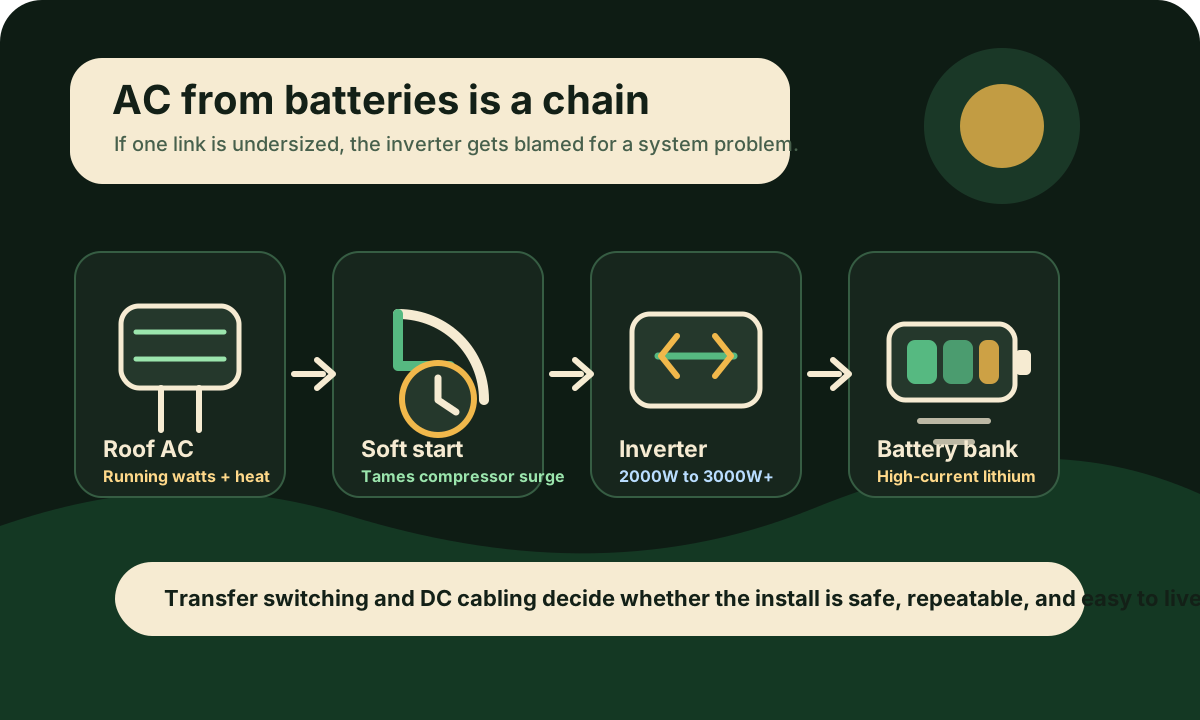
Running an RV air conditioner from batteries sounds like an inverter question, but it is really a system question.
The inverter has to handle the compressor startup event, the running watts, the heat inside the install cabinet, and the DC current coming out of the battery bank. The battery bank has to tolerate that current without tripping the BMS. The wiring has to be short and large enough. The transfer plan has to keep shore power, generator power, and inverter power from fighting each other.
That is why a cheap 2000W box can look tempting and still be the wrong answer for a 13,500 BTU roof unit. It is also why a premium 3000VA inverter charger can be the right answer even though its continuous watt rating is lower than the marketing number.
If you have not sized the rest of the system yet, start with the RV air-conditioner solar sizing guide and then run the battery calculator. This guide is for the next decision: which inverter class makes sense once the load is real.
Price and spec note
Specs and model availability were re-verified against the official manufacturer pages on June 6, 2026. The Giandel and AIMS Power direct prices shown were captured April 11, 2026 — those pages render price dynamically, so confirm the live price before buying. Victron does not publish one simple direct-cart US price on its official product page, so it is listed as dealer-priced.
The soft start is not optional math
A roof air conditioner has two different electrical moments: compressor startup and steady running.
The running load may be inside the reach of a 2000W or 3000W inverter. The startup surge can be the part that trips the inverter, trips the battery BMS, or causes the system voltage to sag hard enough that everything shuts down.
A soft start does not make air conditioning cheap on batteries. It lowers the startup hit so the inverter has a fighting chance. That is different from solving the daily energy problem.
For example, a soft-started 13,500 BTU roof unit might run inside a 1500W to 1800W lane once the compressor is moving, depending on the unit, fan speed, heat, altitude, voltage, and condition. At 12V, that can still mean roughly 140A to 170A from the battery bank after inverter losses. That is why the battery discharge rating matters as much as the inverter label.
If your bank is one 100Ah lithium battery with a 100A BMS, stop here. Size the bank first with the battery-bank sizing guide. The inverter cannot pull current the battery is not willing to deliver.
What matters before the brand name
Continuous output has to be read honestly
Inverter names often use VA, watts, peak watts, and marketing class in ways that sound interchangeable. They are not.
The Victron MultiPlus-II 12/3000/120-50 is a 3000VA unit, but the official 12V model spec lists 2400W continuous output at 25 C and 2200W at 40 C. That can still be a very strong RV air-conditioner choice because it includes charger and transfer functions, but it is not a magic 3000W continuous output box.
Giandel's PS-3000SAR-USA is the blunt budget option here: 3000W continuous and 6100W surge for 2 seconds on the official page. That makes it more appealing for a soft-started compressor, but it does not include the transfer and charging infrastructure a coach may need.
AIMS Power's PWRIG200012120S is the conservative 2000W industrial-grade lane. It is better suited to smaller AC loads, well-behaved soft-start installations, or owners who value a more industrial inverter-only product over bargain price.
Transfer behavior decides how clean the install feels
If you only want to power one dedicated air-conditioner circuit from an inverter, an inverter-only unit can work with the right transfer strategy and an electrician who understands RV wiring.
If you want shore power, generator power, charging, and inverter power to behave like one calmer system, compare inverter chargers before buying. The RV inverter charger guide is the better path when the coach needs charging and transfer switching, not just AC output.
The mistake is using an inverter-only bargain box as if it were a complete power center. It is not.
Battery current is the hidden cost
The rough DC current formula is:
- AC load watts divided by inverter efficiency, then divided by battery voltage
At 1500W of AC load and 90 percent inverter efficiency, a 12V battery bank sees about 139A before cable losses. At 2000W, that same math is about 185A. At 2400W, it is about 222A.
Those numbers explain why air conditioning usually belongs with a larger lithium bank, short cable runs, appropriate fusing, and a battery monitor. If you are still on a small AGM bank, read lithium versus AGM before treating AC runtime as a reasonable inverter upgrade.
RV AC inverter decision checkpoints
Use these checks before comparing checkout prices. The wrong missing piece can make even the best inverter feel broken.
Soft start
Usually required
A compressor soft start is the practical bridge between paper surge specs and real RV rooftop AC startup.
Battery bank
High-current lithium favored
Check continuous discharge rating, BMS limit, cable length, fuse size, and reserve before buying the inverter.
Inverter class
2000W to 3000W+
Smaller AC units may fit 2000W with a soft start. Larger or hotter use cases usually want the 3000W class.
Transfer plan
Do not improvise
Shore, generator, and inverter power need a safe transfer strategy. Backfeeding is not a shortcut.
Runtime reality
Minutes are easy, hours are expensive
The inverter starts the load. Battery capacity and recharge sources decide how long the comfort lasts.
First check
Nameplate plus calculator
Use actual AC watts, not forum guesses, then model the bank in the battery calculator.
Worked example: why the inverter is only one part of AC runtime
Imagine a soft-started rooftop air conditioner that averages around 1,500W while running in hot weather. At 90 percent inverter efficiency, that load asks the DC side for about 1,667W. On a 12V bank, that is roughly 139A before cable losses and voltage behavior. If the compressor cycles hard during peak afternoon heat, the battery bank may see repeated high-current pulls even if the inverter itself is technically inside its rating.
Now connect that to runtime. A 400Ah lithium bank at 12V stores roughly 5,120Wh rated. If you reserve some capacity and account for inverter losses, two hours of air conditioning can consume a large share of the practical reserve. That does not make inverter AC impossible. It means the purchase is really an air conditioner, inverter, battery, wire, fuse, soft-start, and recharge decision all at once.
This is why a cheap 3000W inverter can be both tempting and incomplete. It may start the load with a soft start, but it does not provide shore charging, transfer behavior, or a clean recovery plan. If the goal is a short lunch stop, that may be fine. If the goal is overnight comfort or routine afternoon cooling, the system needs a deeper plan.
Match the inverter path to the comfort goal
For brief cooling windows, the inverter only has to support controlled use: pre-cooling before quiet hours, a short pet-safe break with monitoring, or a lunch stop where the battery starts high and the owner watches the numbers. In that lane, a properly installed inverter-only unit can make sense.
For daily hot-weather comfort, the inverter charger path becomes more compelling. Shore power, generator input, battery charging, and transfer behavior all matter because the air conditioner is no longer an occasional load. This is where the Victron MultiPlus-II earns its keep even though it is expensive and heavy.
For smaller or highly controlled loads, the AIMS 2000W lane can be more honest. If the air conditioner is small, verified, soft-started, and used with discipline, staying below the full 3000W class may reduce cost and complexity. The tradeoff is less margin.
The worst buying path is "big inverter first, system later." The best path is to confirm the AC nameplate and soft-start behavior, run the AC runtime calculator, check the battery discharge limits, and then buy the inverter that fits the whole comfort plan.
Pre-checkout questions for AC inverter installs
Ask these before buying:
- What is the air conditioner's running wattage in real heat?
- What startup behavior is expected after a soft start is installed?
- What is the battery bank's continuous discharge limit?
- What DC current will the inverter pull at the expected AC load?
- What cable length, fuse, disconnect, and ventilation plan supports that current?
- How will shore or generator power transfer safely?
- What recharge source replaces the energy after the cooling window?
- What owner-visible monitor will show when to stop?
If the answer is only "it is a 3000W inverter," the plan is not finished. Air conditioning is one of the fastest ways to expose weak assumptions in an RV electrical system.
Exact specs compared
Compare
RV air conditioner inverter spec comparison
Use one comparison matrix to scan the practical differences. Small screens stack each row; wider screens keep the first column pinned.
| Spec | Victron MultiPlus-II 12/3000/120-50 | Giandel PS-3000SAR-USA | AIMS Power PWRIG200012120S |
|---|---|---|---|
| Price checked | Dealer-priced; varies by seller | $289.82 direct | $534.00 direct sale price |
| Product type | Inverter charger | Inverter only | Inverter only |
| Continuous output | 3000VA / 2400W at 25 C; 2200W at 40 C | 3000W | 2000W |
| Surge / peak output | 5500W peak | 6100W for 2 seconds | 4000W surge |
| Charger included | Yes, 120A max battery charge current | No | No |
| Transfer behavior | 50A transfer switch | No integrated RV transfer switching | No integrated RV transfer switching |
| Efficiency | 93% maximum | Not clearly published as a full-load number on official text page | 90% full load; 95% at one-third load |
| Weight | 64 lb | 14.96 lb product data | 12.13 lb unit; 17 lb shipping weight |
| Dimensions | 22.7 x 10.9 x 5.8 in | Not clearly published on official text page | 16.54 x 8.86 x 3.50 in |
| Warranty signal | Dealer / Victron channel dependent | 18-month hassle-free warranty stated | 1-year warranty parts and labor stated |
| Best fit | Full coach power integration where AC is part of a larger lithium build | Budget inverter-only AC experiment with a soft start and careful wiring | Smaller soft-start AC load or owner who values industrial-grade inverter-only construction |
The shortlist
- Latest product check
- Specs, fit notes, and current listing context were reviewed June 6, 2026.
- Evidence label
- Spec-verified: Score is based on current published specs, official documentation, pricing context, compatibility, and RV-use fit analysis.
- Price context
- Pricing and availability can change, so confirm the merchant listing before buying.
Product facts last checked June 6, 2026
Victron MultiPlus-II 12/3000/120-50
Editorial fit score
Victron's official 120V technical specifications list the 12/3000/120-50 at 3000VA, 2400W continuous output at 25 C, 2200W at 40 C, 5500W peak power, 120A maximum battery charging, a 50A transfer switch, 93 percent maximum efficiency, 64 lb weight, and a 22.7 x 10.9 x 5.8 inch enclosure. It is expensive and heavy, but it solves more of the RV power-center problem than an inverter-only box.
Review verdict
- Short verdict
- The best overall choice when the RV air conditioner is part of a serious lithium, charging, and transfer-switch build instead of a one-load experiment.
- Evidence used
- Spec-verified
- Score is based on current published specs, official documentation, pricing context, compatibility, and RV-use fit analysis.
- Why it made the shortlist
- Best overall
- The first option to evaluate if you want the strongest all-around fit for this guide.
- Best if
- System-grade AC build
- Why not this product?
- If you only want to experiment with one soft-started AC circuit and already have a safe transfer plan, Giandel costs far less.
- Watch for
- Heavy and physically larger than the inverter-only options
- Product check date
- Specs, fit notes, and current listing context were last checked June 6, 2026.
Key specs
- Price checked
- Dealer-priced; varies
- Continuous output
- 2400W at 25 C
- Peak power
- 5500W
- Transfer switch
- 50A
Score basis
Score is based on current published specs, official documentation, pricing context, compatibility, and RV-use fit analysis. These are editorial fit scores, not customer-review averages. Read the scoring rubric.
- RV-use fit
- 30% weight
- Verified specs and limits
- 25% weight
- Whole-rig friction
- 20% weight
- Downsides and support risk
- 15% weight
- Value for the job
- 10% weight
How directly the product solves the specific off-grid RV job in this guide.
Capacity, dimensions, electrical limits, protection claims, and compatibility constraints we can verify from current sources.
Install effort, storage, wiring, service access, weight, refill workflow, or daily-use hassle.
Known tradeoffs, unclear claims, warranty coverage, support risk, and wrong-buyer failure modes.
Whether the price makes sense after fit, specs, and tradeoffs still hold.
Testing limits
- This is not a hands-on endurance or lab test unless the review explicitly says so.
- Specs, pricing, bundles, and availability can change, so confirm the current listing and manual before buying.
Reasons to buy
- Best complete system fit in this comparison
- Includes charging and transfer switching instead of leaving those decisions outside the inverter
- Strong match for planned lithium builds with shore, generator, and solar recovery
Watch-outs
- Heavy and physically larger than the inverter-only options
- Dealer-priced, so checkout cost is not as transparent as direct-cart brands
- The 3000VA name should not be mistaken for 3000W continuous output
Whole-bank math
Why it wins
It solves more than output
AC-from-battery installs usually get messy around transfer and charging. This unit handles those jobs inside the same ecosystem.
Battery implication
Large lithium bank
A soft-started air conditioner can still ask for well over 100A from a 12V bank while running.
When to skip it
Single-circuit budget test
If you only want to experiment with one soft-started AC circuit and already have a safe transfer plan, Giandel costs far less.
Related parts and setup checks
RV air-conditioner solar sizing guide
Use this to decide whether you are buying a short comfort window, a generator-hybrid setup, or a true large battery system.
Open RV air-conditioner solar sizing guideBattery calculator
Model the daily watt-hours and reserve target before you assume the bank can support AC runtime.
Open Battery calculatorRV inverter charger guide
Compare the all-in-one power-center alternatives if charging and transfer behavior matter more than a standalone inverter.
Open RV inverter charger guideCheck current listing
Victron MultiPlus-II 12/3000/120-50
Use the listing after the fit notes make sense for your rig. Pricing and availability can change, so verify the merchant page before buying.
- Latest product check
- Specs, fit notes, and current listing context were reviewed June 6, 2026.
- Evidence label
- Spec-verified: Score is based on current published specs, official documentation, pricing context, compatibility, and RV-use fit analysis.
- Price context
- Pricing and availability can change, so confirm the merchant listing before buying.
Product facts last checked June 6, 2026
Giandel PS-3000SAR-USA
Editorial fit score
Giandel's official PS-3000SAR-USA page lists a direct price of $289.82, 3000W continuous output, 6100W surge power for 2 seconds, 12V DC to 110V/120V AC output, battery-type selectable low-voltage settings, UL listed 20A GFCI outlets, a 30 ft wired remote, and 14.96 lb product data. It is a lot of inverter for the money, but it is not a charger, transfer switch, or complete RV power system.
Review verdict
- Short verdict
- The best budget high-surge inverter-only pick when you already understand the wiring, transfer, fusing, and battery-current consequences.
- Evidence used
- Spec-verified
- Score is based on current published specs, official documentation, pricing context, compatibility, and RV-use fit analysis.
- Why it made the shortlist
- Budget pick
- The lower-cost route to check when the premium option is more than the job needs.
- Best if
- Budget high-surge inverter-only install
- Why not this product?
- If you want shore, generator, charging, and inverter transfer to feel seamless, buy an inverter charger instead.
- Watch for
- No charger and no integrated RV transfer-switch solution
- Product check date
- Specs, fit notes, and current listing context were last checked June 6, 2026.
Key specs
- Price checked
- $289.82 direct
- Continuous output
- 3000W
- Surge output
- 6100W for 2 sec
- Type
- Inverter only
Score basis
Score is based on current published specs, official documentation, pricing context, compatibility, and RV-use fit analysis. These are editorial fit scores, not customer-review averages. Read the scoring rubric.
- RV-use fit
- 30% weight
- Verified specs and limits
- 25% weight
- Whole-rig friction
- 20% weight
- Downsides and support risk
- 15% weight
- Value for the job
- 10% weight
How directly the product solves the specific off-grid RV job in this guide.
Capacity, dimensions, electrical limits, protection claims, and compatibility constraints we can verify from current sources.
Install effort, storage, wiring, service access, weight, refill workflow, or daily-use hassle.
Known tradeoffs, unclear claims, warranty coverage, support risk, and wrong-buyer failure modes.
Whether the price makes sense after fit, specs, and tradeoffs still hold.
Testing limits
- This is not a hands-on endurance or lab test unless the review explicitly says so.
- Specs, pricing, bundles, and availability can change, so confirm the current listing and manual before buying.
Reasons to buy
- Lowest direct price in this comparison by a wide margin
- High published surge rating for a soft-started compressor use case
- Battery-type selectable low-voltage settings are useful when lithium and lead-acid behavior differ
Watch-outs
- No charger and no integrated RV transfer-switch solution
- Official text page did not expose a clear dimensional spec, so cabinet fit needs extra verification
- Budget value disappears if you have to add a lot of professional transfer hardware after the fact
Whole-bank math
Why it wins
Low-cost output
It is the cheapest way in this group to get a 3000W continuous, high-surge inverter-only box.
Battery implication
Still high-current
A 3000W inverter can ask for current that a small 12V bank cannot safely supply.
When to skip it
Whole-coach integration
If you want shore, generator, charging, and inverter transfer to feel seamless, buy an inverter charger instead.
Related parts and setup checks
RV electrical system diagram
Use this before you decide where the inverter belongs relative to shore power, the converter, branch circuits, and batteries.
Open RV electrical system diagramRV shore power guide
Helpful if you are still fuzzy on 30A service, transfer behavior, adapters, and what the coach panel can safely support.
Open RV shore power guideBattery-bank sizing guide
Use the bank math before trusting the inverter's surge number to mean the batteries can deliver the current.
Open Battery-bank sizing guideCheck current listing
Giandel PS-3000SAR-USA 3000W Pure Sine Wave Inverter
Use the listing after the fit notes make sense for your rig. Pricing and availability can change, so verify the merchant page before buying.
- Latest product check
- Specs, fit notes, and current listing context were reviewed June 6, 2026.
- Evidence label
- Spec-verified: Score is based on current published specs, official documentation, pricing context, compatibility, and RV-use fit analysis.
- Price context
- Pricing and availability can change, so confirm the merchant listing before buying.
Product facts last checked June 6, 2026
AIMS Power PWRIG200012120S
Editorial fit score
AIMS Power lists the PWRIG200012120S at a $534.00 direct sale price, 2000W continuous output, 4000W surge, 12V DC input, 120V AC output, pure sine wave output, 90 percent full-load efficiency, 95 percent one-third-load efficiency, under 5 percent THD, 16.54 x 8.86 x 3.50 inch size, and 12.13 lb unit weight. It is not the strongest AC choice here, but it is the more industrial 2000W lane for owners who are not trying to run a large roof unit for hours.
Review verdict
- Short verdict
- The best industrial 2000W inverter-only option when the AC load is smaller, soft-started, and intentionally kept inside a narrower comfort window.
- Evidence used
- Spec-verified
- Score is based on current published specs, official documentation, pricing context, compatibility, and RV-use fit analysis.
- Why it made the shortlist
- Also great
- A strong alternate when its specific tradeoffs fit your rig better than the winner.
- Best if
- Smaller soft-start AC or industrial 2000W lane
- Why not this product?
- If the plan is a hot-weather 13,500 or 15,000 BTU roof unit, start in the 3000W class and verify the soft-start result.
- Watch for
- Less surge and continuous headroom than the 3000W options
- Product check date
- Specs, fit notes, and current listing context were last checked June 6, 2026.
Key specs
- Price checked
- $534.00 direct
- Continuous output
- 2000W
- Surge output
- 4000W
- Efficiency
- 90% full load
Score basis
Score is based on current published specs, official documentation, pricing context, compatibility, and RV-use fit analysis. These are editorial fit scores, not customer-review averages. Read the scoring rubric.
- RV-use fit
- 30% weight
- Verified specs and limits
- 25% weight
- Whole-rig friction
- 20% weight
- Downsides and support risk
- 15% weight
- Value for the job
- 10% weight
How directly the product solves the specific off-grid RV job in this guide.
Capacity, dimensions, electrical limits, protection claims, and compatibility constraints we can verify from current sources.
Install effort, storage, wiring, service access, weight, refill workflow, or daily-use hassle.
Known tradeoffs, unclear claims, warranty coverage, support risk, and wrong-buyer failure modes.
Whether the price makes sense after fit, specs, and tradeoffs still hold.
Testing limits
- This is not a hands-on endurance or lab test unless the review explicitly says so.
- Specs, pricing, bundles, and availability can change, so confirm the current listing and manual before buying.
Reasons to buy
- Clear official dimensions, efficiency, THD, and weight data
- More industrial fit than the lowest-cost inverter-only lane
- Useful for smaller soft-started AC loads where 3000W is not necessary
Watch-outs
- Less surge and continuous headroom than the 3000W options
- No charger or integrated RV transfer behavior
- Direct price is higher than Giandel despite lower output capacity
Whole-bank math
Why it fits
Conservative 2000W lane
It makes more sense when the air conditioner is known, soft-started, and not a large unknown roof load.
Battery implication
Still not small-bank friendly
A 2000W AC load can still pull roughly 185A from a 12V bank after inverter losses.
When to skip it
Large AC ambitions
If the plan is a hot-weather 13,500 or 15,000 BTU roof unit, start in the 3000W class and verify the soft-start result.
Related parts and setup checks
Solar to run RV air conditioner
Use this before you assume a 2000W inverter means the battery and solar system can support meaningful AC runtime.
Open Solar to run RV air conditionerBest RV battery monitors
Air conditioning is the kind of load where voltage-only battery guessing gets expensive quickly.
Open Best RV battery monitorsRV electrical 101
A good primer if inverter-only wiring, branch circuits, and charging equipment still feel like one tangled subject.
Open RV electrical 101Check current listing
AIMS Power PWRIG200012120S 2000W Industrial Grade Pure Sine Inverter
Use the listing after the fit notes make sense for your rig. Pricing and availability can change, so verify the merchant page before buying.
Which one should you buy?
Buy the Victron MultiPlus-II 12/3000/120-50 if the air conditioner is part of a full electrical upgrade. It is the right kind of expensive when you also need shore-power transfer, battery charging, and a cleaner path into a larger lithium system.
Buy the Giandel PS-3000SAR-USA if the goal is a budget inverter-only setup and you already have the rest of the install solved. The surge rating is attractive for a soft-started compressor, but the low price does not include a safe transfer plan.
Buy the AIMS Power PWRIG200012120S if you are intentionally staying in the 2000W lane. That usually means a smaller AC, a verified soft-start result, shorter runtime expectations, and a preference for an industrial inverter-only unit over the cheapest high-watt option.
If you are still asking "can I run my whole RV air conditioner all night," pause the product comparison. That is battery, solar, heat, and generator-hybrid math first. Use the solar calculator and battery calculator before you make the inverter carry a promise the rest of the rig cannot keep.
The mistake most RVers make
The common mistake is buying the inverter that matches the running wattage and ignoring the startup, battery, and transfer pieces.
That creates a frustrating chain: the air conditioner starts once in mild weather, trips on a hotter day, pulls the lithium bank into BMS protection, or works only when every other load is off. Then the owner blames the inverter when the real problem was that the system was never designed as a system.
The cleaner sequence is simple:
- Measure or verify the actual air-conditioner load.
- Install or plan a compatible soft start.
- Confirm the battery bank can deliver the DC current.
- Size the fuse, cable, and disconnects for the run.
- Decide whether you need inverter-only output or an inverter charger.
- Only then compare product prices.
FAQ
Frequently asked
Questions RVers usually ask next.
Can a 2000W inverter run an RV air conditioner?
Sometimes, but only with the right AC unit, a compatible soft start, a battery bank that can deliver the current, and a conservative load plan. A 2000W inverter is a narrow lane for smaller or very well-behaved AC loads, not a blanket answer for every 13,500 or 15,000 BTU roof unit.
Is a 3000W inverter enough for a 13,500 BTU RV air conditioner?
A 3000W-class inverter is the more realistic starting point for a soft-started 13,500 BTU roof air conditioner. You still need to verify the AC nameplate, soft-start performance, battery discharge rating, wire size, and whether other loads will overlap while the compressor is running.
Do I need a soft start if I buy a bigger inverter?
Usually, yes. A larger inverter can provide more headroom, but a soft start reduces the compressor startup hit so the inverter and battery bank are less likely to trip or sag. Oversizing the inverter without solving startup current can make the system more expensive without making it dependable.
Should I buy an inverter or an inverter charger for RV air conditioning?
Buy an inverter-only unit if you are powering a dedicated load and already have a safe transfer and charging plan. Buy an inverter charger if you want shore power, generator input, battery charging, and inverter output to behave as one coordinated coach system.
How much battery do I need to run RV AC from an inverter?
For meaningful runtime, most RVers should think in several hundred amp-hours of lithium, not one small battery. The exact answer depends on AC watts, inverter efficiency, outside temperature, insulation, duty cycle, and recharge sources, so model it with the battery calculator before buying hardware.
Helpful next reads
Freshness note
Last checked June 6, 2026
This topic can change when products, plans, prices, campsite rules, or fit guidance move. These notes show what was reviewed most recently.
This review included
- Verified current official specs, pricing, surge ratings, transfer behavior, dimensions, weight, and warranty signals for the Victron MultiPlus-II 12/3000/120-50, Giandel PS-3000SAR-USA, and AIMS Power PWRIG200012120S.
- Checked official product pages for whether each unit is an inverter-only product or an inverter charger, since that changes the install plan for RV air-conditioning loads.
- Reviewed soft-start pairing context so the guide does not imply that inverter size alone solves RV air-conditioner startup surge.
Recent change log
June 6, 2026
Freshness re-verify against official sources. Re-confirmed current: Giandel PS-3000SAR (3000W continuous, 6100W surge, giandel.com) and AIMS Power PWRIG200012120S (2000W continuous, 4000W surge) specs and product pages, plus the Victron MultiPlus-II 12/3000/120-50 (2400W continuous, 120A charger, 50A transfer). The Giandel ($289.82) and AIMS ($534.00 sale) figures are manufacturer-direct prices those pages render dynamically; they could not be independently re-fetched this round, so they are kept as the April 11 capture with a 'check the live price' note. No spec changes were needed.
April 11, 2026
Published the first RV air-conditioner inverter shortlist with exact Victron, Giandel, and AIMS Power specs.
Broader editorial corrections are tracked on the Corrections and Updates page.

