RV parasitic draw at a glance
Use this first-pass map before replacing batteries or adding solar to cover a drain you have not measured.
Normal baseline
0.05-0.30A
A few safety and memory circuits can be normal, but the exact number depends on the rig and what the disconnect switch really isolates.
Watch closely
0.5A+
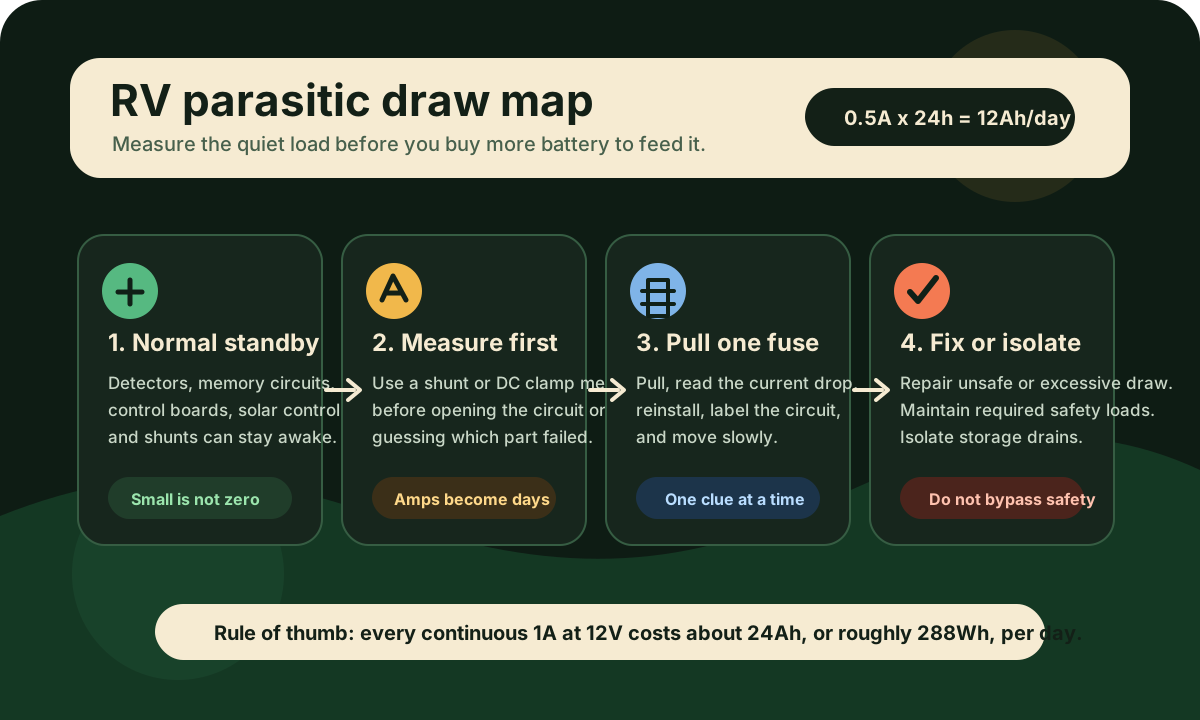
Half an amp is about 12Ah per day. That is easy to miss overnight and painful during storage.
Common culprit
Inverter standby
An inverter left on can use more energy doing nothing than several small DC standby loads combined.
Best first tool
Shunt or clamp meter
Measure total current without inserting a small meter fuse into the path of a possible large load.
Best isolation method
One fuse at a time
Pull, read the drop, label the circuit, reinstall, and move slowly. Random fuse pulling creates false clues.
Storage answer
Disconnect or maintain
If the rig sits for weeks, either isolate the bank correctly or maintain it with an appropriate charger or solar maintainer.
What counts as parasitic draw in an RV?
Parasitic draw is battery current that continues when you think the RV is off.
That does not automatically mean something is broken. Many RV systems are designed to stay awake at a low level. Propane detectors, CO detectors, stereo memory, refrigerator control boards, furnace boards, converter or charger control circuits, tank monitors, solar controllers, battery monitors, and communication modules may all pull small amounts of 12V power.
The problem starts when the draw is larger than expected, runs longer than planned, bypasses the disconnect you thought was protecting the bank, or stacks with storage time.
A small draw is a camping detail. A medium draw is a storage problem. A large draw can make you think the battery is bad when the real issue is an always-on circuit.
If you are still building the full load picture, use the RV appliance wattage chart alongside this guide. The wattage chart handles intentional loads. This page handles the quiet loads that stay behind after the obvious appliances are off.
The normal standby loads to expect
The goal is not zero draw at every moment. A true zero reading can mean the battery is fully isolated, but it can also mean safety devices or monitors are off.
Use this table as a sanity check, not a verdict on your exact rig.
Compare
Common RV standby loads and what they usually mean
Use one comparison matrix to scan the practical differences. Small screens stack each row; wider screens keep the first column pinned.
| Spec | Typical draw clue | When it matters | What to check first |
|---|---|---|---|
| Propane or CO detector | Often a small continuous 12V load | Matters during storage because it runs 24 hours a day | Confirm whether it stays powered after the battery disconnect is off |
| Stereo memory or clock | Small memory draw that may survive the coach disconnect | Usually minor alone, but annoying over long storage | Look for a radio memory fuse or accessory circuit |
| Refrigerator control board | Low draw when the fridge controls stay awake | Can matter if the fridge is left in a standby or auto mode | Turn the fridge fully off and recheck net current |
| Furnace or water-heater board | Small board draw when controls remain energized | Usually not the main culprit unless combined with other standby loads | Check thermostat and appliance switch positions |
| Solar controller idle draw | Small draw from the battery side when panels are dark | Usually normal, but it can matter in covered storage | Check the controller manual and whether solar is maintaining the bank |
| Converter or charger controls | Usually small if the charger has battery-side monitoring or control logic | Matters when the rig is unplugged and the charger path still has a standby circuit | Check the charger manual before disconnecting control or sensing wires |
| Battery monitor or shunt | Very small continuous monitoring load | Usually worth keeping because it tells you what is happening | Do not blame the monitor until larger loads are ruled out |
| Inverter standby | Can be much larger than normal DC standby loads | Matters overnight and during storage | Turn the inverter fully off, not just the AC appliance plugged into it |
| Router, booster, or USB charger | Small to moderate draw that gets forgotten | Matters when it runs all night or through storage | Unplug adapters and disable network gear before measuring baseline |
If the RV has a shunt-based monitor, look at the current number with obvious loads off. If you do not have one yet, the RV battery monitor guide explains why voltage-only panels are not enough for this kind of diagnosis.
Convert the amp reading into daily battery loss
A parasitic draw reading only becomes useful when you turn it into time.
Use these formulas:
- amps x 24 hours = amp-hours per day
- amps x volts = watts
- watts x 24 hours = watt-hours per day
For a 12V RV system, the quick version is simple: every 1A of continuous draw is about 24Ah per day, or roughly 288Wh per day.
Compare
What continuous parasitic draw costs over a day
Use one comparison matrix to scan the practical differences. Small screens stack each row; wider screens keep the first column pinned.
| Spec | Approx watts at 12V | Battery loss per day | Practical meaning |
|---|---|---|---|
| 0.05A | 0.6W | 1.2Ah / about 14Wh | Usually a small normal standby load |
| 0.20A | 2.4W | 4.8Ah / about 58Wh | Noticeable over storage, usually minor during a trip |
| 0.50A | 6W | 12Ah / about 144Wh | Worth finding before blaming the battery |
| 1.00A | 12W | 24Ah / about 288Wh | Can drain a small lead-acid bank quickly in storage |
| 2.00A | 24W | 48Ah / about 576Wh | A real load is still on, or something is wrong |
This is why storage problems can look more dramatic than camping problems.
A 0.2A draw may not ruin a single night of boondocking. Left alone for three weeks, it can remove roughly 100Ah from the bank before self-discharge, cold weather, and battery age are considered.
If your question is whether the bank is large enough after the drain is fixed, run the measured daily loads through the battery calculator. Do not size new batteries around a mystery leak.
For a smaller bank, the math gets personal fast. The 100Ah RV battery runtime guide shows why a continuous 0.5A or 1A drain can matter even before you add normal fridge, fan, CPAP, or furnace loads.
How to measure RV parasitic draw safely
Start with the least invasive measurement you have.
A shunt-based battery monitor is the cleanest option because it already sits in the main negative path and shows net current. A DC clamp meter is also useful because it can read current around a cable without opening the circuit, as long as the meter is designed for DC current and you clamp the correct conductor.
The basic workflow is:
- Fully charge the battery bank.
- Turn off intentional loads: lights, fans, water pump, inverter, fridge, router, boosters, and appliance switches.
- Let equipment settle for a few minutes.
- Read the net current at the shunt or with a DC clamp meter.
- Compare the reading with the normal standby range for your rig.
- Turn off the battery disconnect and measure again.
- Note what still draws power after the disconnect is off.
- Pull one fuse at a time from the DC fuse panel, watch the current drop, reinstall the fuse, and label the result.
- Repeat slowly until the unexplained draw has a circuit name.
The important part is discipline. Pulling five fuses at once may make the number drop, but it does not tell you which circuit mattered.
Do not put a small meter fuse in the path of a large load
Many handheld meters require the meter to be placed in series for current measurement, and the meter's internal fuse has a limit. If an inverter, pump, fridge, slide, jack, or other large load turns on while the meter is in the current path, you can blow the meter fuse or create a dangerous situation. Use a shunt or DC clamp meter when possible, and do not use inline current testing unless you understand the meter ports, range, fuse rating, and circuit risk.
If the draw is on a high-current path, stop. The fuse-panel isolation method is for coach circuits and small mystery draws, not for testing inverter cables, main battery cables, slide motors, or leveling systems.
What the battery disconnect may not disconnect
The battery disconnect switch is not always a full storage isolation switch.
Some RVs leave safety devices, steps, stereo memory, solar controller paths, leveling controls, or other circuits connected even when the coach disconnect is off. That can be intentional. It can also be confusing.
The test is not what the label says. The test is what the meter says.
Turn the disconnect off and look at the net current. If current still leaves the battery, trace what remains connected. You may decide that a small safety-device draw is acceptable and worth maintaining with a charger. You may also find an aftermarket accessory that was wired directly to the battery and never passes through the disconnect at all.
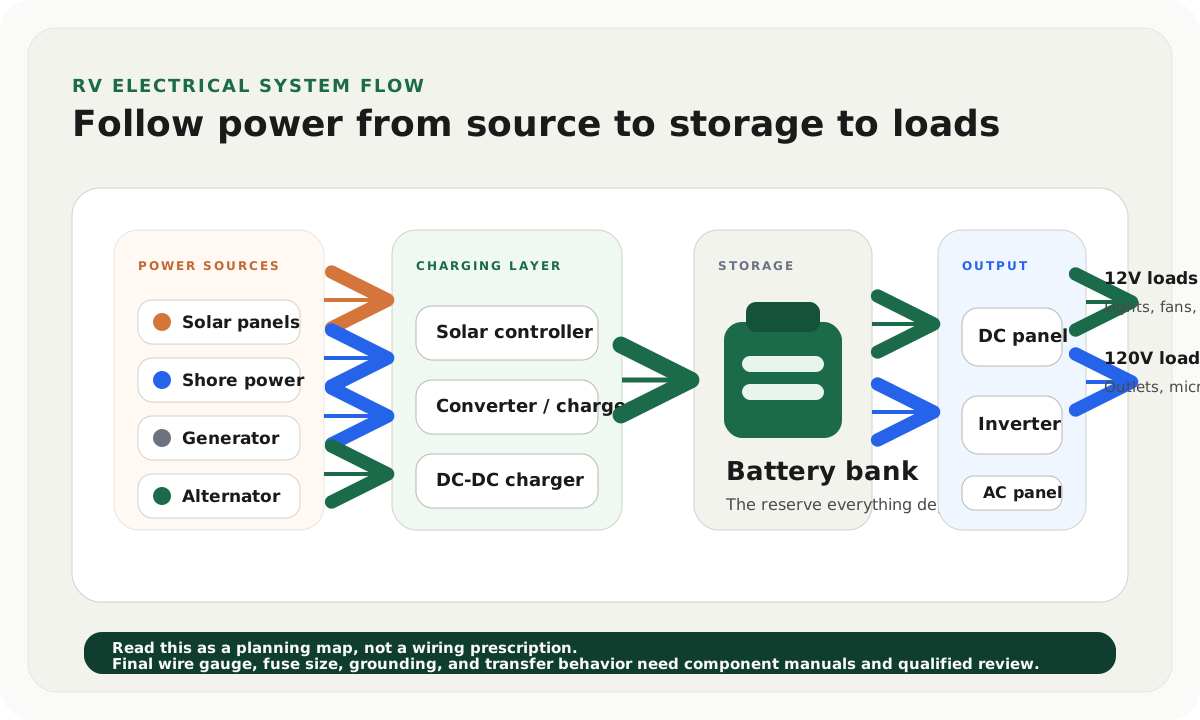
This is where the RV electrical system diagram helps. It gives you a mental map for separating battery bank, disconnects, DC distribution, inverter paths, and direct-to-battery accessories.
Common mistakes when hunting battery drain
The most common mistake is assuming the battery is bad because it is low.
A battery can be low because it is old, undersized, undercharged, cold, sulfated, or in a lithium protection state. It can also be low because the RV kept using power while parked.
Other mistakes are just as expensive:
- Replacing the battery before measuring the draw.
- Leaving the inverter on and calling the drain "mysterious."
- Trusting the factory disconnect without checking current at the battery.
- Measuring voltage only and never measuring amps.
- Pulling multiple fuses at once and losing the circuit clue.
- Forgetting aftermarket gear wired directly to the battery.
- Treating a solar maintainer as a cure for a large drain.
- Ignoring a warm wire, hot fuse holder, or repeated blown fuse.
If the battery is also not recovering from shore power, solar, or alternator charging, use the RV battery not charging troubleshooting guide. Parasitic draw and weak charging can stack together and make each other look worse.
Symptom-first troubleshooting table
Use the symptom to pick the next test.
Compare
RV battery drain symptoms and likely next checks
Use one comparison matrix to scan the practical differences. Small screens stack each row; wider screens keep the first column pinned.
| Spec | Most likely clue | First useful test | What not to do first |
|---|---|---|---|
| Battery dies in storage | Disconnect does not isolate everything, or a small normal draw runs for weeks | Measure current with the disconnect off, then identify direct-to-battery loads | Do not buy a larger battery just to feed an unknown storage drain |
| Battery drops hard overnight | Inverter standby, fridge, furnace blower, router, CPAP, or a forgotten DC load | Turn off each overnight load deliberately and compare net current | Do not assume the solar system failed while the sun was down |
| Solar never catches up | Daily loads plus standby draw exceed solar harvest | Compare daily watt-hours from loads with actual controller harvest | Do not add panels until you know whether the load side is reasonable |
| Disconnect off, battery still drains | Safety circuits, solar path, stereo memory, steps, or aftermarket direct wiring | Measure current at the battery and trace circuits that bypass the switch | Do not assume the switch is defective until you know what it is designed to isolate |
| Drain started after a modification | Accessory, monitor, charger, relay, or wiring path added outside the normal panel | Temporarily disable the new device according to its manual and remeasure | Do not leave unfused direct-battery wiring in place because it seems convenient |
Decide whether to fix, isolate, or maintain
Not every draw needs to be eliminated.
A propane detector should not be casually disabled just because it uses power. A battery monitor may be worth its tiny draw because it prevents much larger mistakes. A solar controller may need battery-side power to manage the system correctly.
The practical choices are:
- Fix the draw if it is unexpected, unsafe, excessive, or caused by a forgotten accessory.
- Isolate the draw if the rig is going into storage and the load does not need to stay powered.
- Maintain the battery if a small required standby load must remain active.
- Redesign the circuit if an aftermarket device bypasses the fuse panel, disconnect, or serviceable wiring path.
For storage, confirm the battery manufacturer's guidance. Lead-acid batteries and lithium batteries have different storage preferences, and lithium batteries may have BMS behavior that changes how a true disconnect should be handled.
If this is part of your first round of upgrades, pair this guide with first off-grid upgrades for an RV. Cleaning up idle loads is one of the cheapest ways to make the existing battery bank feel more predictable before you buy a bigger one.
Final thought
RV parasitic draw is not automatically a defect. It is a time problem.
A few small standby loads can be normal on a camping weekend and damaging during a month of storage. Measure the amps, convert them to daily battery loss, isolate one circuit at a time, and only then decide whether the answer is repair, isolation, better monitoring, or a different storage routine.
Sources and verification notes
- Department of Energy guidance on standby power helped frame why small always-on loads matter over time: Low standby power requirements and resources.
- Department of Energy appliance-use math supports the watts, amps, and watt-hour formulas used in this guide: Estimating appliance and home electronic energy use.
- Fluke's multimeter fuse guidance informed the warning about inline current testing and meter fuse limits: How to choose the correct fuse for your tester.
Frequently asked
Questions RVers usually ask next.
How much parasitic draw is normal in an RV?
A small continuous draw can be normal because detectors, memory circuits, control boards, solar controllers, and battery monitors may stay awake. As a rough first-pass range, 0.05-0.30A is not unusual, but the right answer depends on the exact rig. Anything around 0.5A or higher deserves closer attention because it can remove about 12Ah per day.
Will the battery disconnect switch stop all parasitic draw?
Not always. Some RVs leave safety devices, stereo memory, steps, solar equipment, or direct-wired accessories connected after the coach disconnect is off. The only reliable answer is to measure current at the battery with the disconnect off.
Can a propane detector drain an RV battery?
Yes, over enough time. A propane detector is usually a small load, but it runs continuously. Do not disable safety equipment casually; instead, maintain the battery during storage or use a proper full-isolation strategy if the rig will sit unattended.
Should I pull fuses to find RV battery drain?
Yes, but only after measuring the total draw and only one fuse at a time. Pull the fuse, watch the current change, reinstall it, and label the result. Do not use this method on high-current battery or inverter cables.
Is inverter idle draw a parasitic load?
It can be. If the inverter is left on while no AC appliance is being used, its standby consumption still comes from the battery bank. Inverter idle draw is one of the first things to check when an RV loses more battery overnight than the small DC loads should explain.
Freshness note
Last checked April 10, 2026
This topic can change when products, plans, prices, campsite rules, or fit guidance move. These notes show what was reviewed most recently.
This review included
- Checked standby-load framing against Department of Energy low-standby-power guidance and the site's RV appliance wattage chart.
- Checked current-measurement safety language against Fluke multimeter fuse guidance and kept the workflow clamp-meter-first where possible.
- Linked the guide into the battery sizing, battery-not-charging, battery monitor, electrical diagram, and first-upgrade paths.
Recent change log
April 10, 2026
Published an RV parasitic draw diagnostic guide with normal standby loads, measurement workflow, circuit-isolation sequence, and fix-or-ignore thresholds.
April 10, 2026
Added a custom parasitic draw visual so readers can turn small amp readings into daily battery loss.
Broader editorial corrections are tracked on the Corrections and Updates page.