Shortlist first
Use this to find the winner first, then compare the alternates only if their tradeoffs fit your rig better.
Shortlist labels are editorial recommendations, not popularity rankings. Fit score still matters, but the label tells you why each pick made this guide.
How fit scores work
Scores are editorial fit scores, not user-review averages. The rubric weighs stated RV-use fit, verified specs and limits, whole-rig friction, visible downsides or support risk, and value for the specific job in this guide. Read the full scoring rubric.
If you need one baseline option before reading the full guide, start with Victron SmartSolar MPPT 100/30 for best polished 30a controller.
The first option to evaluate if you want the strongest all-around fit for this guide. Check the other cards only if their award label matches your constraint better.
| Product | Why shortlisted | Fit score | Key spec | Best for | Actions |
|---|---|---|---|---|---|
| Victron SmartSolar MPPT 100/30 Links to: Victron SmartSolar MPPT 100/30 | Best overall The first option to evaluate if you want the strongest all-around fit for this guide. | 4.8 / 5 fit scoreScore rubric | EUR 137.00 ex VAT Q2 list | 100V PV | 30A | 12/24V | Bluetooth | Best polished 30A controller | Read Victron SmartSolar MPPT 100/30 notesCheck listing at VictronMerchant link - direct listing. Verify price and specs at Victron. |
| Renogy Rover Li 40A Links to: Renogy Rover Li 40 Amp MPPT Solar Charge Controller | Best value The pick that balances capability and cost pressure best for this decision. | 4.6 / 5 fit score | $205.99 bare | 100V PV | 40A | 12/24V | lithium profiles | Best direct-buy 40A value | Read Renogy Rover Li 40A notesCheck listing at RenogyMerchant link - direct listing. Verify price and specs at Renogy. |
| EPEVER Tracer4210AN G3 Links to: EPEVER Tracer4210AN G3 MPPT Charge Controller | Best value The pick that balances capability and cost pressure best for this decision. | 4.4 / 5 fit score | Price varies | 100V PV | 40A | 12/24V | RS485 + LCD | Best configurable budget 40A controller | Read EPEVER Tracer4210AN G3 notesCheck listing at EPEVERMerchant link - direct listing. Verify price and specs at EPEVER. |
Must read before you buy a controller
Read the RV solar installation guide before ordering the controller. The right MPPT size depends on the real roof layout, cable entry, wire route, battery location, protection plan, and commissioning checks, not only the panel watts on a product page.
Why this comparison exists
MPPT charge controllers look simple until you wire the roof.
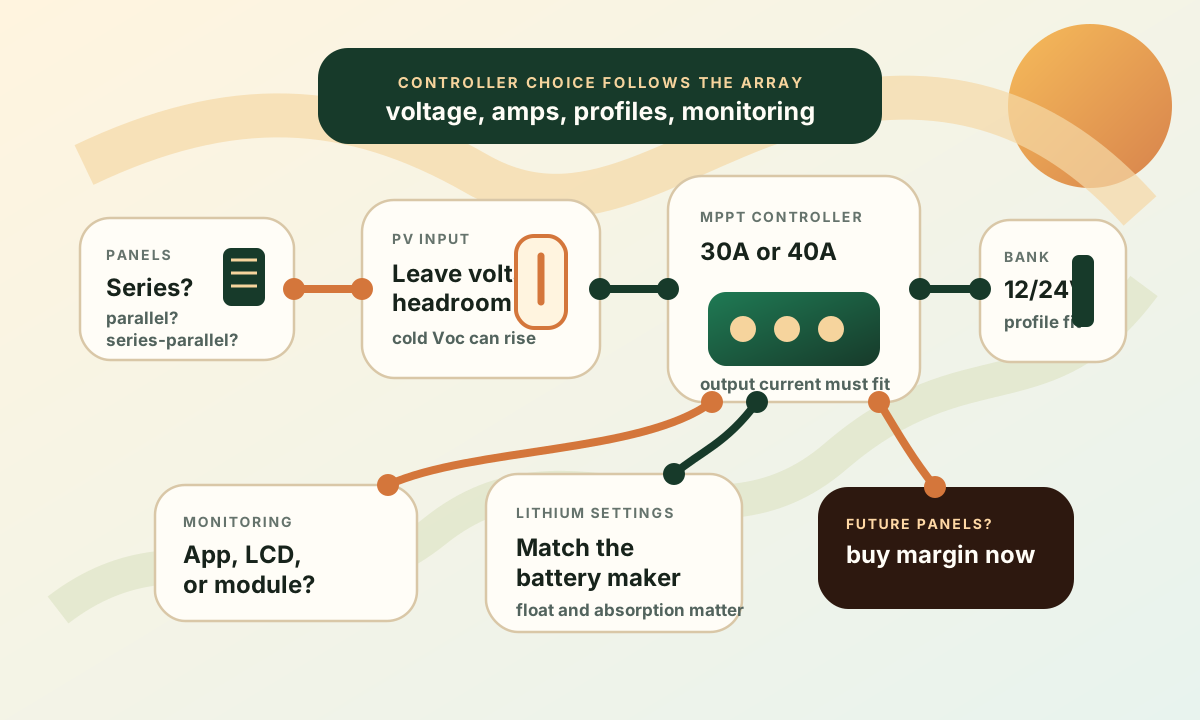
The shopping page asks you to pick 30A or 40A. The actual RV asks a better set of questions:
- how many panels fit around vents, antennas, and air conditioners
- whether those panels are wired in series, parallel, or series-parallel
- what the cold-weather open-circuit voltage will be
- whether the battery bank is 12V or 24V
- whether lithium settings can match the battery maker's charging guidance
- whether you want app-based monitoring or are happy with a small LCD and add-on modules
That is why this guide compares three exact controllers that often show up in real RV solar builds: the Victron SmartSolar MPPT 100/30, the Renogy Rover Li 40A, and the current EPEVER Tracer4210AN G3.
If you are still deciding how many panels the rig needs, start with how many solar watts you need and run the solar calculator before you buy a controller. If the array layout is the fuzzy part, the RV solar wiring diagram and series-vs-parallel RV solar wiring guide should come before checkout.
Price and source note
Prices and specs below were checked against official manufacturer pages on April 11, 2026. Victron publishes a EUR ex-VAT price list rather than one direct US checkout price, Renogy publishes current direct US pricing, and EPEVER did not publish a fixed direct price on its official product page when checked.
Controller sizing follows the array wiring
The controller has two different jobs, and both matter.
On the panel side, it must safely accept the array voltage. That means checking the controller's maximum PV open-circuit voltage against the way your panels are wired and the voltage rise that happens in cold weather. A 100V controller can be plenty for many RV arrays, but it is not a blank check for any series string you can imagine.
On the battery side, it must deliver controlled charging current without living at its ceiling all day. A 30A controller on a 12V bank is a different animal than a 30A controller on a 24V bank because battery-side current changes with system voltage.
That is why a 30A controller can make sense for a compact 12V roof array, while a 40A controller can be the calmer choice for a 12V system that may grow past the first few panels.
MPPT charge controller decision checkpoints
Use these before comparing price. The best controller is the one that fits the array, battery bank, monitoring routine, and expansion plan.
Array wiring
Start here
Series wiring raises voltage, parallel wiring raises current, and series-parallel does both. The controller has to fit the actual layout.
PV voltage headroom
Do not crowd 100V
Check panel Voc, cold-weather voltage rise, and the controller's maximum PV input before a series string goes on the roof.
Output current
30A vs 40A matters
A 40A controller gives a 12V RV more battery-side current headroom than a 30A controller, especially if the array may expand.
Battery profile fit
Lithium is not generic
Make sure the absorption, float, and temperature behavior can match the battery manufacturer's charging guidance.
Monitoring
Built-in beats forgotten
Bluetooth, a remote display, or RS485 modules matter because the controller is also your first solar diagnostic tool.
Install environment
Ventilation counts
A controller mounted in a sealed, hot compartment can underperform even when the spec sheet looks correct.
30A versus 40A in RV terms
The easiest way to misunderstand controller amperage is to treat it like panel wattage.
A 30A controller is not automatically "for 300W" and a 40A controller is not automatically "for 400W." The battery bank voltage changes the math. A 30A MPPT controller on a 12V system often lands in the neighborhood of a mid-size roof array. On a 24V battery bank, the same output current supports roughly twice the charging power because the battery voltage is higher.
The practical RV tradeoff is expansion margin. If you know the system will stay compact, a Victron 100/30 can be a clean, high-confidence controller. If you are building around a 12V bank and suspect you may add panels later, a 40A controller gives you more room before the controller becomes the bottleneck.
Do not solve that by intentionally overpaneling without understanding the manual. Some controllers tolerate panel wattage above the nominal charge power within limits, but that is a design decision, not a casual shortcut.
PV voltage headroom is where tidy plans fail
MPPT controllers make higher-voltage array layouts possible, and that is one reason RVers like them. Higher PV voltage can reduce voltage drop pressure on the roof-to-controller run and make some wiring cleaner.
The catch is that solar panel open-circuit voltage rises in cold weather. A series string that looks fine at room temperature can push closer to the controller's PV input ceiling on a cold clear morning. That matters with all three controllers in this guide because each sits in the 100V PV class.
Use panel Voc, not just watts, when planning the string. Then add cold-weather margin. If that makes your planned series string too close to 100V, change the wiring layout or choose a higher-voltage controller.
The controller should not be asked to absorb a design mistake. It should be selected after the array wiring is already honest.
Lithium support still needs setting discipline
All three controllers here support lithium in some form, but "supports lithium" is not the end of the check.
Lithium batteries usually need charge settings that match the battery manufacturer's guidance. You should compare:
- absorption voltage
- float voltage or whether float should be reduced
- temperature compensation behavior
- low-temperature charging protections elsewhere in the system
- whether the controller can wake or recover a protected battery
This is especially important if the battery bank is being upgraded from AGM or flooded lead-acid. The controller may have been fine for the old bank and still be poorly configured for the new one.
If the battery plan is still in motion, pair this buyer guide with the battery sizing guide and the lithium-vs-AGM comparison. The controller should follow the bank you are actually building, not the bank the RV came with.
Monitoring is not a luxury feature
The charge controller is one of the first places you look when solar harvest feels weak.
Built-in Bluetooth matters because it makes checking panel voltage, battery voltage, charge state, history, and settings easy enough that you will actually do it. That is Victron's big advantage here. Renogy can do app monitoring, but the BT-2 module is an add-on unless you buy a bundle. EPEVER can use PC software, an app, a remote meter, or communication modules, but that is a more DIY-flavored path.
If you are the kind of owner who likes settings and does not mind accessories, EPEVER can be a strong value. If you want the diagnostic path to be obvious on a travel day, the Victron app ecosystem is the calmer pick.
Official product and source-check links
These are the source pages used for the April 11, 2026 check. Reopen them before checkout because controller specs, module bundles, and prices can change.
Pre-arrival checks
Check the exact suffix
Model names can hide bundle, terminal, or generation differences. Match the label on the unit to the spec sheet.
Check the monitoring bundle
A controller that needs a Bluetooth dongle, BT-2 module, remote meter, or Wi-Fi module may cost more than the first price suggests.
Check panel Voc in cold weather
Do not let a 100V input rating become a guess. Calculate the cold string voltage before wiring panels in series.
Compare
Exact 30-40A MPPT charge controller specs compared
Use one comparison matrix to scan the practical differences. Small screens stack each row; wider screens keep the first column pinned.
| Spec | Victron SmartSolar 100/30 | Renogy Rover Li 40A | EPEVER Tracer4210AN G3 |
|---|---|---|---|
| Price checked | EUR 137.00 ex VAT official 2026-Q2 list; US dealer pricing varies | $205.99 bare controller; $242.99 with BT-2; $274.99 with BT-2 and Battery Sense | Price varies; official EPEVER product page did not publish fixed direct pricing |
| Rated charge current | 30A | 40A | 40A |
| Battery voltage support | 12/24V auto select | 12/24V auto recognition | 12/24V auto recognition |
| Max PV open-circuit voltage | 100V | 100VDC | 100V at minimum operating temperature; 92V at 25 deg C |
| PV power reference | 440W at 12V; 880W at 24V | 520W at 12V; 1040W at 24V | 520W at 12V; 1040W at 24V |
| Efficiency claim | Up to 98% | Up to 98% conversion; 99% tracking | Up to 98% conversion; >99.5% tracking |
| Battery types | Configurable charge profiles, including lithium-friendly settings | Sealed, Gel, Flooded, Lithium | Lead-acid and lithium, including LiFePO4 and Li-NiCoMn profiles |
| Monitoring | Bluetooth built in plus VE.Direct | RS485/RJ12; BT-2 required for app monitoring unless bundled | LCD plus RS485; PC software, app, remote meter, Wi-Fi/4G modules optional |
| Dimensions and weight | 130 x 186 x 70 mm; 1.3 kg | 238 x 172 x 77 mm; 2.0 kg / 4.41 lb | 252 x 180 x 63 mm; 1.65 kg |
| Warranty coverage | Standard 5-year Victron power-product warranty | 3-year material and workmanship warranty | Warranty conditions page linked by EPEVER; verify distributor handling before purchase |
The shortlist
- Latest product check
- Specs, fit notes, and current listing context were reviewed April 11, 2026.
- Evidence label
- Spec-verified: Score is based on current published specs, official documentation, pricing context, compatibility, and RV-use fit analysis.
- Price context
- Pricing and availability can change, so confirm the merchant listing before buying.
Product facts last checked April 11, 2026
Victron SmartSolar MPPT 100/30
Editorial fit score
The Victron SmartSolar MPPT 100/30 is the controller I would start with for a compact-to-midsize RV roof array where 30A is enough. The official 2026-Q2 Victron price list shows EUR 137.00 ex VAT, while US street pricing is dealer-variable. The draw is not just the spec sheet: 100V PV input, 30A output, 12/24V support, built-in Bluetooth, VE.Direct, a standard 5-year power-product warranty, and a strong app ecosystem make it easier to verify settings and diagnose weak harvest.
Review verdict
- Short verdict
- The cleanest 30A recommendation when the array fits the output limit and you value built-in Bluetooth, strong documentation, and a calmer diagnostic path.
- Evidence used
- Spec-verified
- Score is based on current published specs, official documentation, pricing context, compatibility, and RV-use fit analysis.
- Why it made the shortlist
- Best overall
- The first option to evaluate if you want the strongest all-around fit for this guide.
- Best if
- Best polished 30A controller
- Why not this product?
- If you already know the roof may grow beyond the 30A comfort zone, start with a larger controller.
- Watch for
- 30A output can be tight for a growing 12V roof array
- Product check date
- Specs, fit notes, and current listing context were last checked April 11, 2026.
Key specs
- Price checked
- EUR 137.00 ex VAT Q2 list
- Charge current
- 30A
- Max PV voltage
- 100V
- Battery voltage
- 12/24V auto select
Score basis
Score is based on current published specs, official documentation, pricing context, compatibility, and RV-use fit analysis. These are editorial fit scores, not customer-review averages. Read the scoring rubric.
- RV-use fit
- 30% weight
- Verified specs and limits
- 25% weight
- Whole-rig friction
- 20% weight
- Downsides and support risk
- 15% weight
- Value for the job
- 10% weight
How directly the product solves the specific off-grid RV job in this guide.
Capacity, dimensions, electrical limits, protection claims, and compatibility constraints we can verify from current sources.
Install effort, storage, wiring, service access, weight, refill workflow, or daily-use hassle.
Known tradeoffs, unclear claims, warranty coverage, support risk, and wrong-buyer failure modes.
Whether the price makes sense after fit, specs, and tradeoffs still hold.
Testing limits
- This is not a hands-on endurance or lab test unless the review explicitly says so.
- Specs, pricing, bundles, and availability can change, so confirm the current listing and manual before buying.
Reasons to buy
- Built-in Bluetooth makes monitoring and setup easier than add-on-module systems
- Strong fit for RVers who want clean app diagnostics and good documentation
- 5-year standard warranty on Victron power products
- Compact enclosure compared with the 40A alternatives here
Watch-outs
- 30A output can be tight for a growing 12V roof array
- US price is dealer-variable rather than one official checkout number
- No front display, so the app or connected ecosystem becomes the normal interface
- The Victron ecosystem can tempt buyers into extra accessories they may not need yet
Whole-bank math
Why it wins
Monitoring and setup clarity
Built-in Bluetooth means the controller is easy to check before a small solar problem becomes guesswork.
Best buyer
RVer whose array fits 30A
Great for a disciplined build where 30A is enough and a future jump to 40A or 50A is not likely.
Skip if
12V expansion is likely
If you already know the roof may grow beyond the 30A comfort zone, start with a larger controller.
Related parts and setup checks
Solar calculator
Use this before buying to see whether your daily loads justify a 30A controller or a larger output path.
Open Solar calculatorSeries-vs-parallel wiring guide
Use this to make sure the planned string voltage fits the 100V PV input class with cold-weather margin.
Open Series-vs-parallel wiring guideSolar charge controller guide
Helpful if you are still deciding whether MPPT, controller placement, and settings are understood well enough.
Open Solar charge controller guideCheck current listing
Victron SmartSolar MPPT 100/30
Use the listing after the fit notes make sense for your rig. Pricing and availability can change, so verify the merchant page before buying.
- Latest product check
- Specs, fit notes, and current listing context were reviewed April 11, 2026.
- Evidence label
- Spec-verified: Score is based on current published specs, official documentation, pricing context, compatibility, and RV-use fit analysis.
- Price context
- Pricing and availability can change, so confirm the merchant listing before buying.
Product facts last checked April 11, 2026
Renogy Rover Li 40 Amp MPPT Solar Charge Controller
Editorial fit score
The Renogy Rover Li 40A is the practical 40A pick for many RVers because Renogy publishes direct US pricing and the specs are easy to understand: 100VDC max PV input, 40A output, 12/24V auto recognition, lithium support, 520W at 12V or 1040W at 24V, and a 3-year material and workmanship warranty. The bare controller showed $205.99 when checked, with higher-priced BT-2 bundles available. The main watchout is monitoring: do not assume app access is included unless the bundle says so.
Review verdict
- Short verdict
- The direct-buy 40A value pick when you want more 12V array headroom than a 30A controller and are fine confirming whether Bluetooth is included in the bundle.
- Evidence used
- Spec-verified
- Score is based on current published specs, official documentation, pricing context, compatibility, and RV-use fit analysis.
- Why it made the shortlist
- Best value
- The pick that balances capability and cost pressure best for this decision.
- Best if
- Best direct-buy 40A value
- Why not this product?
- By the time you add the monitoring bundle, the value comparison should be rechecked against Victron and other options.
- Watch for
- Bluetooth app monitoring requires the BT-2 path unless included in the selected bundle
- Product check date
- Specs, fit notes, and current listing context were last checked April 11, 2026.
Key specs
- Price checked
- $205.99 bare
- Charge current
- 40A
- Max PV voltage
- 100VDC
- Battery voltage
- 12/24V auto
Score basis
Score is based on current published specs, official documentation, pricing context, compatibility, and RV-use fit analysis. These are editorial fit scores, not customer-review averages. Read the scoring rubric.
- RV-use fit
- 30% weight
- Verified specs and limits
- 25% weight
- Whole-rig friction
- 20% weight
- Downsides and support risk
- 15% weight
- Value for the job
- 10% weight
How directly the product solves the specific off-grid RV job in this guide.
Capacity, dimensions, electrical limits, protection claims, and compatibility constraints we can verify from current sources.
Install effort, storage, wiring, service access, weight, refill workflow, or daily-use hassle.
Known tradeoffs, unclear claims, warranty coverage, support risk, and wrong-buyer failure modes.
Whether the price makes sense after fit, specs, and tradeoffs still hold.
Testing limits
- This is not a hands-on endurance or lab test unless the review explicitly says so.
- Specs, pricing, bundles, and availability can change, so confirm the current listing and manual before buying.
Reasons to buy
- 40A output gives more 12V headroom than the Victron 100/30
- Official page publishes direct US pricing and bundle prices
- Supports Sealed, Gel, Flooded, and Lithium battery types
- Good fit for a straightforward value-minded RV solar build
Watch-outs
- Bluetooth app monitoring requires the BT-2 path unless included in the selected bundle
- Larger and heavier than the Victron 100/30
- IP32 protection is not a license to mount it in wet or exposed spaces
- Warranty length is shorter than Victron's standard power-product warranty
Whole-bank math
Why it wins
40A value with direct price
It gives a 12V RV more current headroom without jumping into a much pricier controller class.
Best buyer
RVer building 400-500W class 12V solar
Especially useful when the array may grow and 30A feels too close to the edge.
Skip if
You want Bluetooth built in
By the time you add the monitoring bundle, the value comparison should be rechecked against Victron and other options.
Related parts and setup checks
How many solar watts you need
Use this to decide whether the extra 40A headroom is solving real daily demand or just buying unused capacity.
Open How many solar watts you needRV solar installation guide
Controller size is only part of the install. Roof entry, fusing, cable routing, and service access still matter.
Open RV solar installation guideSolar calculator
Run the load math before choosing between the bare controller and the Bluetooth bundle.
Open Solar calculatorCheck current listing
Renogy Rover Li 40 Amp MPPT Solar Charge Controller
Use the listing after the fit notes make sense for your rig. Pricing and availability can change, so verify the merchant page before buying.
- Latest product check
- Specs, fit notes, and current listing context were reviewed April 11, 2026.
- Evidence label
- Spec-verified: Score is based on current published specs, official documentation, pricing context, compatibility, and RV-use fit analysis.
- Price context
- Pricing and availability can change, so confirm the merchant listing before buying.
Product facts last checked April 11, 2026
EPEVER Tracer4210AN G3 MPPT Charge Controller
Editorial fit score
The current EPEVER Tracer AN G3 page lists the Tracer4210AN G3 as the 40A model with 12/24V auto recognition, 100V PV open-circuit rating at minimum operating temperature, 92V at 25 deg C, 520W at 12V, 1040W at 24V, lithium and lead-acid support, an LCD, RS485 communication, and optional PC, app, remote meter, Wi-Fi, or 4G monitoring paths. The official page did not publish a fixed direct price when checked, so the buyer has to verify current dealer pricing and support. It is a strong value candidate, but not the most beginner-proof choice.
Review verdict
- Short verdict
- The configurable 40A value pick for DIY owners who are comfortable verifying the exact G3 model, adding monitoring hardware if needed, and checking distributor support before buying.
- Evidence used
- Spec-verified
- Score is based on current published specs, official documentation, pricing context, compatibility, and RV-use fit analysis.
- Why it made the shortlist
- Best value
- The pick that balances capability and cost pressure best for this decision.
- Best if
- Best configurable budget 40A controller
- Why not this product?
- If you want a simple app, one clear merchant page, and obvious warranty routing, Victron or Renogy may feel calmer.
- Watch for
- Official page did not publish a fixed direct price when checked
- Product check date
- Specs, fit notes, and current listing context were last checked April 11, 2026.
Key specs
- Price checked
- Price varies
- Charge current
- 40A
- Max PV voltage
- 100V cold / 92V at 25 deg C
- Battery voltage
- 12/24V auto
Score basis
Score is based on current published specs, official documentation, pricing context, compatibility, and RV-use fit analysis. These are editorial fit scores, not customer-review averages. Read the scoring rubric.
- RV-use fit
- 30% weight
- Verified specs and limits
- 25% weight
- Whole-rig friction
- 20% weight
- Downsides and support risk
- 15% weight
- Value for the job
- 10% weight
How directly the product solves the specific off-grid RV job in this guide.
Capacity, dimensions, electrical limits, protection claims, and compatibility constraints we can verify from current sources.
Install effort, storage, wiring, service access, weight, refill workflow, or daily-use hassle.
Known tradeoffs, unclear claims, warranty coverage, support risk, and wrong-buyer failure modes.
Whether the price makes sense after fit, specs, and tradeoffs still hold.
Testing limits
- This is not a hands-on endurance or lab test unless the review explicitly says so.
- Specs, pricing, bundles, and availability can change, so confirm the current listing and manual before buying.
Reasons to buy
- 40A output and 100V PV class at a budget-oriented position
- LCD gives local status without requiring a phone for every glance
- Supports lead-acid and lithium battery profiles, including LiFePO4
- RS485 path can fit owners who want remote meters, software, or modules
Watch-outs
- Official page did not publish a fixed direct price when checked
- Monitoring can require extra modules and more setup work
- Model naming and generation details require careful matching before purchase
- Warranty and support handling should be verified with the seller or distributor
Whole-bank math
Why it wins
Configurable 40A value
It offers the key 40A/100V shape without forcing app-first monitoring.
Best buyer
Hands-on DIY owner
Best when you are comfortable checking settings, matching model numbers, and adding modules only if needed.
Skip if
You need a frictionless support path
If you want a simple app, one clear merchant page, and obvious warranty routing, Victron or Renogy may feel calmer.
Related parts and setup checks
Series-vs-parallel wiring guide
This matters because a 100V PV class controller can still be pushed too hard by the wrong cold-weather series string.
Open Series-vs-parallel wiring guideRV solar charge controller guide
Use this if you want the controller sizing and settings sequence before choosing a more DIY-flavored product.
Open RV solar charge controller guideSolar calculator
Use load math to decide whether 40A is enough or whether the whole array plan belongs in a bigger controller class.
Open Solar calculatorCheck current listing
EPEVER Tracer4210AN G3 MPPT Charge Controller
Use the listing after the fit notes make sense for your rig. Pricing and availability can change, so verify the merchant page before buying.
Which one should you buy?
Buy the Victron SmartSolar MPPT 100/30 if your array fits the 30A output limit and you want the least-fussy monitoring and setup experience. It is the controller I would choose for a compact RV array where the owner wants to see what is happening without turning every solar question into a wiring archaeology project.
Buy the Renogy Rover Li 40A if you want a straightforward 40A controller with published direct pricing and enough headroom for a bigger 12V roof array. It is the better fit when 30A feels tight and you are already comfortable checking whether the selected bundle includes Bluetooth.
Buy the EPEVER Tracer4210AN G3 if you want a configurable 40A controller and are comfortable doing a little more verification before checkout. It can be a smart value, but it asks more from the buyer: exact model confirmation, monitoring accessory decisions, and distributor support checks.
Skip all three if your planned series string pushes too close to 100V in cold weather or if your roof array is clearly heading beyond the 30-40A class. In that case, the right answer is not forcing one of these to fit. It is choosing a higher-voltage or higher-amperage controller class and designing the array around it.
The mistake most RVers make
The mistake is buying the controller before the array wiring is real.
That usually starts with a panel count: "I want 400W, so I need a 40A controller." Sometimes that works. Sometimes the roof layout, cold-weather voltage, battery voltage, and charging goals make the answer different.
The better sequence is calmer:
- list the daily loads
- choose a realistic solar wattage target
- map the roof and panel wiring
- calculate cold-weather string voltage
- choose the battery bank voltage and chemistry
- select the controller that fits the whole design
- leave enough margin that the controller is not the next upgrade
That sequence is less exciting than ordering parts in one cart, but it prevents the expensive version of "almost right."
Final thought
The best MPPT charge controller for an RV is the one that disappears into a well-designed system. If the array wiring, PV voltage headroom, battery profile, monitoring routine, and expansion plan are honest, any of these three can make sense. If those pieces are still guesses, pause the purchase and do the system math first.
Frequently asked
Questions RVers usually ask next.
Is a 30A MPPT charge controller enough for an RV?
A 30A MPPT controller can be enough for a compact RV solar array, especially when the array is fixed and expansion is unlikely. It can feel tight on a 12V system if you plan to grow into a larger roof array, so check battery-side current before buying.
Can I use a 40A controller with fewer panels?
Yes, using a 40A controller with a smaller array is usually fine as long as the controller matches the battery voltage and panel input limits. The downside is paying for capacity you may not use, but that can be smart if future expansion is likely.
Does MPPT mean I can wire any panels in series?
No. MPPT gives you more flexibility, but the controller still has a maximum PV open-circuit voltage. Use the panel Voc, cold-weather voltage rise, and controller limit before wiring a series string.
Do I need Bluetooth on an RV solar charge controller?
You do not need Bluetooth for charging to work, but easy monitoring makes diagnosis much easier. If harvest drops, app or remote monitoring helps you separate panel voltage, battery acceptance, settings, and controller behavior instead of guessing.
Which is better for RVs, Victron, Renogy, or EPEVER?
Victron is usually the calmer monitoring and documentation choice, Renogy is often the easier direct-buy value path, and EPEVER can be a good configurable budget option for hands-on owners. The best choice depends on output current, monitoring expectations, support path, and whether the array may grow.
Helpful next reads
- How to wire RV solar in series vs. parallel
- How many solar watts do you need for an RV?
- Solar calculator
Freshness note
Last checked April 11, 2026
This topic can change when products, plans, prices, campsite rules, or fit guidance move. These notes show what was reviewed most recently.
This review included
- Verified official specs for Victron SmartSolar MPPT 100/30, Renogy Rover Li 40A, and EPEVER Tracer4210AN G3.
- Checked current direct pricing where manufacturers publish it, including Victron's 2026-Q2 EUR price list and Renogy's current direct product page.
- Reviewed PV voltage limits, output amperage, supported battery voltages, lithium support, monitoring path, dimensions, weight, efficiency claims, and warranty coverage.
Recent change log
April 21, 2026
Added pre-purchase routing to the RV solar installation guide before controller buyers choose a parts path.
April 11, 2026
Published exact MPPT charge-controller comparison with official specs and current pricing context.
Broader editorial corrections are tracked on the Corrections and Updates page.


