Start with the system path
An RV solar wiring diagram is useful only if it shows the full path, not just panel-to-panel jumpers.
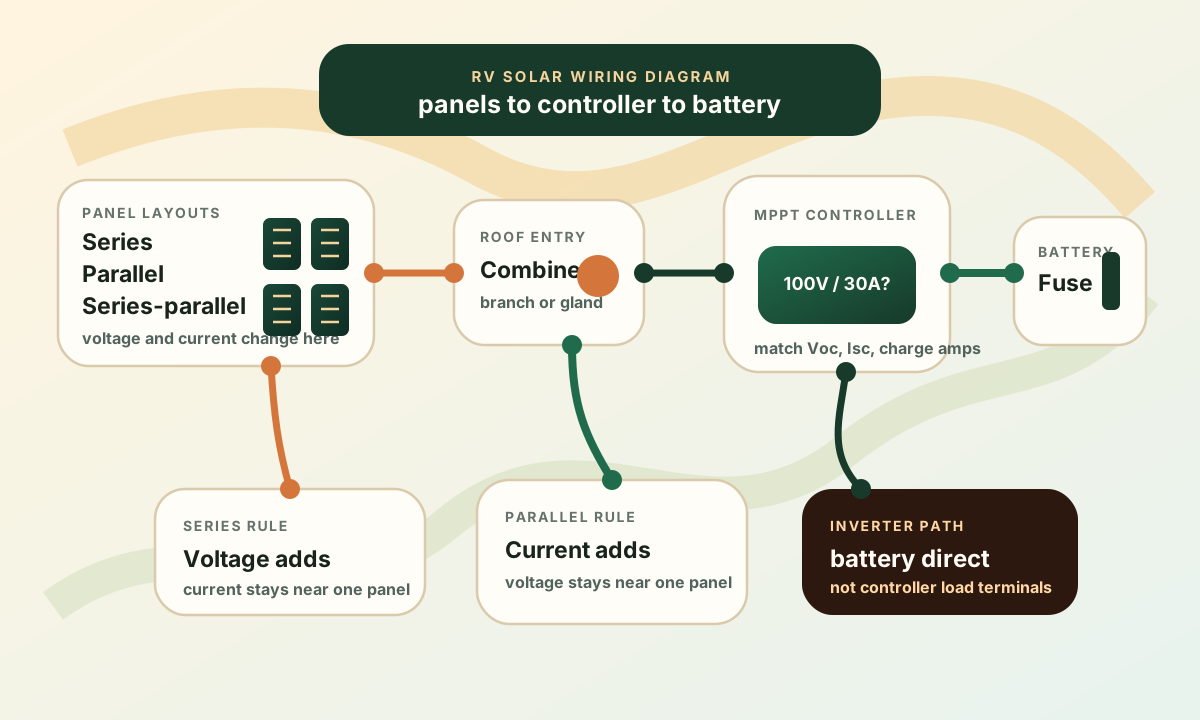
The basic path looks like this:
- solar panels on the roof or portable input
- series, parallel, or series-parallel panel connections
- branch connectors, combiner, or junction point where needed
- roof gland or sidewall entry
- PV disconnect or breaker where the design requires one
- MPPT charge controller
- battery-side fuse or breaker close to the battery
- battery bank, bus bars, and shunt if used
- inverter or DC distribution after the battery, not from the controller's load terminals
That order matters because the charge controller is the translator between the array and the battery. It is not a generic pass-through box. It has maximum PV voltage, maximum PV current, maximum charge current, battery voltage support, and charging-profile limits.
If you are still deciding how large the array should be, start with how many solar watts your RV needs or run the solar calculator. Wiring comes after the daily load target is honest.
For the broader build sequence, keep this page next to the solar power hub so the wiring plan stays connected to sizing, controller choice, troubleshooting, and installation order.
RV solar wiring diagram checkpoints
Use these before choosing series, parallel, or series-parallel wiring. The best diagram is the one the controller, roof, and battery bank can all support.
Panel layout
Series, parallel, or hybrid
The layout decides whether voltage rises, current rises, or both.
Controller voltage
Check PV Voc
The cold-weather open-circuit voltage of the string must stay below the controller's PV limit.
Controller current
Check PV Isc
Parallel branches add short-circuit current, which affects wire, breaker, and controller input limits.
Battery side
Fuse close to battery
The controller-to-battery run needs protection sized to the real current and cable.
Roof entry
Plan service access
A clean diagram should show where the array enters the RV and how it can be disconnected for service.
Expansion
Leave headroom
A wiring plan that maxes out voltage or current on day one leaves little room for future panels.
What series wiring does
Series wiring connects the positive lead of one panel to the negative lead of the next panel. The string's voltage adds, while current stays close to the current of one panel in that string.
That makes series wiring attractive when the roof-to-controller run would benefit from higher voltage and lower current. It can reduce voltage-drop pressure on the panel side, especially on a tidy matched-panel string.
The risk is controller voltage headroom. Victron explains its MPPT model names plainly: the first number is the maximum PV open-circuit voltage and the second is maximum charge current. A 100/30 controller is not just "30 amps." It is also a 100V PV-limit device.
Series wiring can be the right answer when:
- the panels are matched
- the string stays safely below the controller PV voltage limit
- cold-weather Voc has been checked
- roof shade does not regularly hit one panel in the string
- the controller has enough input and output margin
Series wiring is usually the wrong answer when the string voltage is already too close to the controller limit or when one shaded roof zone will drag the whole string down too often.
What parallel wiring does
Parallel wiring connects positives together and negatives together. Voltage stays close to one panel's voltage, while current adds across the branches.
That can make parallel wiring more forgiving when panels see uneven light. It also keeps voltage lower, which can be useful with smaller controllers or portable-panel inputs that cannot accept a high-voltage string.
The tradeoff is current. EPEVER's Tracer AN G3 manual states the practical rule clearly: when PV modules are in series, total short-circuit current equals one module's short-circuit current; when modules are in parallel, total short-circuit current equals the sum of the modules' short-circuit current. That is the part many simple diagrams hide.
Parallel wiring can be the right answer when:
- the array is small
- partial shade is expected
- the controller PV voltage limit is modest
- branch current, wire size, and protection are sized correctly
- serviceability matters more than squeezing every advantage from voltage
Parallel wiring is usually the wrong answer when long runs and high current create avoidable voltage drop or when branch protection is ignored because the diagram looked simple.
What series-parallel wiring does
Series-parallel wiring builds strings in series, then parallels those strings together.
A common example is four similar panels arranged as two panels in series, paralleled with another two-panel series string. Voltage rises compared with all-parallel wiring, but current also rises compared with one simple series string.
This is often the realistic middle ground on RV roofs because roof space is awkward. You may have four panels that fit in two clean roof zones, a controller that can handle the voltage, and a cable path that benefits from keeping current lower than all-parallel.
The watchout is matching. The strings should be built from similar panels with similar orientation and shade exposure. A messy hybrid layout can create confusion if one string gets shade and the other does not, or if mismatched panel specs are forced together because the roof layout was decided before the electrical plan.
If you want the deeper tradeoff layer, use the series-vs-parallel RV solar guide. This page gives you the diagram-reading sequence; that guide helps you decide which layout belongs on your roof.
Compare
Series, parallel, and series-parallel wiring behavior
Use one comparison matrix to scan the practical differences. Small screens stack each row; wider screens keep the first column pinned.
| Spec | Series | Parallel | Series-parallel |
|---|---|---|---|
| Voltage | Adds across panels | Stays near one panel | Adds within each string |
| Current | Stays near one panel/string | Adds across branches | Adds across parallel strings |
| Best use | Matched panels, cleaner roof-to-controller run | Small arrays or uneven shade | Larger arrays with controller headroom |
| Main watchout | Cold-weather Voc can exceed controller limit | Higher current affects wire and protection | String matching and controller limits both matter |
| Diagram clue | Panel plus to next panel minus | All positives together, all negatives together | Series strings paralleled at combiner or branch point |
The controller check comes before the roof order
The controller check has three parts.
First, check PV voltage. Add the Voc of panels in each series string, then apply cold-weather margin from the panel data sheet or controller sizing tool. That final number must stay below the controller's maximum PV open-circuit voltage.
Second, check PV current. Add Isc across parallel branches. That number affects wire size, branch protection, breaker choice, and the controller's PV input-current limit.
Third, check battery-side output. The controller's rated charge current is what it can send toward the battery. Victron's 100/30 technical sheet lists 30A rated charge current, 440W nominal PV power at 12V, and 880W at 24V. Renogy's Rover 40A page lists 40A charge current, 100VDC max PV input, and 520W at 12V or 1040W at 24V.
That is why battery voltage changes the diagram. The same controller current supports more watts on a 24V battery bank than on a 12V battery bank. If your diagram ignores battery voltage, it is not finished.
The battery-side fuse is not optional decoration
A clean diagram should show protection on the controller-to-battery run.
The reason is not that the controller is expected to fail. The reason is that the battery can supply high fault current if the cable shorts. Protection belongs close enough to the battery to protect the wire, not merely close to the controller because that was easier to draw.
EPEVER's manual calls for a battery-side fast-acting fuse close to the battery on its Tracer AN G3 wiring instructions. The exact fuse or breaker size still depends on the controller, wire, battery, installation environment, and applicable standards, but the principle is stable: the battery-side conductor needs a protection plan.
Do not run an inverter from a controller load terminal. If an inverter is part of the system, it should connect to the battery system through its own correctly sized cable, fuse or breaker, and disconnect path. The RV electrical system diagram shows that broader flow.
A practical wiring diagram for a 400W class roof array
For a simple 400W class RV roof array using four similar 100W panels, the diagram decision usually starts with three candidate layouts.
All series creates one high-voltage, low-current string. That can be tidy, but it may get too close to the controller voltage limit depending on panel Voc and cold weather. It also makes the string more sensitive when one panel is shaded.
All parallel keeps voltage low and adds current. That can be shade-friendly, but it raises current on the roof side and may need more attention to wire size, branch protection, and voltage drop.
Two series strings in parallel often becomes the middle path. It raises voltage enough to help the run while keeping the string voltage lower than four in series. It also avoids putting every panel in one long shade-sensitive string.
The right answer is not the one with the neatest internet diagram. It is the one whose voltage, current, shade behavior, controller limit, and service access all make sense for your actual roof.
Common mistakes when copying RV solar diagrams
Mistake: using watts when the controller needs volts and amps
Panel wattage is the outcome. Controller safety depends on voltage and current limits. A diagram that says "400W solar" but does not show string Voc and branch Isc is still incomplete.
Mistake: forgetting cold-weather voltage rise
Panel Voc is usually listed at standard test conditions. Cold panels can produce higher voltage. That matters most in series strings where voltages add.
Mistake: placing the controller near the roof entry instead of the battery
The controller should usually be closer to the battery bank than the roof gland. That keeps the battery-side run shorter, which helps charging accuracy and reduces high-current cable distance.
Mistake: leaving out disconnects and service points
A wiring diagram should help you safely service the system later. If the only way to isolate the array is to pull connectors on a sunny roof, the diagram needs more thought.
Mistake: copying a house solar diagram into an RV
RVs move, flex, vibrate, park in shade, and compress equipment into weird compartments. Use manufacturer guidance and RV-specific serviceability, not a generic house-array diagram.
Official wiring and controller references
These are the source pages used for the April 11, 2026 check. Use them to verify the details before turning a generic diagram into an actual wiring plan.
Pre-arrival checks
Use the exact manual
A controller family page is useful, but the final diagram should use the manual for your exact model and revision.
Calculate cold Voc
Do this before committing to series strings, especially with 100V-class controllers.
Protect the battery-side run
The controller-to-battery conductor needs overcurrent protection sized for the actual cable and equipment.
Final thought
A good RV solar wiring diagram should make the system easier to inspect, explain, and troubleshoot. If the drawing shows voltage, current, controller limits, battery-side protection, and service points clearly, it is doing its job. If it only shows panel jumpers, it is a sketch, not a plan.
Frequently asked
Questions RVers usually ask next.
What is the best RV solar wiring diagram for beginners?
The best beginner diagram is the one that shows the full path from panels to controller to battery, not just the panel connections. Start with a small series or parallel layout, then check controller PV voltage, PV current, and battery-side fuse requirements before buying parts.
Should RV solar panels be wired in series or parallel?
It depends on roof shade, cable distance, panel specs, and controller limits. Series raises voltage, parallel raises current, and a hybrid layout can be useful when the roof is larger or awkward.
Can I wire four RV solar panels in series?
Sometimes, but only if the cold-weather open-circuit voltage of the full string stays below the controller's PV limit. With a 100V-class controller, four panels in series can be too close depending on the panel Voc.
Where should the fuse go between the solar controller and battery?
The battery-side protection should be close enough to the battery to protect the conductor from battery fault current. The exact fuse or breaker size depends on the controller rating, wire size, cable length, battery bank, and installation guidance.
Can I connect an inverter to the solar charge controller load terminals?
No, an RV inverter should normally connect to the battery system through its own properly sized cable and protection path. Controller load terminals are not meant to feed high-current inverter loads.
Helpful next reads
- How to wire RV solar in series vs. parallel
- How many solar watts does your RV need?
- Solar calculator
Freshness note
Last checked April 11, 2026
This topic can change when products, plans, prices, campsite rules, or fit guidance move. These notes show what was reviewed most recently.
This review included
- Verified voltage and current rules against official Victron, Renogy, and EPEVER charge-controller documentation.
- Checked controller model-name logic, PV open-circuit voltage limits, rated charge-current limits, and PV short-circuit current guidance.
- Reviewed manufacturer installation cautions for wire size, breaker placement, airflow, polarity, and battery-side protection.
Recent change log
April 11, 2026
Published wiring-diagram guide with verified controller limits, wiring cautions, and protection guidance.
Broader editorial corrections are tracked on the Corrections and Updates page.


