Key takeaways
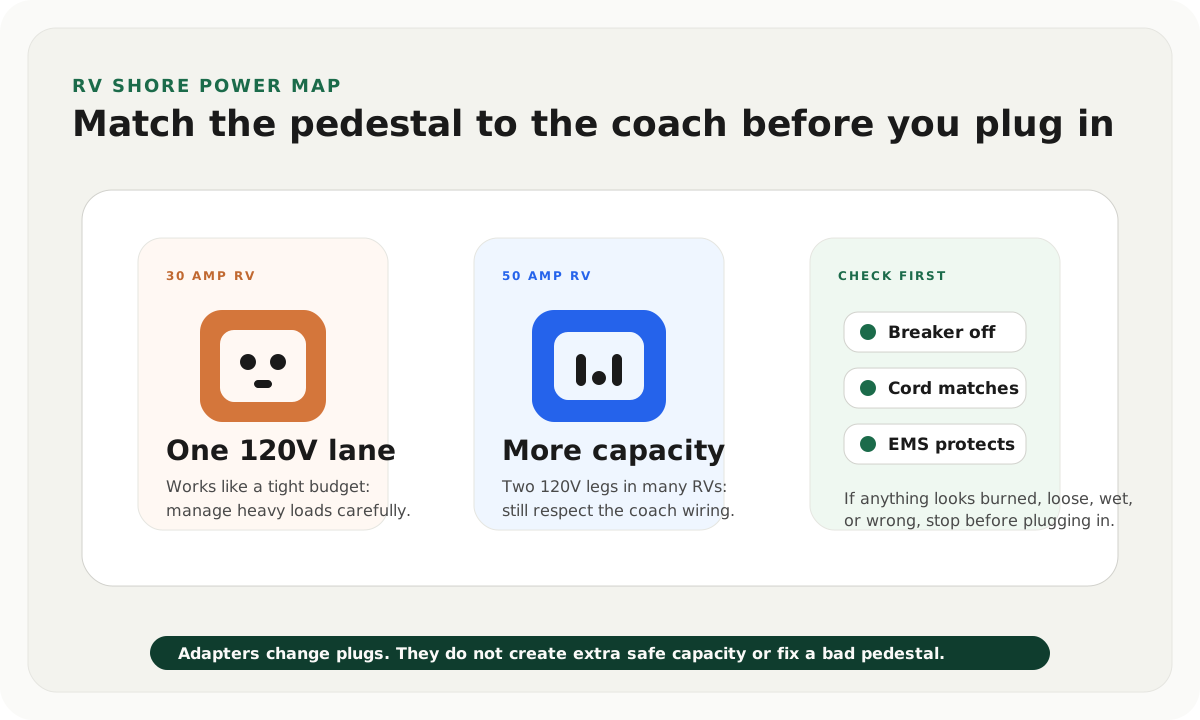
- 30A RV service is usually one 120V leg, so the planning ceiling is about 3,600 watts before safety margin and real-world voltage issues.
- 50A RV service is usually two 120V legs, so the total capacity is much higher, but a real panel can still have leg-balance limits.
- Adapters change plug compatibility, not electrical capacity. A 50A rig plugged into a 30A pedestal still needs to behave like a 30A rig.
Source checks used for this answer
The capacity math is simple, but RV shore-power safety depends on real pedestal wiring, adapters, and loss-of-ground protection.
The short answer
The simple version is:
- 30A RV service: about 3,600 watts
- 50A RV service: about 12,000 total watts
That surprises people because 50A does not mean "just 20 amps more." In RV hookups, 50A service is typically two 120V legs. That is why the total available power is much higher.
Why 50A feels so different
Compare
Compare fast
Use one comparison matrix to scan the practical differences. Small screens stack each row; wider screens keep the first column pinned.
| Spec | 30A RV service | 50A RV service | Adapter reality |
|---|---|---|---|
| Basic capacity | About 3,600W at 120V | About 12,000W total across two legs | Limited by the source, not the plug shape |
| Common fit | Smaller trailers and many modest rigs | Larger rigs with more AC and appliance overlap | Useful for compatibility, not capacity creation |
| Main watchout | AC plus microwave plus charger can trip quickly | Leg balance still matters | A dogbone cannot create missing amps |
| Best planning tool | Load-shedding discipline | Panel awareness and EMS monitoring | Shore-power load calculator |
Worked example: why 30A trips quickly
A 30A RV has about 3,600W available at 120V before real-world safety margin. One rooftop air conditioner, battery charger, microwave, and electric water heater can easily collide inside that ceiling.
The problem is usually not one appliance. It is overlap.
For example:
- air conditioner running load
- converter or inverter-charger refilling batteries
- microwave for lunch
- electric water heater left on
- coffee maker or hair dryer
Any one of those may be fine. Several together may trip the pedestal breaker or the RV main breaker.
That is why 30A camping often becomes a sequencing habit. Run the air conditioner, but pause the microwave. Heat water on propane instead of electric. Reduce charger amps if the inverter-charger allows it. Let the coffee maker finish before the hair dryer starts. None of those habits are glamorous, but they keep the rig comfortable without pretending 30A is more than it is.
On 50A service, the extra capacity makes overlap easier. It does not remove judgment entirely. A 50A panel splits loads across two legs, and a poorly balanced or overloaded leg can still become the limiter even when the total service sounds generous.
What a dogbone adapter can and cannot do
A dogbone can let a plug fit a different pedestal. It cannot make a small source behave like a large source.
If a 50A RV is plugged into a 30A pedestal, the rig still needs to shed loads like a 30A rig. If a 30A RV plugs into a 50A pedestal through the correct adapter, the RV is still limited by its 30A cord, main breaker, and internal wiring.
The adapter also does not fix bad pedestal power. If voltage is low, the outlet is worn, the ground path is questionable, or the breaker is tired, the RV still needs a safer plan. That might mean choosing a different pedestal, using an EMS, reducing load, or leaving the site.
Fit is not capacity
If the adapter makes the plug fit, you still need to check the load. The breaker, cord, pedestal, voltage, ground path, and actual appliance overlap decide whether the setup is safe and usable.
When the answer changes
The answer changes when the RV has two air conditioners, a large inverter-charger, washer/dryer, residential fridge, or electric-heavy habits. Those rigs usually benefit from 50A service when available.
The answer also changes at weak pedestals. A theoretical 3,600W or 12,000W ceiling assumes voltage is healthy and wiring is correct. Low voltage, poor grounding, or worn outlets can make the practical answer lower.
That is why a surge protector or EMS is not just an accessory. Use the RV surge protector guide if you plug into unfamiliar pedestals often.
For a first trip, the safest habit is to assume the pedestal gives you less than the label until you have checked voltage, watched what happens under AC load, and learned which appliances overlap. That habit makes both 30A and 50A camping calmer.
Best next move
Use the shore-power load calculator before assuming the pedestal can carry your plan.
If the calculator is close, turn off electric water heating, reduce charger amps if your system allows it, and avoid running kitchen loads during heavy AC use. For a deeper explanation, read the full 30A vs 50A shore-power guide.
Frequently asked
Questions RVers usually ask next.
Can I plug a 50A RV into a 30A pedestal?
Yes, with the correct adapter, but the RV has to behave like a 30A rig. You will need to shed loads and avoid running multiple high-draw appliances at once.
Can I plug a 30A RV into a 50A pedestal?
Yes, with the correct adapter, but the RV does not become a 50A rig. The 30A cord, main breaker, and internal wiring still limit the coach.
Why is 50A RV service so much more than 30A?
Because 50A RV service is typically two 120V legs. Each leg can provide about 6,000W, for about 12,000W total when the system is wired and balanced correctly.
Related guides
Keep moving with the most relevant guides.
RV Shore Power Guide: 30 Amp vs 50 Amp, Adapters, and Pedestal Safety
A practical RV shore power guide explaining 30 amp versus 50 amp service, adapters, surge protection, EMS units, pedestal checks, and common campground power mistakes.
RV Electrical System 101: A Simple RV Electrical System Diagram
A practical beginner guide to RV electrical systems, including 12V DC power, 120V AC power, batteries, converters, inverters, solar, shore power, generators, and alternator charging.

Best RV Surge Protectors in 2026: Exact Power Watchdog Models Compared
A practical buyer's guide to exact Hughes Power Watchdog surge protectors with current pricing, service match, auto-shutoff behavior, install style, and the real RV scenarios each one fits.