Key takeaways
- Do not size a generator from running watts alone. The air conditioner startup surge is usually the moment that decides whether the setup works.
- A soft start can make a smaller generator more realistic, but it does not create unlimited headroom for the charger, microwave, water heater, or high altitude.
- Run the generator-size calculator with the AC, charger, altitude, and overlap loads before buying a generator or assuming a 2,000W unit is enough.
Source checks used for this answer
Generator sizing depends on rated output, surge output, load overlap, and whether the air conditioner has a soft start.
The short answer
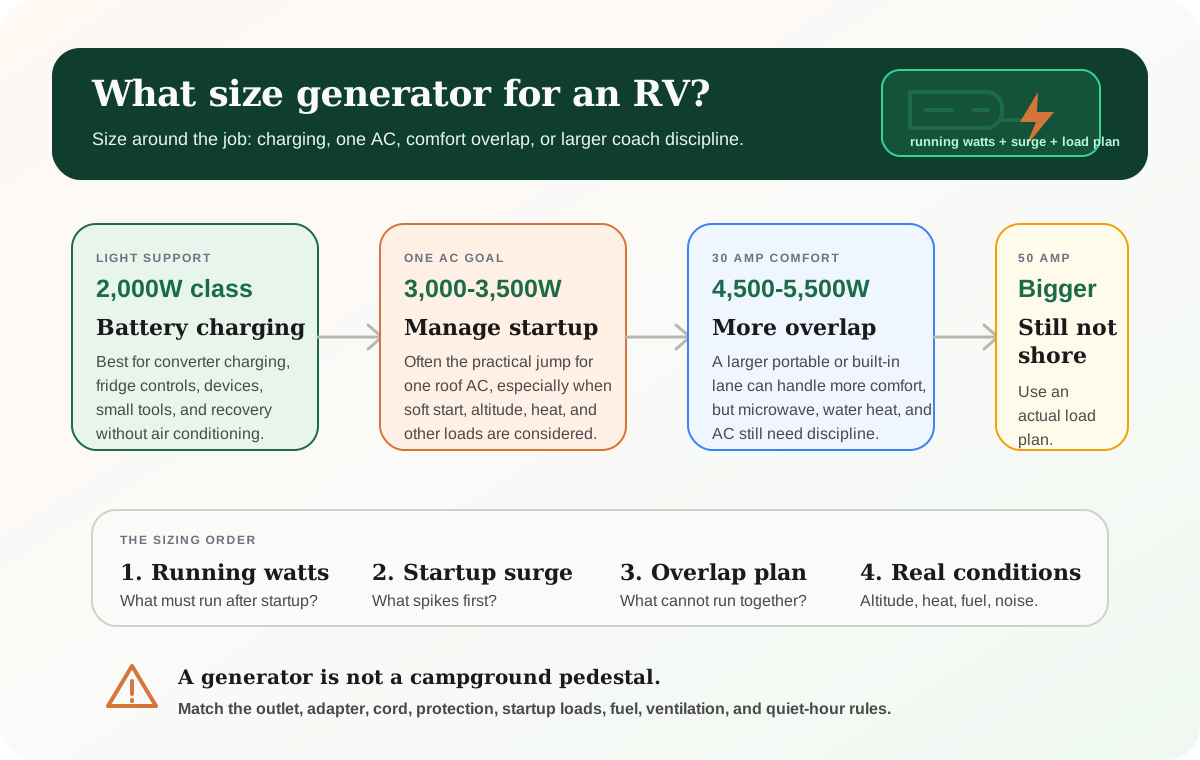
For many rooftop RV air conditioners, a 3,000W to 3,500W inverter generator is the more realistic starting lane.
Some smaller generators can work with the right AC, soft start, altitude, and load discipline. But a generator that barely starts the AC at home can feel weak at elevation or when the converter, microwave, or water heater is also running.
What decides the generator size
Compare
Compare fast
Use one comparison matrix to scan the practical differences. Small screens stack each row; wider screens keep the first column pinned.
| Spec | 2,000W class | 3,000W to 3,500W class | Larger or dual-generator setup |
|---|---|---|---|
| Best fit | Small AC, soft start, strict load control | Most practical one-AC planning | Bigger AC loads, 50A rigs, or heavy overlap |
| Main upside | Light and easy to move | Better startup and overlap margin | More room for charger and appliance loads |
| Main watchout | Easy to overload | Still needs altitude derating | Heavier, louder, and more fuel-hungry |
| What to test | Startup surge and charger off | AC plus charger draw | Which loads can overlap safely |
Worked example: why 2,000W is often tight
Honda's EU2200i lane is 2,200W maximum and 1,800W rated. That is a useful, quiet, portable class, but a rooftop RV air conditioner can demand a hard startup event before settling into lower running watts.
If the AC has a soft start and you turn off the converter, microwave, and electric water heater, a 2,000W-class generator may work for some setups. If the charger is pulling hundreds of watts at the same time, or the campground is at elevation, the same setup can trip or sag.
Honda's EU3200i lane is 3,200W maximum and 2,600W rated, and Honda lists RV air conditioner use up to 13,500 BTU among its applications. That does not guarantee every RV AC and every overlap load will work. It does explain why many RVers land in the 3,000W-class lane for practical margin.
Here is the practical test: can the generator start the AC, keep it running, and still tolerate the converter waking up after the batteries have been drawn down? If the only way the setup works is with every other breaker off and the generator at low elevation, it may be technically possible but not travel-friendly.
The overlap problem
The AC is not always alone.
The generator may also be feeding:
- converter or inverter-charger
- microwave
- electric water heater mode
- refrigerator on AC
- coffee maker
- battery charger
That is where the math gets ugly. A generator can look large enough for the AC and still trip when the charger and kitchen loads overlap.
This is especially common after a boondocking night. The battery charger may pull hard right when you start the generator, then the air conditioner asks for startup current, then someone starts the microwave. The fix is not always a larger generator. Sometimes it is setting lower charger amps, turning off electric water heat, and sequencing high-draw loads.
If runtime and fuel are part of the decision, use the generator runtime calculator after the size looks right. A generator that can start the AC may still be annoying if it burns fuel quickly at the load you actually need.
Altitude steals margin
Portable generators usually lose output at higher elevation. That means a setup that works near sea level may struggle in mountain campgrounds.
If your summer route includes elevation, derate before the trip instead of after the first hot afternoon. The practical fix may be a larger generator, a soft start, stricter load shedding, or a different cooling plan.
A dogbone does not create generator capacity
Adapter cables can make plugs fit, but they do not add watts. The generator still has to carry the actual running load and startup surge.
When the answer changes
The answer changes toward smaller when the AC is small, a soft start is installed, altitude is low, and you are willing to shut off battery charging and kitchen loads.
The answer changes toward larger when the RV has a 15,000 BTU AC, a big charger, high elevation, a 50A coach, or a second air conditioner.
The answer changes toward "do not solve this with a generator" when noise rules, fuel storage, neighbors, or heat risk make generator cooling impractical.
Best next move
Open the generator-size calculator and include the AC, battery charger, altitude, and any loads you realistically overlap.
If the result is close, reduce overlap, add a soft start, choose a larger generator lane, or change the cooling plan. For a deeper walkthrough, use the RV generator sizing guide.
If you are comparing generator cooling against battery cooling, the air-conditioner runtime calculator gives a useful reality check before you spend money in the wrong lane.
Frequently asked
Questions RVers usually ask next.
Will a 2,000W generator run an RV air conditioner?
Sometimes, but it is a tight lane. It usually requires a smaller AC, soft start, low altitude, and strict load shedding. Many RVers choose a 3,000W-class generator for better margin.
Does a soft start mean I can buy a smaller generator?
It can reduce startup surge enough to make a smaller generator possible, but it does not remove running watts, altitude loss, charger draw, or other appliance overlap.
Why does my generator trip when the AC is already running?
Another load may be overlapping with the AC, such as the converter, microwave, water heater, or coffee maker. The generator has to carry the whole load, not just the air conditioner.
Related guides
Keep moving with the most relevant guides.
What Size Generator Do You Need for an RV?
A practical RV generator sizing guide that explains running watts, startup surge, one-air-conditioner goals, battery charging, 30 amp and 50 amp expectations, fuel, noise, altitude, and safe load management.