Key takeaways
- Yes, RV solar can run an air conditioner in the right system, but the useful question is how many hours of cooling you need and what battery reserve remains afterward.
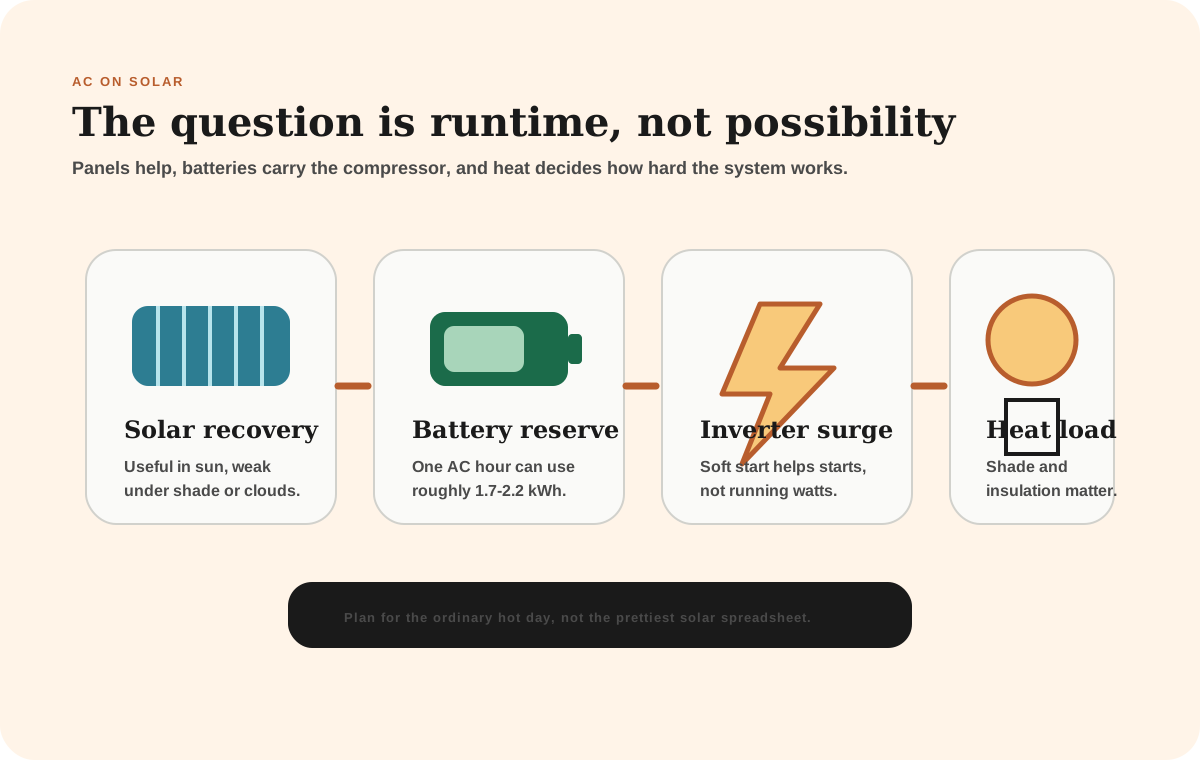
- A typical rooftop AC hour can consume roughly 1.7-2.2 kWh from the battery after inverter losses, depending on the unit, cycling, heat, and inverter efficiency.
- A soft start helps the inverter survive compressor startup. It does not make the air conditioner cheap to run once the compressor is already running.
Source checks used for this answer
Use these as planning references, then verify the nameplate and manual for the exact air conditioner, inverter, and soft-start device in your RV.
The short answer
Yes, you can run an RV air conditioner on solar.
But that answer is only useful after you define the runtime. Running AC for 30 to 60 minutes to cool the rig before bed is a different project from cooling a trailer all afternoon in July.
Most disappointments come from treating "solar can run AC" as a product claim instead of a system budget.
The one-hour reality check
A common 13,500 to 15,000 BTU rooftop RV air conditioner often draws somewhere around 12 to 16 amps while running at 120V across compressor and fan load. Your exact unit may be higher or lower, so the data plate and manual win.
For planning, that range is roughly:
- 1,440W to 1,920W of AC-side running power
- about 1.6-2.1 kWh from the battery for one hour after inverter losses
- about 125-165Ah from a 12.8V lithium bank for one hour of steady runtime
The compressor may cycle instead of running continuously, which helps. Hot sun, poor insulation, air leaks, and a heat-soaked rig push the other way.
That is why AC-on-solar math should use ranges, not a single heroic number.
Compare
Compare fast
Use one comparison matrix to scan the practical differences. Small screens stack each row; wider screens keep the first column pinned.
| Spec | Short burst | Shoulder-season cooling | Summer comfort plan |
|---|---|---|---|
| What it means | 20-60 minutes to knock heat down | Several controlled runs in moderate heat | Long runtime in exposed hot weather |
| Battery reality | Often possible with a serious lithium bank | Needs substantial reserve and recovery | Quickly becomes a large-bank, large-array project |
| Solar role | Helps replace part of the draw | Can support midday cycling | May still lag behind heat load and AC draw |
| Main watchout | Do not spend the evening reserve by accident | Clouds and shade change the answer | Roof space and cost climb faster than expected |
Battery size decides whether it feels calm
Think in watt-hours first.
A 200Ah lithium bank at 12.8V is about 2,560Wh rated. If you reserve 20 percent, you are planning around roughly 2,050Wh usable before inverter losses and other loads.
That means one hard AC hour can consume a very large share of a 200Ah bank.
A 400Ah lithium bank is about 5,120Wh rated. With an 80 percent usable planning lane, that is roughly 4,100Wh. Now one AC hour is still meaningful, but it does not erase the entire day by itself.
This is why the AC question belongs beside the battery calculator, not only the solar calculator.
The inverter has two jobs
The inverter must handle running power and startup surge.
Running power is the ongoing load after the compressor is on. Startup surge is the short, hard demand when the compressor starts. A soft-start device can reduce that starting surge and make a good inverter setup more realistic.
It does not change the basic energy bill of cooling the RV.
That distinction matters. If the inverter trips on startup, you have a surge problem. If the battery drains faster than expected after the AC is running, you have an energy-budget problem.
Use the RV inverter guide after the runtime math is honest, not before.
Solar helps most during the same window AC hurts most
Solar and air conditioning overlap in a useful way: hot afternoons often have strong sun. That is the good news.
The bad news is that the same sun also heats the rig, raises roof temperature, and makes the compressor work harder. Shade helps comfort, but shade can also reduce panel production. This is the classic AC-on-solar tradeoff.
Before buying hardware, model:
- array watts
- location and season
- roof shade
- battery size
- AC runtime goal
- non-AC loads
- recovery needed before evening
For the deeper version, use the dedicated how much solar for RV air conditioning guide.
Do not plan around the best possible solar day
If AC only works when the sky is perfect, the battery is full, the rig is shaded just right, and no other loads matter, the setup is too fragile for real heat.
When the answer is yes, maybe, or no
The answer is usually yes when you want limited cooling, have a large lithium bank, have a properly sized inverter, and can recharge meaningfully during the day.
The answer is maybe when the goal is a few hours in shoulder season or mild summer conditions and you are willing to monitor the bank closely.
The answer is usually no when the roof is small, the battery bank is modest, the rig camps in exposed hot places, and the expectation is all-day cooling without generator, shore power, or a much larger system.
That does not make solar pointless. It means solar may be a cooling support tool instead of a complete air-conditioning replacement.
Best next move
Do the runtime math before shopping.
Start with one target: "I want one hour of AC after lunch" or "I want two hours before bed." Then run the battery and solar numbers around that target.
If the numbers are close, the right answer may be shade, roof vent strategy, reflective window covers, travel timing, or a generator plan before it is more panels.
Frequently asked
Questions RVers usually ask next.
How much battery does one hour of RV AC use?
A practical planning range is roughly 1.7-2.2 kWh from the battery for one hour of rooftop AC after inverter losses. Cycling, heat, unit size, and insulation can move that number up or down.
Will a soft start make RV AC run longer on solar?
A soft start mainly helps with compressor startup surge so the inverter is less likely to trip. It does not remove the ongoing running load once the air conditioner is operating.
Is 200Ah enough to run RV air conditioning?
It may run AC for a limited period, but a single hard AC hour can use much of a 200Ah lithium bank's comfortable reserve. For regular AC use, larger banks and better recharge paths are usually needed.
Should I add more solar or more battery first for AC?
First define the runtime goal. Battery size determines whether the AC can run without draining the rig too far, while solar determines how well the system recovers during the day.
Related guides
Keep moving with the most relevant guides.

How Much Solar Do You Need to Run an RV Air Conditioner?
A practical guide to sizing solar, battery, and inverter capacity for RV air conditioner use without relying on unrealistic paper math.

Best RV Inverter Chargers in 2026: Exact 3000W Models Compared
A practical buyer's guide to exact RV inverter chargers with current official specs, charging output, transfer-switch ratings, dimensions, and the real build each one fits.