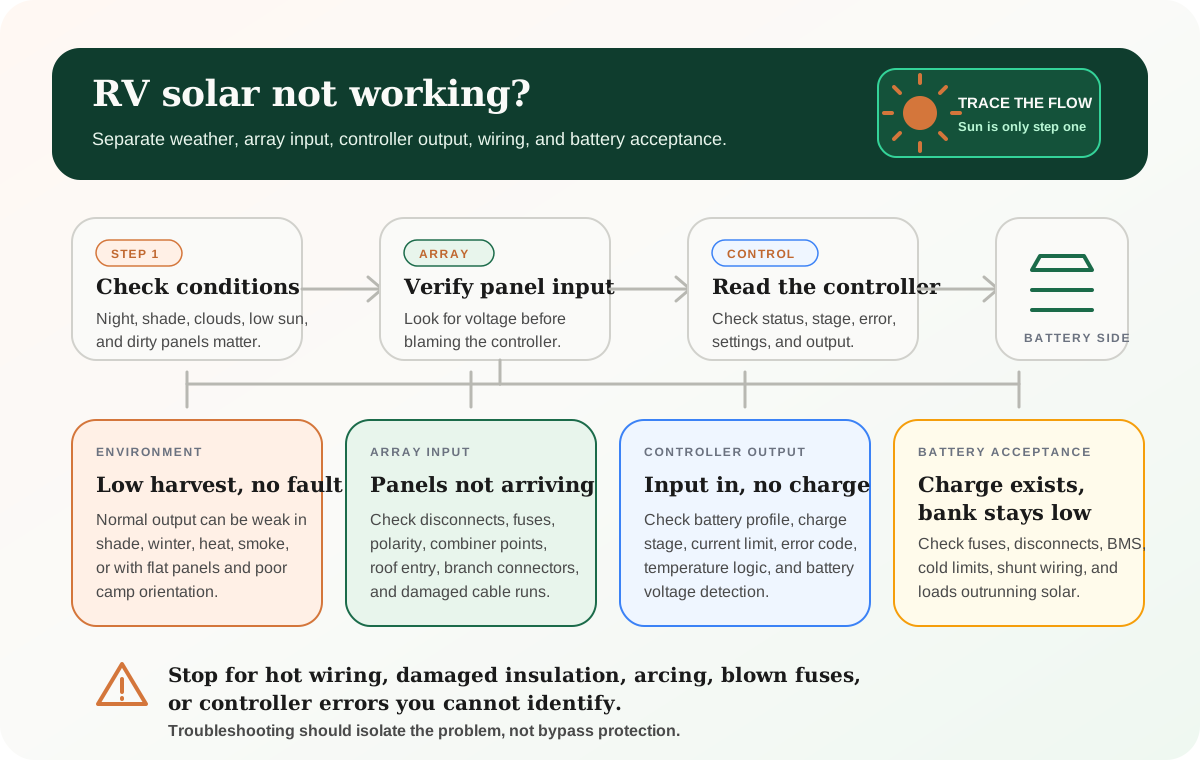
RV solar diagnosis at a glance
Use this first-pass map before assuming the panels, controller, or battery bank have failed.
First question
Is low output normal?
Clouds, shade, low sun angle, dirty panels, heat, and flat roof mounting can make a healthy system look weak.
Panel lane
Does input reach the controller?
Check array disconnects, fuses, branch connectors, polarity, roof-entry wiring, and damaged cable runs.
Controller lane
Does output leave the controller?
Check status, charge stage, battery profile, current limit, error code, and battery voltage detection.
Battery lane
Can the bank accept charge?
Check main fuse, disconnect, BMS state, low-temperature charging limits, shunt wiring, and live loads.
Expectation lane
Was the system undersized?
A working 200W setup can still disappoint if the load profile needs 600W or more in real weather.
Stop sign
Heat or blown protection
Do not keep replacing fuses or bypassing disconnects. Find the fault before energizing the system again.
Start by separating weak harvest from a real fault
An RV solar system can be "not working" in several different ways.
It might be producing zero watts. It might be producing less than expected. The charge controller might be on but not charging. The controller might show panel voltage but no output current. The battery monitor might show no net gain because the RV is using power as fast as solar is making it. Or the battery may be refusing charge because of temperature or protection limits.
Those are not the same problem.
Before replacing a panel, controller, fuse, or battery, answer five questions:
- Is there enough sun for a fair test?
- Is panel input reaching the charge controller?
- Is the controller sending charging current out?
- Is that current reaching the battery side of the system?
- Is the battery able to accept charge right now?
That order prevents a lot of parts-cannon spending.
Quick safety boundaries before you test
Solar feels harmless because it is quiet. That can make people too casual around it.
Stop and get qualified help if you see:
- hot wiring, hot connectors, or hot breaker bodies
- melted insulation, discoloration, or a burning smell
- arcing, popping, buzzing, or visible sparking
- repeated blown fuses or tripped breakers
- cracked panel glass or damaged junction boxes
- roof-entry wiring that is pinched, water-damaged, or abraded
- polarity confusion you cannot confidently resolve
- controller fault codes you cannot identify from the manual
- any previous-owner wiring that bypasses fuses, disconnects, or breakers
Troubleshooting should isolate the problem. It should not defeat the protection that is trying to keep the fault contained.
Do not bypass solar protection to prove a point
If a fuse, breaker, disconnect, controller, or battery protection circuit is stopping the solar path, treat that as a finding. Bypassing it can turn a solar problem into a damaged-controller, damaged-battery, or wiring-overheat problem.
Step 1: Check whether the conditions are fooling you
Solar production is not a fixed number. A 400W array does not produce 400W all day.
Real output changes with:
- time of day
- season
- clouds and haze
- smoke, dust, or dirty panels
- shade from trees, vents, air conditioners, antennas, or roof racks
- panel temperature
- flat mounting versus tilt
- campsite orientation
- battery state of charge and controller stage
That last point surprises people. If the battery is nearly full, the controller may intentionally reduce current. That can look like weak solar even though the system is behaving normally.
For a fair first test, look for clear sun, minimal shade, and a battery bank that is low enough to accept charge. If the array still shows little or no production in those conditions, move to the input checks.
Step 2: Verify panel input before blaming the controller
The charge controller cannot charge from power that never reaches it.
Check the array path:
- Is the solar disconnect on?
- Is the array breaker on?
- Are inline fuses intact?
- Are branch connectors fully seated?
- Is the roof gland or cable entry dry and undamaged?
- Are any panel leads pinched, pulled, chewed, or abraded?
- Did a portable panel connector get reversed, loosened, or left unplugged?
- Does the controller show panel voltage during daylight?
If the controller shows no panel voltage in good sun, the issue is probably upstream of the controller. That can be as simple as a disconnect left open or as serious as damaged wiring.
If the controller shows panel voltage but no useful output, move to the controller checks.
Compare
RV solar input symptoms and likely starting points
Use one comparison matrix to scan the practical differences. Small screens stack each row; wider screens keep the first column pinned.
| Spec | What you see | Likely starting point | What to avoid |
|---|---|---|---|
| No panel voltage at controller | Array disconnect, fuse, breaker, connector, roof entry, or panel wiring | Confirm the upstream path before replacing the controller | Do not jump around blown protection devices |
| Panel voltage present, no charge current | Controller stage, settings, battery detection, output wiring, or battery acceptance | Read the controller status and battery-side voltage | Do not assume panel voltage means the battery is charging |
| Some charging, much lower than expected | Shade, weather, dirty panels, high heat, undersized array, or poor string layout | Compare conditions against realistic output, not nameplate watts | Do not call normal winter/flat-panel behavior a failure too quickly |
| Charging stops randomly | Loose connection, heat derating, controller fault, BMS limit, or intermittent shade | Look for patterns by time, load, temperature, and road vibration | Do not ignore heat or repeating error states |
Step 3: Read the charge controller like a diagnostic tool
The charge controller is the traffic manager between the panels and the battery bank. Its display or app often tells you which side of the system needs attention.
Look for:
- PV or panel voltage
- battery voltage
- charge current
- charge stage
- error code
- battery profile
- current limit
- temperature or sensor status
- whether the controller is in standby, float, bulk, absorption, or fault
If the controller is in float or absorption with a nearly full battery, low current may be normal. If the battery is low and the controller sees good panel input but sends little or no output, settings, current limits, wiring, battery detection, or a controller fault deserve a closer look.
Use the RV solar charge controller guide if you need to understand MPPT versus PWM, battery profiles, placement, current limits, or controller sizing.
Step 4: Check the settings that change charging behavior
Many solar systems are mechanically installed correctly but configured poorly.
Settings worth checking include:
- battery chemistry profile
- absorption voltage
- float voltage
- absorption duration
- temperature compensation
- lithium low-temperature charging logic
- current limit
- custom battery profile values
- system voltage detection
Lithium batteries make this more important, not less. The battery's BMS is a safety backstop. It is not a reason to ignore controller setup.
Wrong settings can create several symptoms:
- the bank never reaches full charge
- the controller stops too early
- charge current looks weak
- the controller reports a battery fault
- the battery BMS blocks charging
- lead-acid batteries are chronically undercharged
If the settings are unknown, compare the controller configuration to the battery manufacturer's charging guidance before you assume the panels are the problem.
Step 5: Inspect the wiring path for voltage drop, heat, and serviceability
Solar wiring problems often hide because the system may still work a little.
Watch for:
- undersized cable on long runs
- loose terminals
- corrosion
- strained connectors
- badly supported roof wiring
- water intrusion at the roof entry
- poor labeling
- inaccessible fuses or breakers
- panel strings wired differently than the controller expects
A system can produce enough to look alive and still lose too much performance through wiring resistance, shade-sensitive layout, or hard-to-service protection points.
If the layout is hard to understand, read RV Solar Wiring Mistakes. If the install is still in planning or rework mode, use the RV solar installation guide to rebuild the sequence more cleanly.
Step 6: Confirm the battery side can accept the charge
Sometimes the solar array and controller are fine, but the battery side is not accepting current.
Check:
- main battery fuse or breaker
- battery disconnect position
- bus-bar connections
- shunt wiring
- battery monitor reading
- BMS state if lithium
- battery temperature
- battery state of charge
- active loads that may be using solar output immediately
This is where a shunt-based monitor is valuable. If the controller says it is outputting 18 amps but the monitor shows almost no net gain, the RV may be using most of that current at the same time. That is not the same as "solar is broken."
If the battery itself is not recovering from any source, switch to the RV battery not charging troubleshooting guide. That page traces shore power, solar, alternator charging, fuses, disconnects, BMS limits, and live loads together.
Step 7: Compare production to system size, not wishful thinking
Sometimes the system is working correctly and still feels disappointing because it is undersized for the way the RV is used.
Common examples:
- 200W of panel trying to support a compressor fridge, laptops, fans, and Starlink
- a shaded campsite that turns a roof array into a fraction of its rating
- flat-mounted winter panels expected to behave like tilted panels in summer
- a large battery bank that cannot be refilled fast enough after cloudy days
- inverter loads that quietly consume far more than expected
This is not a failure of a single part. It is a system-sizing mismatch.
Use the solar calculator to compare daily watt-hours, sun hours, installed panel wattage, battery reserve, and inverter use. A realistic system may need more panel, less load, more battery, better alternator charging, or a different camp routine.
Step 8: Use a simple diagnostic order
Work in this order:
- Check whether sun and shade conditions are good enough for a fair test.
- Confirm the battery is low enough to accept charge.
- Check whether panel voltage reaches the controller.
- Check whether the controller shows a normal status, stage, and battery profile.
- Check whether the controller is sending output current.
- Check whether that output reaches the battery-side bus or terminals.
- Check fuses, breakers, disconnects, wiring, and connectors.
- Check battery temperature, BMS state, and live loads.
- Compare the result to realistic system size and weather.
That sequence keeps you from replacing panels when shade is the issue, replacing a controller when a fuse is open, or blaming solar when the battery is already full.
The best solar test is boring and repeatable
Pick a clear-sun window, reduce loads, note battery state, read panel input, read controller output, and record what changes over 30 to 60 minutes. A simple repeatable test beats anxious guesswork.
Where to go next
Use the solar charge controller guide if the controller display, charge stage, or battery settings are confusing.
Use RV Solar Wiring Mistakes if the system technically works but is hard to isolate, label, or service.
Use the RV solar maintenance guide if the system used to work and has gradually become weaker after weather, storage, dust, or road vibration.
Use the battery not charging guide if the battery bank is not recovering from solar, shore power, alternator charging, or generator-fed charging.
Frequently asked
Questions RVers usually ask next.
Why are my RV solar panels not charging the battery?
Common causes include shade, weak sun, dirty panels, an open disconnect, blown fuse, loose connector, charge controller setting problem, controller fault, battery-side disconnect, BMS limit, cold battery, or loads using the solar output as fast as it is produced.
Can a solar charge controller be on but not charging?
Yes. The controller may have power but still be in standby, float, fault, current limit, low-temperature protection, or a state where it sees panel input but is not sending useful current to the battery.
How do I know if low RV solar output is normal?
Compare output during a fair test: clear sun, minimal shade, clean panels, and a battery low enough to accept charge. If output is weak only in shade, winter, heat, or when the battery is nearly full, it may be normal behavior rather than a broken system.
Should I replace the panels first if RV solar stops working?
Usually no. Confirm sun conditions, panel voltage at the controller, controller output, wiring protection, battery-side connections, and battery acceptance before replacing panels.
Freshness note
Last checked April 10, 2026
This topic can change when products, plans, prices, campsite rules, or fit guidance move. These notes show what was reviewed most recently.
This review included
- Checked the diagnostic sequence against the solar sizing, solar wiring, charge controller, installation, maintenance, and battery troubleshooting guides.
- Added safety boundaries around hot wiring, damaged insulation, arcing, blown fuses, polarity errors, roof-entry damage, and bypassed protection devices.
- Kept panel-voltage and controller-output checks framed as diagnostic observations, not final wiring instructions or a substitute for component manuals.
Recent change log
April 10, 2026
Published an RV solar troubleshooting guide covering low harvest, dead controllers, weak panel input, wiring faults, and battery-side acceptance issues.
April 10, 2026
Added a solar troubleshooting flow visual, at-a-glance diagnosis grid, source-lane checks, and stop-now safety boundaries.
Broader editorial corrections are tracked on the Corrections and Updates page.


