Shortlist first
Use this to find the winner first, then compare the alternates only if their tradeoffs fit your rig better.
Shortlist labels are editorial recommendations, not popularity rankings. Fit score still matters, but the label tells you why each pick made this guide.
How fit scores work
Scores are editorial fit scores, not user-review averages. The rubric weighs stated RV-use fit, verified specs and limits, whole-rig friction, visible downsides or support risk, and value for the specific job in this guide. Read the full scoring rubric.
If you need one baseline option before reading the full guide, start with Renogy ShadowFlux 200W for mainstream roof-first build.
The first option to evaluate if you want the strongest all-around fit for this guide. Check the other cards only if their award label matches your constraint better.
| Product | Why shortlisted | Fit score | Key spec | Best for | Actions |
|---|---|---|---|---|---|
| Renogy ShadowFlux 200W Links to: Renogy ShadowFlux 200W N-Type Solar Panel | Best overall The first option to evaluate if you want the strongest all-around fit for this guide. | 4.7 / 5 fit scoreScore rubric | $239.99 | 23.83 lb | 49.69 x 30.08 in | 20.7% module efficiency | Mainstream roof-first build | Read Renogy ShadowFlux 200W notesCheck listing at RenogyMerchant link - direct listing. Verify price and specs at Renogy. |
| Rich Solar MEGA 200 Links to: Rich Solar MEGA 200 Solar Panel | Best value The pick that balances capability and cost pressure best for this decision. | 4.6 / 5 fit score | $239.99 | 24 lb | 58.7 x 26.8 in | 18.4V Vmp | Value rigid roof panel | Read Rich Solar MEGA 200 notesCheck listing at Rich SolarMerchant link - direct listing. Verify price and specs at Rich Solar. |
| EcoFlow NextGen 220W Bifacial Links to: EcoFlow NextGen 220W Bifacial Portable Solar Panel | Specialized pick A narrower recommendation that wins only for a specific use case. | 4.7 / 5 fit score | $299.00 | 15.4 lb | folds to 24.2 x 23.2 in | XT60 cable included | Portable support charging | Read EcoFlow NextGen 220W Bifacial notesCheck listing at EcoFlowMerchant link - direct listing. Verify price and specs at EcoFlow. |
Official panel checks
Solar panel listings change with sales, bundles, cable kits, and replacement models. Verify the exact panel page before committing roof space, controller sizing, or cable entry.
Pre-arrival checks
Confirm the roof rectangle
Measure the actual usable roof area between vents, air conditioners, antennas, curves, ladders, and safe walk paths before buying panels.
Match the controller, not just the watts
Voc, Vmp, Imp, Isc, series strings, cold-weather voltage, and fuse limits decide whether the panel plan is electrically sane.
Give portable panels a real job
A folding panel is best as shade support or a temporary lane, not as a pretend roof array unless your usage is very light.
These are exact panels, not generic 200-watt classes
A lot of solar buying advice still lives at the category level:
- rigid roof panel
- portable support panel
- 200-watt class
- bifacial option
That is useful up to a point, but the real buying decision happens at the exact model level:
- the actual footprint that has to fit between roof obstacles
- the real connector path that has to land on your controller or power station
- the true panel weight you have to install or move
- the warranty and cell-type story you will live with after the purchase
That is why this guide compares three exact panels instead of speaking only in wattage classes.
If you are still deciding how much panel you need, start with how many solar watts your RV needs and the solar calculator before comparing exact models. Panel shopping is cleaner when the array target is based on loads instead of roof optimism.
Price note
Prices below were checked against current manufacturer product pages on April 21, 2026. Sale pricing shifts fast, so use the numbers as a comparison snapshot rather than a forever promise.
Field note
Field fit note
Roof-panel purchases feel best when the panel was chosen for the roof you actually have, not the wattage class you wanted to brag about. Portable support panels feel best when they are solving shade and camp-position problems on purpose.
Must read before you buy roof panels
Read the RV solar installation guide before buying rigid panels for the roof. Panel dimensions only matter after you know the obstruction map, safe cable-entry point, sealant plan, controller location, and commissioning sequence.
What matters before you compare any panel
Roof fit beats marketing wattage
If a panel does not fit the roof cleanly, the rest of its spec sheet matters a lot less.
Connector path changes installation friction
Roof panels usually want to land in a controller-led battery system. Portable panels may need to land on MC4-style inputs, XT60, or brand-specific power-station adapters.
Portable panels should be judged as support tools
Portable support panels can be fantastic. They just solve a different problem than fixed roof charging.
If that roof-versus-ground decision is still unsettled, read the portable vs. roof solar comparison before choosing a product. If you already know this will be a roof install, the RV solar installation guide and series-vs-parallel wiring guide are the next practical checks.
The roof-layout check before the cart
Before buying any rigid panel, draw the usable roof as rectangles.
Do not start with the whole roof length. Start with the spaces that are actually installable after you remove the air conditioner shadow, vent lids, skylights, antennas, ladder zone, curved front cap, roof seams, walk path, and the area you need for cable entry. A 200W panel that technically fits can still be wrong if it blocks service access or forces a cable route across a future repair area.
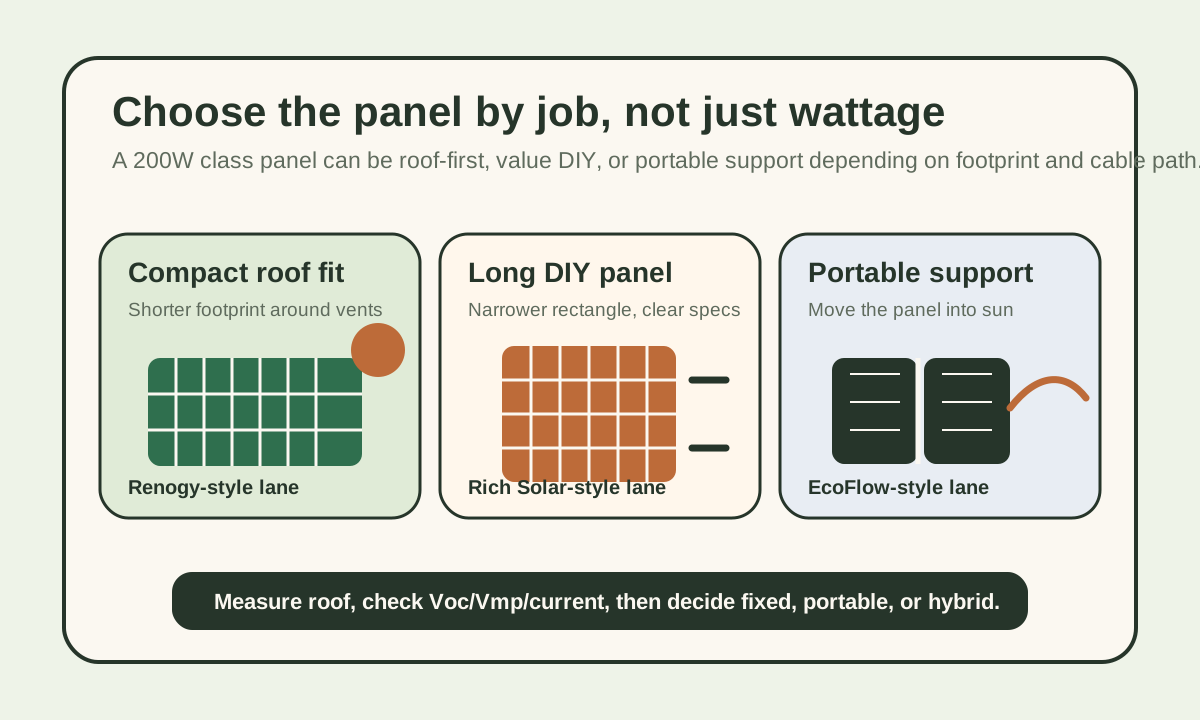
The Renogy and Rich Solar panels both sit in the 200W rigid-panel role, but their shapes are different. The Renogy is shorter and wider. The Rich Solar is longer and narrower. That shape difference can matter more than the price when the roof is broken into awkward zones. A shorter panel may fit behind an air conditioner where a longer panel crosses a vent. A longer narrow panel may fit along an edge where the wider panel crowds a hatch.
The smart move is to test both footprints on paper before choosing the brand. Tape the panel outline on the roof if the layout is tight. Then mark where the mounting feet, cable gland, combiner, and service path will live. If the panel only fits by making the install ugly, the cheaper or higher-efficiency choice is not really cheaper.
Controller matching is part of panel selection
Watts are the headline, but voltage and current are the compatibility story.
The Renogy ShadowFlux 200W publishes a higher Vmp and Voc than a traditional 12V-nominal panel. That can be useful with an MPPT controller, but it also means the controller plan has to be deliberate. The Rich Solar MEGA 200 publishes the more familiar 18.4V Vmp and 21.8V Voc lane. That can be easier to reason about for simple 12V systems, especially when replacing or expanding an existing array.
Neither spec is automatically better. They are different design inputs.
If panels will be wired in series, add the open-circuit voltages and check the controller's maximum input voltage with cold-weather margin. Panels produce higher voltage in cold conditions, so a string that looks fine in warm weather can crowd a controller limit during a cold morning. If panels will be wired in parallel, pay closer attention to current, wire size, fusing, and combiner layout.
This is why "I bought two 200W panels" is not enough information. Two panels in series can ask a controller a different question than two panels in parallel. A panel with higher voltage and lower current can change wire and controller planning compared with a lower-voltage, higher-current panel.
If that sounds like too much, that is a sign to choose a kit or a simpler wiring path, not to ignore the math. The series-vs-parallel solar wiring guide exists for exactly this decision.
Roof solar and portable solar solve different travel problems
Roof solar is the passive charging lane. It works while you are away from the rig, while driving, while parked for a quick stop, and on the days when nobody wants to set up another piece of gear. Its weakness is that the panel goes wherever the RV goes. If shade covers the roof, the array has to live with it.
Portable solar is the placement lane. It can move into a sunny patch while the RV stays comfortable in shade. It can aim better in low sun. It can support a power station, a hybrid system, or a small battery bank without committing to roof holes. Its weakness is labor. A portable panel only helps when someone deploys it, watches the cable path, protects it from wind, and stores it again.
That is why the EcoFlow pick is framed as a support panel. It is excellent when the campsite problem is "the RV belongs in shade but the charging surface belongs in sun." It is not the same as 600W of roof solar quietly recovering a battery bank every day without setup.
For many RVers, the best answer is not roof or portable. It is roof first, portable second. Fixed panels handle the ordinary baseline. A folding panel helps on shaded days, low-sun shoulder seasons, or camps where the roof never gets a clean window.
Worked example: one 200W panel versus a real array
A single 200W panel can be useful, but it should not be oversold.
In good sun, a 200W panel might return roughly 700 to 900Wh across a strong day after temperature, angle, controller, wiring, and real-world losses. That is enough to meaningfully support lights, fans, a small fridge control load, router time, and laptop charging. It is not enough to make air conditioning, electric heat, heavy inverter use, or careless battery planning disappear.
Now compare a 600W roof array. Under the same rough assumptions, that array may return something closer to 2.1 to 2.7kWh on a strong day. That changes the trip. It can recover a larger lithium bank after overnight inverter use, support a more realistic remote-work load, and reduce generator dependence. It still does not make weather irrelevant.
That is why the article keeps pushing the panel back into the system. A panel is not the plan. The plan is load audit, battery capacity, charge controller, roof layout, cable route, fuse protection, and backup charging. The product only makes sense after the role is clear.
How I would shortlist these three
Start with the Renogy ShadowFlux if roof space is awkward and you want a mainstream roof-first panel with modern anti-shading positioning. Its shape and higher-voltage MPPT-friendly profile make the most sense when the roof plan is deliberate and you are building a real fixed array.
Start with the Rich Solar MEGA 200 if you are comfortable with DIY fit checks and want a straightforward rigid panel with transparent electrical specs. It is the easiest value recommendation when the longer footprint fits cleanly and the controller plan is already understood.
Start with the EcoFlow NextGen 220W only if the panel needs to move. It is the right comparison when the RV often parks in shade, when you use a portable power station, or when a folding support lane is more useful than another roof rectangle.
If none of those roles is clear, pause before buying. Use the solar calculator, measure the roof, and decide whether you are building a passive array, a portable support lane, or a hybrid system.
Compare
Compare fast
Use one comparison matrix to scan the practical differences. Small screens stack each row; wider screens keep the first column pinned.
| Spec | Renogy ShadowFlux 200W | Rich Solar MEGA 200 | EcoFlow NextGen 220W |
|---|---|---|---|
| Price checked | $239.99 | $239.99 | $299.00 |
| Cell type | N-type monocrystalline | Monocrystalline | N Type TOPCon monocrystalline silicon |
| Weight | 23.83 lb | 24 lb | 15.4 lb |
| Dimensions | 49.69 x 30.08 x 1.18 in | 58.7 x 26.8 x 1.2 in | Folded 24.2 x 23.2 x 1.3 in |
| Voltage/current note | Vmp 31.3V / Voc 36.5V / Imp 6.38A / Isc 6.86A | Vmp 18.4V / Voc 21.8V / Imp 10.9A / Isc 11.6A | Voc 21.5V / Vmp 18.4V / front Imp 11.9A |
| Connector path | Rigid roof-panel wiring path | Rigid roof-panel wiring path | Photovoltaic connectors + XT60 charging cable included |
| Best fit | Mainstream roof-first array | Value-minded DIY roof array | Shade-flex support charging |
The shortlist
- Latest product check
- Specs, fit notes, and current listing context were reviewed April 21, 2026.
- Evidence label
- Spec-verified: Score is based on current published specs, official documentation, pricing context, compatibility, and RV-use fit analysis.
- Price context
- Pricing and availability can change, so confirm the merchant listing before buying.
Product facts last checked April 21, 2026
Renogy ShadowFlux 200W N-Type Solar Panel
Editorial fit score
Renogy's ShadowFlux 200W wins on the blend most RVers actually need: mainstream availability, modern N-type cell design, a shorter panel footprint than many 200W rigid panels, and published 20.7% module / 25% cell efficiency. It is the cleanest recommendation when the roof array needs to feel like a sensible permanent upgrade rather than a bargain hunt.
Review verdict
- Short verdict
- The best roof-first RV solar panel for a mainstream fixed array when you want a compact, modern 200W panel with strong support and a strong anti-shading story.
- Evidence used
- Spec-verified
- Score is based on current published specs, official documentation, pricing context, compatibility, and RV-use fit analysis.
- Why it made the shortlist
- Best overall
- The first option to evaluate if you want the strongest all-around fit for this guide.
- Best if
- Mainstream roof-first build
- Why not this product?
- If the rig often sits in shade and the panel needs to move around camp, the EcoFlow support-panel path is more useful.
- Watch for
- Still a roof panel, so install effort is real
- Product check date
- Specs, fit notes, and current listing context were last checked April 21, 2026.
Key specs
- Price checked
- $239.99
- Weight
- 23.83 lb
- Dimensions
- 49.69 x 30.08 x 1.18 in
- Efficiency note
- 20.7% module / 25% cell
Score basis
Score is based on current published specs, official documentation, pricing context, compatibility, and RV-use fit analysis. These are editorial fit scores, not customer-review averages. Read the scoring rubric.
- RV-use fit
- 30% weight
- Verified specs and limits
- 25% weight
- Whole-rig friction
- 20% weight
- Downsides and support risk
- 15% weight
- Value for the job
- 10% weight
How directly the product solves the specific off-grid RV job in this guide.
Capacity, dimensions, electrical limits, protection claims, and compatibility constraints we can verify from current sources.
Install effort, storage, wiring, service access, weight, refill workflow, or daily-use hassle.
Known tradeoffs, unclear claims, warranty coverage, support risk, and wrong-buyer failure modes.
Whether the price makes sense after fit, specs, and tradeoffs still hold.
Testing limits
- This is not a hands-on endurance or lab test unless the review explicitly says so.
- Specs, pricing, bundles, and availability can change, so confirm the current listing and manual before buying.
Reasons to buy
- Best blend of roof fit, mainstream support, and modern cell design
- Shorter footprint than many traditional 200W rigid panels
- Strongest roof-first recommendation for most mainstream RV builds
Watch-outs
- Still a roof panel, so install effort is real
- Not the cheapest path if all you need is occasional support charging
- Best value shows up when it is part of a real array, not a one-panel theory build
Whole-bank math
Why it wins
Best mainstream roof-fit story
It balances modern panel specs with the kind of dimensions and support most RVers can actually work around.
Best buyer
RVer building a serious roof array
Especially strong if you want dependable fixed charging and a panel that does not feel like a fringe import gamble.
When to skip it
Need flexible shade charging
If the rig often sits in shade and the panel needs to move around camp, the EcoFlow support-panel path is more useful.
Related parts and setup checks
Solar calculator
Use this before buying to see whether a single 200W roof panel is solving a real load problem or just starting the array.
Open Solar calculatorSolar charge-controller guide
Helpful when the panel choice is easy but the rest of the system still needs a smarter controller path.
Open Solar charge-controller guidePortable vs roof solar guide
Use this if you are still deciding whether the main answer should live on the roof or stay portable.
Open Portable vs roof solar guideCheck current listing
Renogy ShadowFlux 200W N-Type Solar Panel
Use the listing after the fit notes make sense for your rig. Pricing and availability can change, so verify the merchant page before buying.
- Latest product check
- Specs, fit notes, and current listing context were reviewed April 21, 2026.
- Evidence label
- Spec-verified: Score is based on current published specs, official documentation, pricing context, compatibility, and RV-use fit analysis.
- Price context
- Pricing and availability can change, so confirm the merchant listing before buying.
Product facts last checked April 21, 2026
Rich Solar MEGA 200 Solar Panel
Editorial fit score
The Rich Solar MEGA 200 is the practical DIY value pick in this comparison. The current product page publishes the core numbers RV buyers actually compare: 18.4V Vmp, 21.8V Voc, 10.9A Imp, 11.6A Isc, 24-pound weight, and a 58.7 x 26.8 inch footprint. It is not the most compact panel here, but it is a very understandable roof-array building block.
Review verdict
- Short verdict
- The best value-minded rigid roof panel when you want a straightforward 200W panel and are comfortable doing the fit and wiring math yourself.
- Evidence used
- Spec-verified
- Score is based on current published specs, official documentation, pricing context, compatibility, and RV-use fit analysis.
- Why it made the shortlist
- Best value
- The pick that balances capability and cost pressure best for this decision.
- Best if
- Value rigid roof panel
- Why not this product?
- If the roof layout is crowded, the shorter Renogy ShadowFlux is easier to place cleanly.
- Watch for
- Longer panel footprint can complicate some RV roof layouts
- Product check date
- Specs, fit notes, and current listing context were last checked April 21, 2026.
Key specs
- Price checked
- $239.99
- Weight
- 24 lb
- Dimensions
- 58.7 x 26.8 x 1.2 in
- Electrical spec
- Vmp 18.4V / Voc 21.8V
Score basis
Score is based on current published specs, official documentation, pricing context, compatibility, and RV-use fit analysis. These are editorial fit scores, not customer-review averages. Read the scoring rubric.
- RV-use fit
- 30% weight
- Verified specs and limits
- 25% weight
- Whole-rig friction
- 20% weight
- Downsides and support risk
- 15% weight
- Value for the job
- 10% weight
How directly the product solves the specific off-grid RV job in this guide.
Capacity, dimensions, electrical limits, protection claims, and compatibility constraints we can verify from current sources.
Install effort, storage, wiring, service access, weight, refill workflow, or daily-use hassle.
Known tradeoffs, unclear claims, warranty coverage, support risk, and wrong-buyer failure modes.
Whether the price makes sense after fit, specs, and tradeoffs still hold.
Testing limits
- This is not a hands-on endurance or lab test unless the review explicitly says so.
- Specs, pricing, bundles, and availability can change, so confirm the current listing and manual before buying.
Reasons to buy
- Strong value-oriented rigid panel with clearly published electrical specs
- Good fit for DIY buyers comfortable planning their own roof layout
- Long workmanship warranty compared with many panel pages in this class
Watch-outs
- Longer panel footprint can complicate some RV roof layouts
- Less compact than the Renogy panel for obstacle-heavy roofs
- Best for buyers comfortable doing more of the fit math themselves
Whole-bank math
Why it wins
Straightforward DIY value
It gives you a clean 200W rigid panel option without forcing you into a bigger brand ecosystem story.
Best buyer
DIY builder comparing hard specs
Best when you already know your controller path, roof layout, and wire plan and just need a solid rigid panel at a fair price.
When to skip it
Roof fit is tight
If the roof layout is crowded, the shorter Renogy ShadowFlux is easier to place cleanly.
Related parts and setup checks
Solar calculator
Use this to see how many 200W panels the roof and load plan actually justify before you buy around price alone.
Open Solar calculatorSolar charge-controller guide
Helpful if you are building a more hands-on DIY system and want the controller choice to match the panel choice.
Open Solar charge-controller guideBest RV solar kits for beginners
A useful contrast if you are still unsure whether you should be buying loose panels at all or starting with a more guided kit.
Open Best RV solar kits for beginnersCheck current listing
Rich Solar MEGA 200 Solar Panel
Use the listing after the fit notes make sense for your rig. Pricing and availability can change, so verify the merchant page before buying.
- Latest product check
- Specs, fit notes, and current listing context were reviewed April 21, 2026.
- Evidence label
- Spec-verified: Score is based on current published specs, official documentation, pricing context, compatibility, and RV-use fit analysis.
- Price context
- Pricing and availability can change, so confirm the merchant listing before buying.
Product facts last checked April 21, 2026
EcoFlow NextGen 220W Bifacial Portable Solar Panel
Editorial fit score
EcoFlow's NextGen 220W is the support-panel answer in this group. It is not competing to be the main roof panel. It wins by being lighter, foldable, and easy to move into the sun while the rig stays in shade. The current EcoFlow page publishes 15.4-pound weight, a folded size of 24.2 x 23.2 x 1.3 inches, photovoltaic connectors, and an included XT60 charging cable, which makes its real role very clear.
Review verdict
- Short verdict
- The best portable support panel in this comparison when the RV cannot sit in full sun and you still want meaningful charging from a lightweight folding panel.
- Evidence used
- Spec-verified
- Score is based on current published specs, official documentation, pricing context, compatibility, and RV-use fit analysis.
- Why it made the shortlist
- Specialized pick
- A narrower recommendation that wins only for a specific use case.
- Best if
- Portable support charging
- Why not this product?
- If the panel must work every day without setup labor, buy around the roof array first.
- Watch for
- Not a true replacement for a serious fixed roof array
- Product check date
- Specs, fit notes, and current listing context were last checked April 21, 2026.
Key specs
- Price checked
- $299.00
- Weight
- 15.4 lb
- Folded size
- 24.2 x 23.2 x 1.3 in
- Rated power
- 220W front / 175W rear
Score basis
Score is based on current published specs, official documentation, pricing context, compatibility, and RV-use fit analysis. These are editorial fit scores, not customer-review averages. Read the scoring rubric.
- RV-use fit
- 30% weight
- Verified specs and limits
- 25% weight
- Whole-rig friction
- 20% weight
- Downsides and support risk
- 15% weight
- Value for the job
- 10% weight
How directly the product solves the specific off-grid RV job in this guide.
Capacity, dimensions, electrical limits, protection claims, and compatibility constraints we can verify from current sources.
Install effort, storage, wiring, service access, weight, refill workflow, or daily-use hassle.
Known tradeoffs, unclear claims, warranty coverage, support risk, and wrong-buyer failure modes.
Whether the price makes sense after fit, specs, and tradeoffs still hold.
Testing limits
- This is not a hands-on endurance or lab test unless the review explicitly says so.
- Specs, pricing, bundles, and availability can change, so confirm the current listing and manual before buying.
Reasons to buy
- Best flexible support-panel answer for shaded camping patterns
- Light enough that repeated deployment still feels realistic
- Connector path is clearer than many portable panels aimed only at brand-locked stations
Watch-outs
- Not a true replacement for a serious fixed roof array
- More setup effort every time than fixed solar
- Portable convenience only pays off if you really deploy it consistently
Whole-bank math
Why it wins
Solves the shade problem
It is the best answer here when the charging surface and the parked rig need to live in different places.
Best buyer
RVer already thinking in hybrid terms
Especially good if you already know the portable panel is a support lane, not the entire plan.
When to skip it
Need passive daily charging
If the panel must work every day without setup labor, buy around the roof array first.
Related parts and setup checks
Portable solar panel guide
Read this if you want the full portable-panel field, not just the one support pick included in this roof-versus-support guide.
Open Portable solar panel guidePortable vs roof solar guide
Best if you are still deciding whether this panel should complement a roof array or stand in for one temporarily.
Open Portable vs roof solar guideSolar calculator
Use this to see whether a support panel is truly enough or whether the rig needs a fixed charging lane instead.
Open Solar calculatorCheck current listing
EcoFlow NextGen 220W Bifacial Portable Solar Panel
Use the listing after the fit notes make sense for your rig. Pricing and availability can change, so verify the merchant page before buying.
The biggest buying mistake
The classic mistake is shopping by advertised wattage before deciding which part of the system the panel is supposed to handle.
Roof panels, support panels, controller choices, battery-bank size, and inverter expectations all need to agree with one another.
The panel is only one part of the charging story
A great panel cannot rescue an undersized battery bank, weak controller choice, or unrealistic load plan. Solar works best when the panel is chosen for a defined role in the system, not as a standalone fix.
Final thought
The best RV solar panel is the exact panel that fits the job it has to do. Pick the roof panel for repeatable daily charging. Pick the portable panel for flexibility. Then size the rest of the system around that choice instead of hoping the panel fixes the whole plan by itself.
Frequently asked
Questions RVers usually ask next.
Is the Renogy ShadowFlux or Rich Solar MEGA 200 better for an RV roof?
The Renogy ShadowFlux is usually the better pick when roof fit and mainstream support matter most. The Rich Solar MEGA 200 is a strong value pick when you are comfortable doing more of the DIY fit and wiring planning yourself.
Should the EcoFlow 220W be my main RV solar panel?
Usually no. It is better treated as a portable support panel for shaded camps or hybrid setups, not as the long-term replacement for a serious roof-first array.
What size panel works best on an RV roof?
A 200W rigid panel is still a common sweet spot, but the actual best panel is the one whose exact footprint, voltage path, and role in the array fit your roof and load plan cleanly.
What matters most when buying RV solar panels?
Panel dimensions, connector path, real system fit, weight, warranty, and whether the panel is meant to be the main charging lane or a support lane matter more than wattage alone.
Freshness note
Last checked April 21, 2026
This topic can change when products, plans, prices, campsite rules, or fit guidance move. These notes show what was reviewed most recently.
This review included
- Rechecked the current Renogy, Rich Solar, and EcoFlow product pages for pricing, dimensions, voltage/current details, weight, warranty, and connector path.
- Expanded the guide with a custom panel-fit visual, official-source checks, roof-layout workflow, controller-matching guidance, and a portable-support example.
- Updated the roof-first versus portable-support framing so the comparison matches how RV solar systems are actually built.
Recent change log
April 21, 2026
Expanded the solar panel guide with official source checks, a custom fit visual, controller-matching context, and deeper roof-versus-portable guidance.
April 21, 2026
Added a pre-purchase installation callout and related-guide link before the panel comparison.
April 10, 2026
Added exact product-link labels and tightened the roof-first versus portable-support decision framing.
April 10, 2026
Rechecked the listed model specs, current pricing notes, and connector paths used in the comparison table.
Broader editorial corrections are tracked on the Corrections and Updates page.

