What do RV weight ratings mean?
RV weight ratings are the manufacturer's hard limits for how much your rig and its tow setup may safely weigh, and they come as a small family of acronyms that all relate to one another. The two that matter most are GVWR, the gross vehicle weight rating — the maximum a single vehicle (your trailer, or your motorhome) may weigh fully loaded with everything aboard — and GCWR, the gross combined weight rating, the maximum the tow vehicle and trailer may weigh together. Between them sit the per-axle limits and the figure that decides what you can actually pack. Exceed any of them and you are over the engineering the rig was built and certified to.
This is not bureaucratic fine print. The RV Safety and Education Foundation, which runs RV weighing programs, exists largely because so many rigs roll down the highway over one limit or another, and the consequences land on the tires, brakes, and frame. Understanding these numbers is the difference between loading your rig with confidence and discovering the limit the hard way on a hot interstate. The rig-review buyer guides, like the used travel-trailer guide, apply these numbers to specific rigs; this guide explains the system itself.
The core ratings, defined
Start with the weights of a single vehicle. UVW (unloaded vehicle weight), often called dry weight, is what the rig weighs empty from the factory — no cargo, no fresh, gray, or black water, no passengers. It is the brochure number, and it is not what you actually tow or drive. GVWR is the ceiling: the most that same vehicle may weigh once you have added everything. The gap between them is your CCC (cargo carrying capacity), also called payload — roughly GVWR minus the rig's loaded-but-gear-empty weight, and the single most useful number for answering "can I bring all my stuff and full tanks?" It is frequently a few hundred to a couple thousand pounds, and it disappears faster than owners expect.
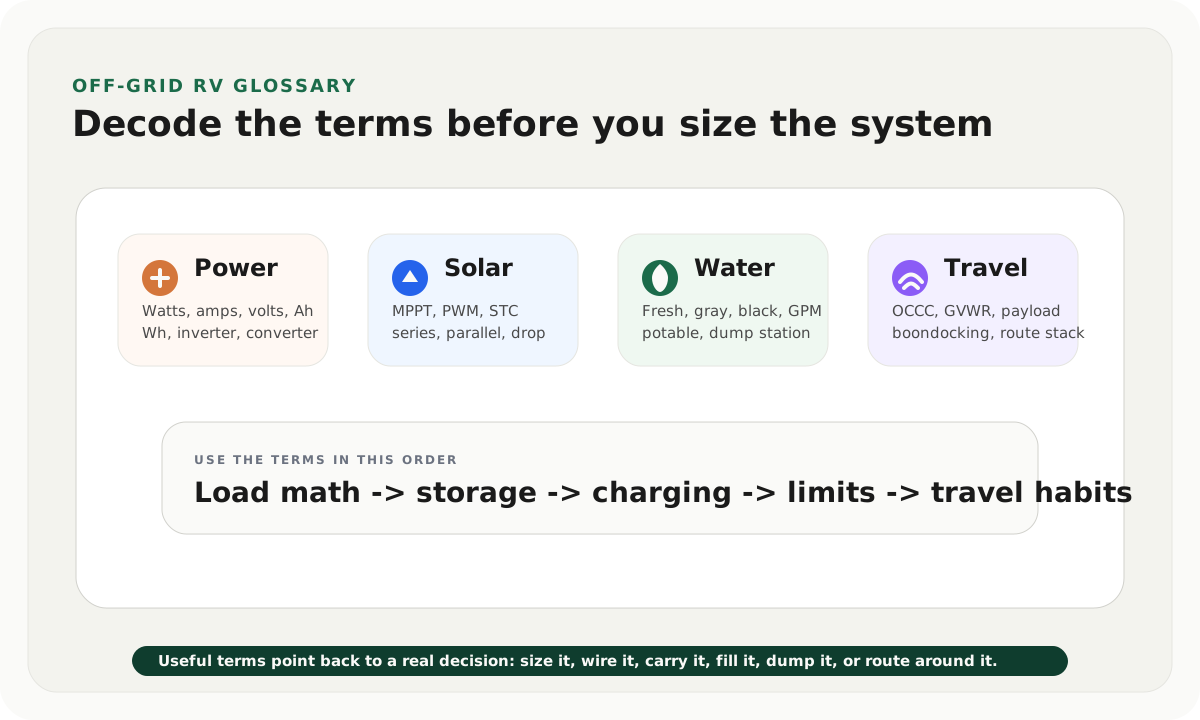
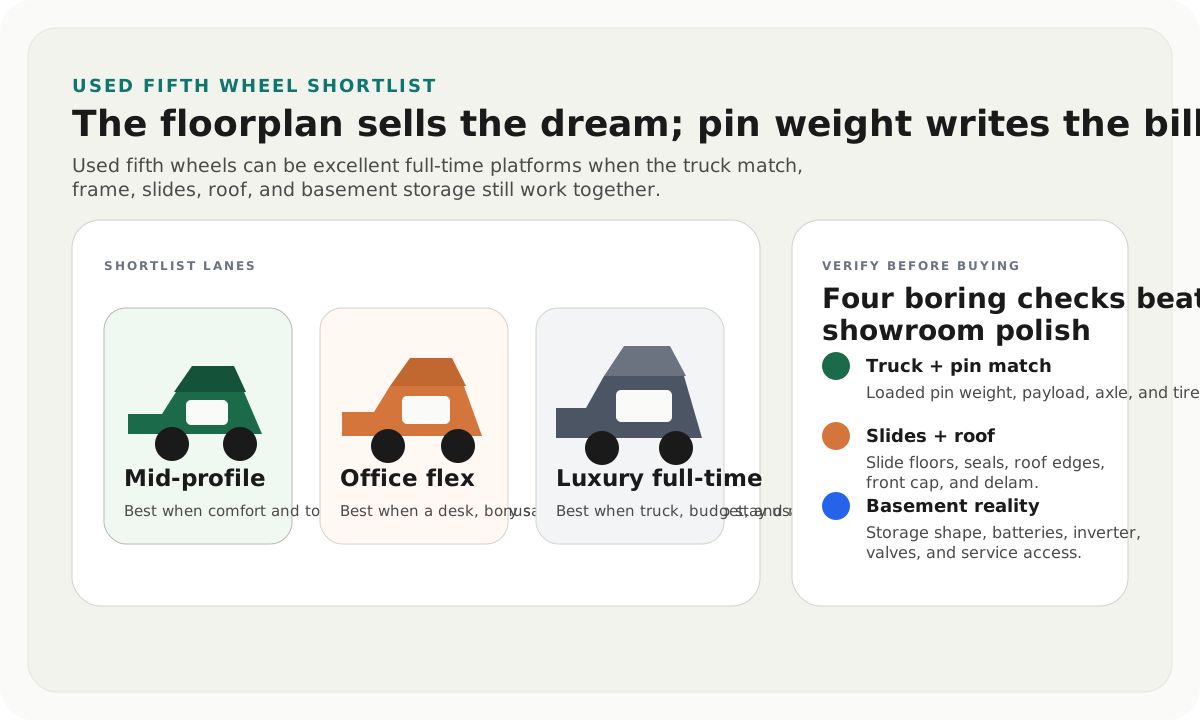
Then come the limits that catch people out. GAWR (gross axle weight rating) is the maximum each axle may carry, front and rear, so a rig can sit under its total GVWR yet still overload one axle if the load is pushed too far forward or back. GCWR governs the whole tow combination. And tongue weight (for a travel trailer) or pin weight (for a fifth wheel) is the downward force the trailer places on the hitch — typically around 10 to 15% of the loaded trailer's weight for a tongue, and roughly 15 to 25% for a fifth-wheel pin. That hitch load must fit both the hitch's rating and the tow vehicle's, and it quietly counts against the tow vehicle's own payload. The off-grid glossary keeps short definitions of each if you need a quick reference.
RV weight ratings at a glance
Compare
The main RV weight ratings, what each one limits, and where to find it
Use one comparison matrix to scan the practical differences. Small screens stack each row; wider screens keep the first column pinned.
| Spec | What it limits | Applies to | Where to find it |
|---|---|---|---|
| GVWR (gross vehicle weight rating) | Total loaded weight of one vehicle | Trailer or motorhome | Federal weight/certification label |
| GCWR (gross combined weight rating) | Tow vehicle + trailer together | The whole combo | Tow vehicle specs / door jamb |
| GAWR (gross axle weight rating) | Weight on each individual axle | Each axle | Weight label / axle sticker |
| CCC / payload | Cargo, water, and people you can add | Trailer or motorhome | Yellow cargo capacity sticker |
| Tongue / pin weight | Downward force on the hitch | Trailer-to-tow-vehicle link | Weigh it; ~10-25% of trailer weight |
Weight ratings at a glance
The numbers that keep a loaded rig safe and legal.
GVWR
One vehicle max
The most your trailer or motorhome may weigh fully loaded — a hard ceiling.
GCWR
Combo max
The most the tow vehicle and trailer may weigh together, loaded.
CCC / payload
What you can add
GVWR minus the rig's own weight — your gear, water, and people budget.
Water is heavy
~8.3 lb/gal
A 40-gallon fresh tank is about 330 lb of your cargo capacity.
Why overloading is a safety problem, not paperwork
It is tempting to treat these as suggestions, but the physics are unforgiving, and the first thing to fail is almost always a tire. Tires are rated to carry a specific load at a specific pressure, and when you exceed that — by overloading the rig, overloading one axle, or running underinflated — they build heat, and heat is what destroys tires. An overheated tire can come apart at highway speed, and tire failure is one of the most common ways an RV trip turns into a roadside emergency or worse. Staying under your axle and vehicle ratings, and keeping tires at the pressure the load actually requires, is the single highest-payoff safety habit in RVing.
The damage is not limited to tires. An overloaded rig takes longer to stop, handles worse in wind and emergency maneuvers, and stresses brakes, bearings, and the frame in ways that shorten their life and can void warranties or insurance coverage. Tongue weight has its own failure mode: too little of it — a trailer loaded heavy at the back — invites trailer sway, the dangerous side-to-side oscillation that has flipped rigs. RVSEF's whole mission is built on the reality that a large share of rigs travel overloaded or badly balanced, so treat the numbers as the safety limits they are, not as targets to creep up against.
A worked example: a half-ton towing a travel trailer
Picture a common setup: a half-ton pickup towing a mid-size travel trailer with a 7,600-pound GVWR and a 6,200-pound unloaded weight. That leaves about 1,400 pounds of cargo carrying capacity — which sounds generous until you start filling it. Top off a 40-gallon fresh tank and you have spent roughly 330 pounds; add two full propane bottles, a loaded pantry, tools, bikes, camp chairs, and a full water heater, and that 1,400 pounds evaporates quickly. Many owners are surprised to weigh their "half-empty" trailer and find it already near its GVWR before the family's gear is even aboard.
Now look at the truck, where the real limit often hides. The trailer's tongue weight — say 800 to 1,000 pounds at the upper end of the normal range — lands directly on the truck's hitch and counts against the truck's payload, the same payload that also carries passengers, the hitch hardware, and anything in the bed. A half-ton can be well within its tow rating yet over its payload once the tongue weight and family pile on, which is exactly why a tow rating alone never tells the story. The class-by-class rig guides wrestle with this same payload-versus-tow-rating trap. The only way to know is to weigh the loaded combination.
How to find and verify your numbers
You do not have to guess, because every RV carries its ratings on a federal weight and tire-loading label, usually including a yellow cargo-capacity sticker that states how much you may add. Read GVWR, the axle GAWRs, and the cargo number there, and read the tow vehicle's GCWR and payload from its door jamb and manual. But the labels only tell you the limits — they cannot tell you your actual loaded weight, and that is where a scale comes in. Pull your fully loaded, trip-ready rig onto a CAT Scale or similar public truck scale and you get the real per-axle and total weights to compare against every rating.
For the most accurate picture, RVSEF advocates weighing each wheel position, because side-to-side imbalance can overload one tire even when an axle total looks fine. Short of that, an axle-by-axle scale weigh catches the large problems and is enough for most owners to load with confidence. Do it loaded the way you actually travel — full fresh tank, full propane, all the gear, everyone aboard — and keep a margin under every number rather than hugging the limit. The used-RV inspection checklist folds a weight check into buying, and the same habit protects you on every trip after.
The short version
RV weight ratings are a connected set of limits: GVWR caps a single vehicle's loaded weight, GCWR caps the tow combination, GAWR caps each axle, CCC or payload is what you can add after the rig's own weight, and tongue or pin weight is the hitch load that also eats the tow vehicle's payload. Water at about 8.3 pounds a gallon and a heavier-than-advertised loaded rig make cargo capacity vanish faster than owners expect. Overloading overheats tires and is a leading cause of blowouts, so read your federal weight label for the limits, weigh your loaded rig at a public scale for the reality, and keep a margin under every rating.
How to check your RV's weights
- Read the labels. Find GVWR, the axle GAWRs, and the yellow cargo-capacity sticker on the RV, and the GCWR and payload on the tow vehicle's door jamb.
- Load it for real. Fill the fresh tank and propane, pack all your gear, and put everyone aboard the way you actually travel.
- Weigh at a public scale. Pull onto a CAT Scale or truck stop scale to get per-axle and total weights for the rig and the combination.
- Compare to every rating. Check the total against GVWR and GCWR, each axle against its GAWR, and the hitch load against the tongue/pin and tow-vehicle limits.
- Fix and keep margin. If anything is over, offload or rebalance weight, set tire pressure to the load, and aim to sit comfortably under each limit, not right at it.
Overloaded tires are the failure that hurts
Exceeding your axle or vehicle ratings, or running tires underinflated for the load, builds heat that causes blowouts — a top cause of RV highway emergencies. Never exceed any weight rating, set tire pressure for the actual load, and keep enough tongue or pin weight to prevent sway. These are general safety principles; follow your rig's weight label, tire placard, and a professional weigh-in rather than estimating.
Official weight-safety references
Read your rig's labels for the limits, then weigh the loaded rig for the reality.
Frequently asked
Questions RVers usually ask next.
What is GVWR on an RV?
GVWR (gross vehicle weight rating) is the maximum a single vehicle — your trailer or motorhome — may weigh fully loaded with cargo, water, propane, and passengers. It is a hard limit set by the manufacturer and printed on the federal weight label; you should never exceed it.
What's the difference between GVWR and GCWR?
GVWR limits one vehicle's total loaded weight, while GCWR (gross combined weight rating) limits the tow vehicle and trailer together. You must stay under both: each vehicle under its own GVWR, and the whole combination under the GCWR.
What is cargo carrying capacity (CCC) or payload?
It is how much weight you can add — gear, water, propane, and people — after the rig's own weight, roughly GVWR minus the loaded-but-empty weight. Water alone is about 8.3 pounds per gallon, so full tanks and gear use it up quickly; check the yellow cargo sticker for your number.
How do I find my RV's weight limits?
Read the federal weight and tire-loading label on the RV (including the yellow cargo-capacity sticker) for GVWR, axle GAWRs, and cargo capacity, and the tow vehicle's door jamb for GCWR and payload. Then weigh the loaded rig at a CAT Scale to compare your real weights against those limits.
What happens if you overload an RV?
Overloading overheats tires and is a leading cause of blowouts, lengthens stopping distance, stresses brakes and the frame, and can void warranties or insurance. Too little tongue weight separately causes dangerous trailer sway. Staying under every rating and setting tire pressure for the load is essential safety, not paperwork.
Freshness note
Last checked June 6, 2026
This topic can change when products, plans, prices, campsite rules, or fit guidance move. These notes show what was reviewed most recently.
This review included
- Confirmed the RV weight-rating definitions (GVWR, GCWR, GAWR, UVW, CCC/payload, tongue and pin weight) and the weigh-your-loaded-rig guidance against RV Safety & Education Foundation weight-safety material and CAT Scale public-scale guidance.
- Framed water weight at about 8.3 pounds per gallon and tongue/pin weight as typical percentage ranges to verify against your rig's labels rather than fixed numbers.
- Kept the tire-overload safety point general and pointed readers to weigh their loaded rig and read the federal weight label.
Recent change log
June 6, 2026
Published an RV weight-ratings explainer: GVWR/GCWR/GAWR/UVW/CCC and tongue-pin weight defined and related, how to read the labels and weigh at a CAT scale, a half-ton-towing worked example, and the overloading-safety case.
Broader editorial corrections are tracked on the Corrections and Updates page.