Glossary quick lanes
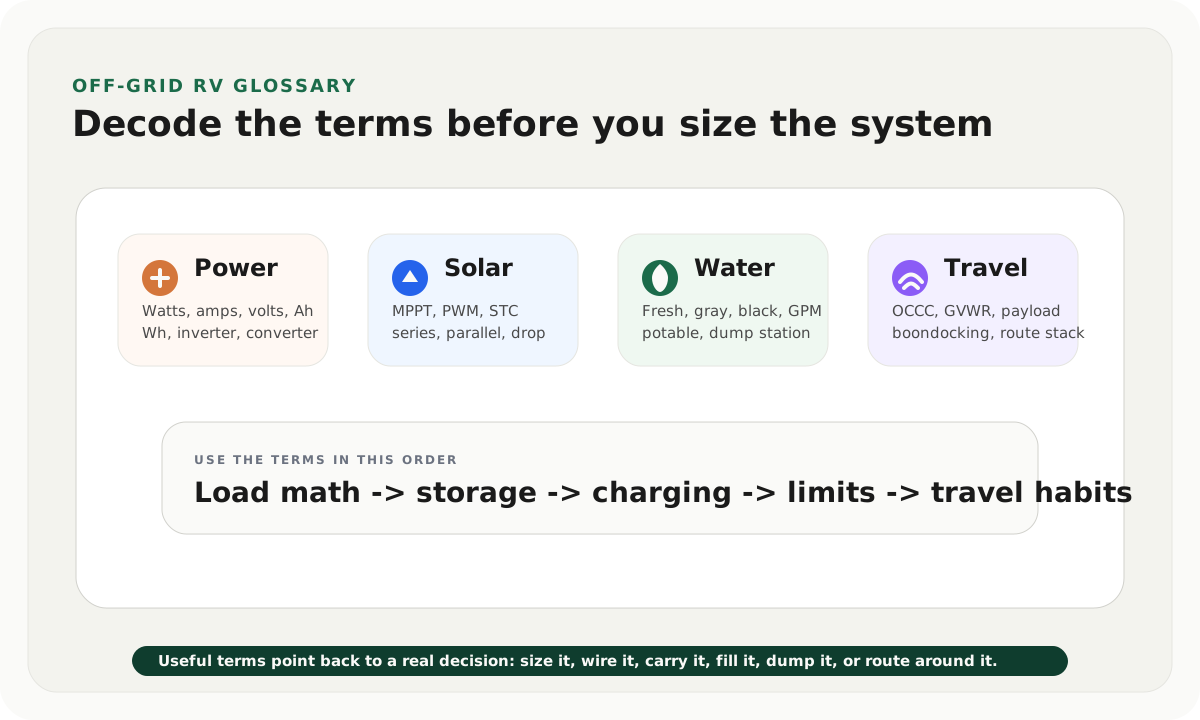
If you are new, read the terms in decision order: what uses energy, what stores it, what recharges it, what limits the rig, and what ends a stay.
Start with
Watts and watt-hours
These explain the size of the daily electrical job before you compare batteries or solar panels.
Then learn
Amp-hours and voltage
Battery capacity only makes sense when amp-hours are tied to the bank voltage and usable depth.
Do not skip
Payload and OCCC
Water, batteries, tools, pets, people, and upgrades all count against the real carrying margin.
Boondocking limiter
Water and waste
Fresh, gray, and black capacity often end a stay before the power system does.
Solar confusion
STC rating vs real harvest
Panel wattage is a lab rating. Camp shade, angle, heat, wiring, and weather decide what you actually collect.
Internet baseline
Primary connection and backup connection
Remote work is calmer when every connection has a role instead of expecting one plan to work everywhere.
Official references behind the glossary
This glossary explains terms in plain English. These sources help anchor the safety, weight, solar, wiring, and water terms that should not be reduced to casual definitions.
Pre-arrival checks
Definitions should change a decision
If a term does not affect sizing, wiring, carrying, filling, dumping, routing, or troubleshooting, it is not the term to learn first.
Ratings are limits, not goals
GVWR, payload, OCCC, tire load, and controller limits are boundaries to respect, not numbers to aim at casually.
Energy terms need units
Watts, watt-hours, amps, amp-hours, and voltage only become useful when they are tied to time, voltage, and the actual RV load.
How to use this glossary
Do not try to memorize every term before you plan an RV upgrade.
Use this page like a translator.
When a calculator asks for watt-hours, use the power section. When a battery guide compares amp-hours, state of charge, or depth of discharge, use the battery section. When a solar guide mentions MPPT, STC, series wiring, or voltage drop, use the solar section. When a rig review talks about payload, OCCC, tank capacity, or boondocking fit, use the rig and water sections.
The point is not to sound technical. The point is to make better decisions with less guessing.
Here is the fastest way to use it:
- Identify the decision in front of you.
- Read only the terms that affect that decision.
- Run the matching calculator or guide.
- Come back when the next unfamiliar term appears.
For example, if you are trying to decide whether 200Ah of lithium is enough, start with watt-hours, amp-hours, voltage, state of charge, and depth of discharge. If you are deciding whether a trailer can carry full water, start with GVWR, payload, CCC, tongue weight, fresh tank, gray tank, and black tank. If you are planning internet for work, start with hotspot, router, antenna, primary connection, backup connection, and deprioritization.
The glossary is not a test. It is a map. You only need the part of the map that gets you through the next purchase or troubleshooting step.
A simple example: one weekend, four term groups
Say you are planning a three-night boondocking weekend with a travel trailer, 200Ah lithium bank, 400W of roof solar, and two portable water containers.
The power terms tell you whether the loads fit the battery. A 60W laptop used for five hours is about 300Wh. A 40W fridge running part of the day may use several hundred watt-hours. Watts tell you the rate. Watt-hours tell you the daily energy budget.
The battery terms tell you how much reserve you actually have. A 200Ah lithium bank at 12.8V is about 2,560Wh nominal before reserve and losses. State of charge tells you whether the bank is recovering. Depth of discharge tells you how deeply you are using it.
The solar terms tell you whether the bank can refill. A 400W STC-rated array will not deliver 400W all day. Shade, panel angle, controller behavior, temperature, and wiring decide real harvest.
The water and rig terms decide whether the trip is physically realistic. Forty gallons of fresh water weighs about 334 pounds. That weight counts against payload or cargo capacity. Gray tank capacity may end the stay before the fresh tank is empty.
That is why off-grid planning feels confusing at first. The terms live in different systems, but the trip uses them all at once.
Power and battery terms
Compare
Power and battery terms for off-grid RV planning
Use one comparison matrix to scan the practical differences. Small screens stack each row; wider screens keep the first column pinned.
| Spec | Plain-English meaning | Why it matters in an RV | Common mix-up |
|---|---|---|---|
| Watt | A measure of how fast something uses or produces power | A 60W laptop uses less power at a moment than a 1,500W microwave | Watts are not storage. They describe rate, not how long the battery lasts |
| Watt-hour | A measure of energy used or stored over time | A 60W laptop used for 5 hours is about 300Wh before losses | Do not compare daily use in watts alone. Use watt-hours |
| Amp | A measure of electrical current | High-current inverter loads require serious cable, fusing, and battery planning | Amps depend on voltage, so 50A at 12V is not the same power as 50A at 120V |
| Amp-hour | A battery-capacity shorthand tied to a specific voltage | 100Ah at 12V is roughly 1,200Wh before usable-capacity limits and losses | Amp-hours without voltage can mislead battery comparisons |
| Voltage | Electrical pressure in the system | Most RV house systems are 12V, while some larger builds use 24V or 48V designs | Voltage does not tell you total stored energy by itself |
| State of charge | How full the battery bank is | A monitor or shunt helps show whether the bank is recovering between trips or days | Voltage alone can be a rough clue, but it is not a perfect fuel gauge |
| Depth of discharge | How much of the bank you use before recharging | Lithium often allows more usable capacity than AGM before performance or life suffers | Rated capacity and comfortable usable capacity are not always the same |
| BMS | Battery management system inside many lithium batteries | It helps protect against unsafe charge, discharge, temperature, or voltage behavior | A BMS is protection, not permission to ignore system sizing |
The most common beginner mix-up is comparing watts and amp-hours directly. A 100Ah battery sounds simple, but it is not a daily-use number until you convert it through voltage and usable capacity. A 1,500W microwave sounds like one number, but the energy cost depends on how long it runs and how much inverter loss sits between the battery and the appliance.
For RV planning, watt-hours are often the cleaner mental unit. Use watts to describe the load right now. Use watt-hours to describe the day. Use amp-hours to compare batteries only after voltage is clear.
Common power-term mistakes
The first mistake is saying "my laptop uses 60 watts per day." It uses 60 watts while running, not per day. If it runs for five hours, the energy use is about 300Wh before charging losses.
The second mistake is assuming battery voltage is a fuel gauge. Voltage can help, but lithium batteries hold voltage differently than lead-acid. A shunt-based monitor is much better for real state-of-charge tracking.
The third mistake is treating inverter size as available energy. A 3,000W inverter can run larger loads, but the battery bank decides for how long. A large inverter on a small bank can drain power quickly.
Charging and solar terms
Compare
Solar and charging terms that shape RV system design
Use one comparison matrix to scan the practical differences. Small screens stack each row; wider screens keep the first column pinned.
| Spec | Plain-English meaning | Why it matters in an RV | Common mix-up |
|---|---|---|---|
| Shore power | Outside AC power supplied by a pedestal, outlet, or generator path | It runs AC loads and often feeds the converter or charger | Shore power quality still needs protection and load awareness |
| Converter or charger | The device that charges the house battery from shore or generator power | Older converters may not charge lithium batteries correctly | A converter is not the same thing as an inverter |
| Inverter | Turns battery DC power into 120V AC power | It lets selected outlets or appliances run from the battery bank | An inverter does not create energy. It consumes battery reserve |
| Inverter charger | Combines inverter behavior with shore-power charging and often transfer behavior | It can simplify larger builds when AC and charging need to be coordinated | It is not always necessary for smaller or simpler rigs |
| EMS | Electrical management system | It can monitor or disconnect unsafe pedestal power depending on the model | A basic surge protector and an EMS are not always the same thing |
| MPPT | A solar controller type that optimizes panel output into battery charging | Useful for many roof arrays, higher panel voltages, and better charging efficiency | MPPT still needs correct array voltage and battery settings |
| PWM | A simpler solar controller type | Can work for small basic setups, but is less flexible than MPPT in many RV systems | Cheap controller does not always mean cheap system if harvest suffers |
| STC rating | The lab-condition wattage printed on a solar panel | A 200W panel rarely produces 200W all day in real camp conditions | Panel rating is not the same as daily harvest |
| Series wiring | Panels connected so voltage adds | Can help controller efficiency and reduce current over a roof run | Shade on one panel can affect the string depending on layout and bypass behavior |
| Parallel wiring | Panels connected so current adds | Can be more shade-tolerant in some layouts but increases current | Higher current can mean larger wire and more attention to fusing |
| Voltage drop | Power lost because wire has resistance | Long cable runs and high current can make charging or inverter performance worse | The fix is not always bigger hardware. Sometimes it is shorter, better-routed cable |
| DC-DC charger | A charger that manages alternator-to-house-bank charging | Common on lithium upgrades because it limits current and uses the right charge profile | It is not the same as a simple battery isolator |
Charging terms matter because many RV upgrades fail at the handoff between sources. A solar panel, alternator charger, shore converter, and inverter/charger may all touch the same battery bank. If one source is configured for the wrong chemistry or voltage, the system may feel inconsistent even when the battery itself is fine.
The same is true for wiring. Higher current needs more attention to cable size, voltage drop, fusing, and connection quality. This is why a high-watt inverter is not only an appliance decision. It becomes a cable, fuse, battery, ventilation, and installation decision.
When you see MPPT, PWM, series, parallel, and voltage drop in a guide, the practical question is not "which term sounds more advanced?" The question is "which layout safely moves the power I need in the roof and battery compartment I actually have?"
A solar-term example
A 200W panel is rated under standard test conditions. That does not mean it produces 200W from breakfast to dinner. In a real campsite, a panel might produce near its rating for a short window, less in heat, less under haze, less under shade, and nothing meaningful after sunset.
If two 200W panels are wired in series, voltage adds. That can help the controller wake up and reduce current on the roof run, but it also raises cold-weather voltage questions and can behave differently under shade. If those panels are wired in parallel, current adds. That may help some shade layouts but asks more from wire sizing and protection.
The right term to learn is the one that changes your layout. If your roof has partial shade, series and parallel matter. If the controller is near its PV input limit, voltage matters. If the cable run is long, voltage drop matters.
Water and boondocking terms
Compare
Water and boondocking terms that affect stay length
Use one comparison matrix to scan the practical differences. Small screens stack each row; wider screens keep the first column pinned.
| Spec | Plain-English meaning | Why it matters in an RV | Common mix-up |
|---|---|---|---|
| Boondocking | Camping without hookups, often on public land or undeveloped sites | Power, water, waste, access, weather, legality, and etiquette all matter | It is not automatically legal just because a spot appears on an app |
| Dry camping | Camping without hookups, including in campgrounds, lots, events, or public land | It describes the lack of hookups more than the type of location | Boondocking is a form of dry camping, but not all dry camping is remote public-land camping |
| Fresh tank | The onboard tank that holds usable water | It sets the starting water supply for showers, dishes, drinking, and flushing | Tank size only helps if payload and refill planning support carrying the water |
| Gray tank | The tank that catches sink and shower water | It often fills faster than beginners expect | Saving fresh water does not automatically solve gray tank capacity |
| Black tank | The tank that holds toilet waste in many RVs | It affects dump timing, water habits, and bathroom strategy | Do not treat black tank management like gray water management |
| GPM | Gallons per minute | Faucet, showerhead, and pump flow affect how quickly water is used | A low-flow fixture helps only if the routine changes too |
| Potable water | Water intended to be safe for drinking | Fill locations, hoses, filters, and storage habits matter | A spigot existing does not mean it is potable |
| Dump station | A place to empty waste tanks legally | Dump access can decide trip rhythm just as much as campsite quality | Not every campground or fuel stop offers public dumping |
Water terms are easy to underestimate because the words sound familiar. Fresh, gray, and black tanks are not just storage labels. They decide the stay length.
A rig with 60 gallons of fresh and 30 gallons of gray may not support the same routine as a rig with 45 gallons fresh and 45 gallons gray. The first rig may run out of gray capacity while fresh water remains. The second may feel more balanced even with a smaller fresh tank.
Boondocking and dry camping are also worth separating. Dry camping simply means no hookups. Boondocking usually implies a more self-directed setting, often dispersed or undeveloped. The practical difference is that boondocking adds land rules, road access, fire restrictions, etiquette, and exit planning.
A water-term example
Suppose two people use 8 gallons of water per day. A 40-gallon fresh tank looks like five days. But if the gray tank holds only 25 gallons and most water goes through the sink and shower, the stay may end closer to three days unless the routine changes.
Now add portable containers. A 7-gallon jug weighs about 58 pounds of water before container weight. That extra water helps only if the rig has payload capacity, a safe storage place, and a workable transfer method. The term "portable water" is not useful until it becomes a specific lift, storage, and pour plan.
Rig weight and fit terms
Compare
Rig weight and fit terms that affect off-grid upgrades
Use one comparison matrix to scan the practical differences. Small screens stack each row; wider screens keep the first column pinned.
| Spec | Plain-English meaning | Why it matters in an RV | Common mix-up |
|---|---|---|---|
| GVWR | Gross vehicle weight rating | The maximum loaded weight the RV is rated to carry | It is a limit, not a target |
| Payload | How much people, water, cargo, and upgrades the rig can carry | Batteries, solar gear, tools, water, and passengers all count | Payload is not just storage space. It is weight capacity |
| OCCC | Occupant and cargo carrying capacity shown on many motorhome stickers | It helps reveal whether a Class C or motorhome can carry water, people, pets, gear, and upgrades | Do not estimate OCCC from model length. Read the actual sticker |
| CCC | Cargo carrying capacity | Used in weight planning for many RVs and towables | The number can change with options and actual configuration |
| Tongue weight | The trailer weight pressing down on the hitch | It affects tow vehicle payload and handling | A trailer can be within tow rating but still overload payload |
| Pin weight | The fifth wheel weight carried in the truck bed | It often controls whether the tow vehicle is realistic | Dry pin weight is not the same as loaded pin weight |
Rig weight terms protect you from building a system the RV cannot safely carry. Lithium batteries are lighter than AGM, but they still weigh something. Solar panels, inverters, tools, water, spare parts, bikes, pets, and people all count. The fact that there is physical storage space does not mean there is legal or safe carrying capacity.
The easiest mistake is using dry weight as a shopping shortcut. Dry weight does not include the full real-life load. Full-time and boondocking rigs rarely travel as empty brochure examples. They carry water, food, tools, camping gear, work equipment, hoses, blocks, spare parts, and upgrades.
If one term matters most here, it is the actual sticker on the actual rig. Published model specs help you shortlist. Stickers and scale weights tell you what you can really carry.
A rig-weight example
A travel trailer can be under its advertised tow rating and still overload the tow vehicle's payload through tongue weight. A fifth wheel can be under tow rating and still overload truck payload through pin weight. A Class C can look compact and still have a tight OCCC once people, water, food, pets, and upgrades are loaded.
This is why payload, OCCC, tongue weight, and pin weight appear so often in rig reviews. They are not paperwork. They decide whether the off-grid build is safe before the first solar panel is installed.
Connectivity and remote-work terms
Compare
Connectivity terms for working from an RV
Use one comparison matrix to scan the practical differences. Small screens stack each row; wider screens keep the first column pinned.
| Spec | Plain-English meaning | Why it matters in an RV | Common mix-up |
|---|---|---|---|
| Hotspot | A device or phone feature that shares cellular data as Wi-Fi | It can be the simplest internet lane when carrier coverage is strong | Signal bars do not always equal usable work performance |
| Deprioritization | When a carrier slows data during congestion or after certain usage thresholds | It can make a plan feel great in one place and weak in another | Unlimited data does not always mean unlimited high-priority data |
| Router | A device that manages the local network and can combine or switch internet sources | Useful when work devices, cameras, tablets, and backups need a stable local setup | A router cannot fix a route with no usable internet source |
| Antenna | Hardware that helps a modem receive or transmit signal | Placement, cable loss, frequency support, and carrier bands all matter | An antenna is not a guaranteed speed upgrade |
| Primary connection | The connection you expect to use most often | It shapes monthly cost, power draw, setup friction, and route confidence | The primary connection should match your route, not the internet's favorite gadget |
| Backup connection | The second path you use when the primary connection fails | Important for video calls, deadlines, and weather-driven route changes | A backup only helps if it uses a different failure pattern |
Connectivity terms matter because internet failures have different causes. A hotspot can fail because the carrier has no coverage. A cellular router can fail because the plan is deprioritized or the tower is congested. Starlink can fail because trees block sky view. A booster can help weak usable signal but cannot create service where the carrier path is not viable.
The best remote-work setup is usually a stack. One connection is primary because it fits most routes. One connection is backup because it fails differently. The router, antennas, and mounts only make sense after those roles are clear.
If you work from the RV, do not learn internet terms as gadget names. Learn them as failure patterns. That makes the internet backup planner much more useful.
Four terms that change many plans
Watt-hour changes power planning because it turns appliance use into a daily energy budget.
OCCC changes motorhome shopping because it shows how much room remains for people, water, gear, and upgrades.
Gray tank changes boondocking planning because it often fills before fresh water is gone.
Backup connection changes remote-work routing because it forces the internet plan to survive more than one failure pattern.
If one term changes the whole plan
If a term feels abstract, ask what decision it changes.
Watts change appliance expectations.
Watt-hours change daily energy planning.
Amp-hours change battery-bank comparisons.
Voltage changes current, cable size, and equipment compatibility.
OCCC changes whether the rig can carry the upgrade.
Gray tank capacity changes how long the stay feels comfortable.
Deprioritization changes whether an internet plan is truly work-ready.
The useful terms are the ones that make the next decision clearer.
Where to go next
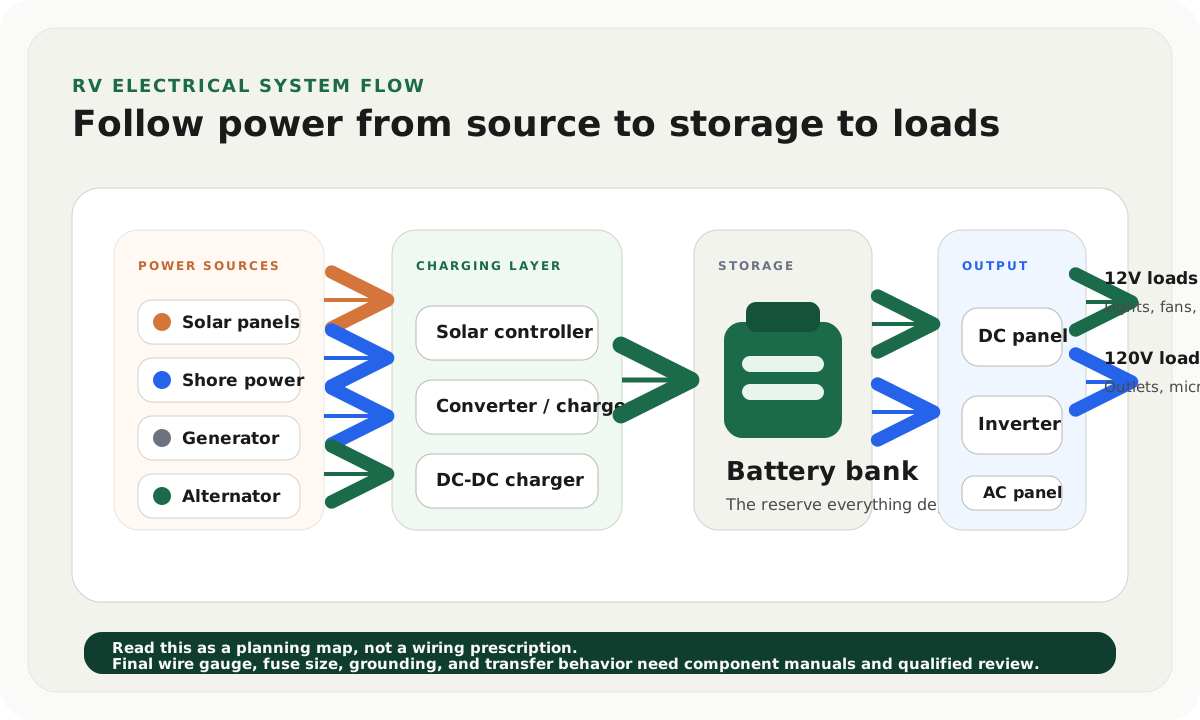
Use the RV electrical system diagram when you want to see how the power terms fit together.
Use the solar calculator when you are ready to turn watts and watt-hours into a panel, battery, and inverter target.
Use the battery calculator when amp-hours, voltage, and usable reserve need to become an actual bank size.
Use the water calculator when fresh, gray, black, and GPM habits need to become a realistic stay-length estimate.
Use the internet backup planner when primary connection, backup connection, cellular, and satellite tradeoffs need to match a real route.
Glossary terms should reduce guessing
If a definition does not change how you size, buy, install, inspect, carry, fill, dump, or route something, it is probably trivia. Start with the terms that affect the next decision in front of you.
Frequently asked
Questions RVers usually ask next.
What RV electrical term should beginners learn first?
Start with watts and watt-hours. Watts describe how fast something uses power, while watt-hours describe how much energy it uses over time. Those two ideas make solar, battery, and inverter planning much easier.
Is amp-hour the same as watt-hour?
No. Amp-hours are tied to voltage, while watt-hours describe energy more directly. A 100Ah battery at 12V is roughly 1,200Wh before usable-capacity limits and losses.
What is the difference between boondocking and dry camping?
Dry camping means camping without hookups. Boondocking usually refers to dry camping in more undeveloped or dispersed settings, often on public land, but legality and land rules still need to be confirmed.
Why do rig weight terms matter for off-grid upgrades?
Solar panels, batteries, water, tools, pets, people, and storage all add weight. GVWR, payload, OCCC, CCC, tongue weight, and pin weight decide whether the rig can safely carry the setup.
Freshness note
Last checked April 21, 2026
This topic can change when products, plans, prices, campsite rules, or fit guidance move. These notes show what was reviewed most recently.
This review included
- Checked definitions against NHTSA tire-safety routing, Go RVing weight-rating guidance, NREL PVWatts, Victron wiring references, and EPA emergency water guidance.
- Grouped common RV solar, battery, water, boondocking, payload, and connectivity terms by the decisions they affect.
- Expanded the glossary with practical examples, common mix-ups, and calculator handoffs so readers can apply definitions instead of memorizing them.
Recent change log
April 21, 2026
Expanded the glossary with official source references, real planning examples, and clearer explanations for how terms change buying, sizing, wiring, and boondocking decisions.
April 10, 2026
Published a glossary-style reference page for off-grid RV terms that appear across calculators, guides, and buyer guides.
April 10, 2026
Added grouped term tables for power, batteries, solar charging, water, boondocking, rig weights, and connectivity.
Broader editorial corrections are tracked on the Corrections and Updates page.