Shortlist first
Use this to find the winner first, then compare the alternates only if their tradeoffs fit your rig better.
Shortlist labels are editorial recommendations, not popularity rankings. Fit score still matters, but the label tells you why each pick made this guide.
How fit scores work
Scores are editorial fit scores, not user-review averages. The rubric weighs stated RV-use fit, verified specs and limits, whole-rig friction, visible downsides or support risk, and value for the specific job in this guide. Read the full scoring rubric.
If you need one baseline option before reading the full guide, start with Nature's Head Composting Toilet for most rv self-contained installs.
The first option to evaluate if you want the strongest all-around fit for this guide. Check the other cards only if their award label matches your constraint better.
| Product | Why shortlisted | Fit score | Key spec | Best for | Actions |
|---|---|---|---|---|---|
| Nature's Head Composting Toilet Links to: Nature's Head Composting Toilet | Best overall The first option to evaluate if you want the strongest all-around fit for this guide. | 4.7 / 5 fit scoreScore rubric | $965 direct | 23 lb | 21 x 20 x 19 in | 2.2 gal liquids | 60-80 solid uses | Most RV self-contained installs | Read Nature's Head Composting Toilet notesCheck listing at Nature's HeadMerchant link - direct listing. Verify price and specs at Nature's Head. |
| Air Head Classic Links to: Air Head Classic Composting Toilet | Also great A strong alternate when its specific tradeoffs fit your rig better than the winner. | 4.5 / 5 fit score | $1,095 direct | 25-30 lb | 18.76 in W | 19.04 in D | 5 gal solids | Configurable compact installs | Read Air Head Classic notesCheck listing at Air HeadMerchant link - direct listing. Verify price and specs at Air Head. |
| Separett Villa Extend Links to: Separett Villa Extend | Also great A strong alternate when its specific tradeoffs fit your rig better than the winner. | 4.0 / 5 fit score | $1,049 direct | 28 lb | 26.5 x 18.5 x 21.3 in | urine drain | external solids container | Stationary or custom external-container builds | Read Separett Villa Extend notesCheck listing at SeparettMerchant link - direct listing. Verify price and specs at Separett. |
Why this comparison exists
An RV composting toilet is not just a toilet purchase. It changes how the bathroom, tanks, venting, power, and daily waste routine work.
The right composting toilet can stretch dump-station intervals, reduce black-tank dependence, and make some boondocking styles calmer. The wrong one can create a thousand-dollar chore in a space where nobody wants a chore.
The real comparison is not "which composting toilet is best." It is: which waste routine fits your rig, your bathroom footprint, your crew, and the way you actually camp?
If your current problem is overall tank management, start with the boondocking bathroom and waste strategy. If you are trying to estimate whether waste, water, or power ends your stay first, read how long you can boondock in an RV and run the water calculator before buying hardware.
Composting toilets do not make waste disappear
These toilets separate liquids and solids so odor and tank pressure are easier to manage. You still have to empty liquids, manage solids legally, keep the fan and vent working, and make sure everyone in the rig uses the system correctly.
The self-contained RV lane is different from the cabin lane
Nature's Head and Air Head are the two cleanest fits for most mobile RV installs because the waste containers travel with the toilet. Liquids go into a removable bottle. Solids stay in a removable bin with a composting medium. A small fan keeps air moving through a vent hose to the exterior.
That does not make either one effortless. You still need a vent route through a wall, roof, floor, or existing exterior path. You also need a 12V fan supply and enough physical clearance to remove the bottle and solids bin without turning every emptying day into a wrestling match.
Separett's current Villa Extend is a different animal. It is a urine-diverting, waterless toilet with a 12V fan, but the solids drop into an external chamber below the toilet area, and urine is routed through a hose to a container, graywater system, soakaway, or other approved handling method. That can be excellent in a cabin or custom stationary build. It is awkward in many travel trailers, vans, and Class C bathrooms.
If you have a park-model RV, a skoolie build with underfloor access, or a stationary off-grid pad, Separett deserves a look. If you want a straightforward replacement for a black-tank toilet in a moving RV, start with Nature's Head or Air Head first.
Liquids handling is the daily reality
Most first-time buyers focus on the solids bin because that feels like the strange part. In daily RV life, the liquids bottle usually becomes the more frequent routine.
Nature's Head uses a 2.2 gallon urine bottle. Air Head Classic lets you choose a 2 gallon bottle or a compact 1 gallon bottle. Separett Villa Extend does not use a front bottle by default; it sends urine through a 1 1/4 in hose that must be routed correctly and handled legally.
That difference matters more than marketing copy. A couple using a bottle toilet every day may be emptying liquids every couple of days, depending on hydration, temperature, nighttime use, and whether public facilities naturally fit the trip. A family can fill a bottle much faster.
Liquids are also where the crew has to be aligned. Overfilling, poor aim, bottle handling, and guest confusion are the practical complaints that turn a good composting toilet into a bad ownership experience. If you want longer stays but do not want to change toilet habits, a portable waste tote or better dump-station planning may be the calmer move.
Venting is not optional
The fan and vent are what keep moisture and odor moving the right direction. Treating the vent as optional is the fastest way to dislike the system.
Nature's Head includes a 12V fan hookup and 5 ft of 1.5 in vent hose with ends. Air Head includes a fan, fan housing, hose, and connectors, and its fan housing can be ordered straight or angled. Separett Villa Extend uses a stronger 12V fan and a 3 in Schedule 20 or 40 PVC vent path that can run roughly 20 ft with up to three 90-degree bends.
That tells you the install lane. Nature's Head and Air Head are better for compact RV bathrooms where you can route a smaller vent hose. Separett wants a more building-style vent path and urine drain plan.
Power draw is small, but continuous. Nature's Head and Air Head are not major battery loads compared with refrigeration, laptops, or fans, but the ventilation fan should be part of the always-on load picture. If you are chasing tiny overnight drains, the RV parasitic draw guide is worth reading before you add another continuous device.
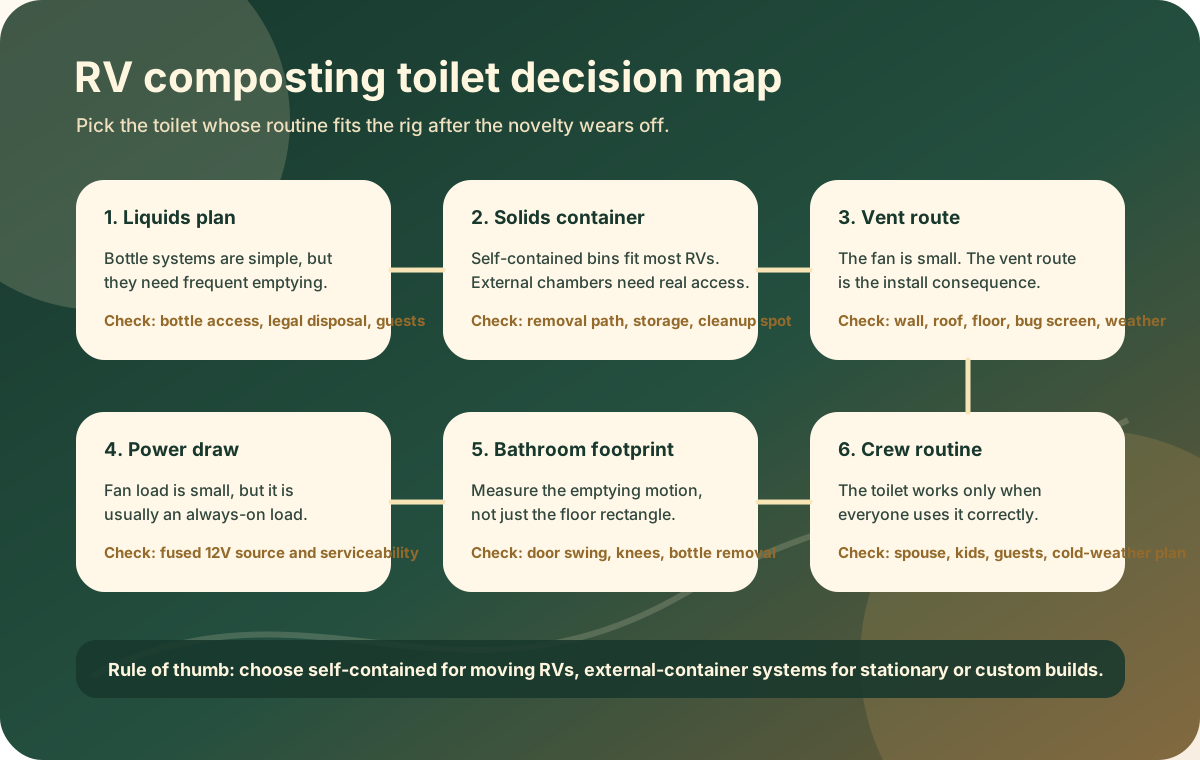
RV composting toilet decision checkpoints
Use these checks before you remove a black-tank toilet or drill a vent hole. The best product is the one whose routine still feels sane after the novelty wears off.
Daily routine
Liquids first
The urine bottle or urine drain usually needs attention more often than the solids bin.
Install route
Vent and power required
A waterless toilet still needs air movement, a fan supply, exterior routing, and service access.
Best RV default
Self-contained bottle system
Most moving RVs are better served by a removable-bottle system than an external-container cabin design.
Crew fit
Non-negotiable
Everyone has to understand separation, bottle emptying, medium use, and what not to put in the toilet.
Stay-length gain
Depends on the limiter
A toilet upgrade helps only if waste capacity is actually what ends your trips.
Skip signal
No service access
If you cannot empty containers cleanly or vent outside, do not force the install.
Exact install specs compared
Compare
RV composting toilet spec comparison
Use one comparison matrix to scan the practical differences. Small screens stack each row; wider screens keep the first column pinned.
| Spec | Nature's Head Composting Toilet | Air Head Classic | Separett Villa Extend |
|---|---|---|---|
| Price checked | $965 direct | $1,095 direct | $1,049 direct |
| Best fit | Most RVers who want a self-contained composting toilet | Compact or odd-shaped installs that need configuration choices | Stationary, park-model, cabin, or custom underfloor container builds |
| Weight | 23 lb | Approx. 25-30 lb complete unit | 28 lb |
| Dimensions | 21 in H x 20 in W x 19 in D | 18.76 in W; comfort-seat diagram shows 19.04 in D x 13.75 in H | 26.5 in L x 18.5 in W x 21.3 in H |
| Liquids handling | 2.2 gal removable bottle | 1 gal or 2 gal removable bottle | 1 1/4 in urine hose to external handling |
| Solids handling | Self-contained solids bin, approx. 60-80 solid uses | 5 gal solids tank, up to about 80 uses | External solids chamber required; container not included with toilet |
| Venting | 12V fan and 5 ft of 1.5 in hose included | Fan, housing, 5 ft hose, and connectors included | 3 in Schedule 20/40 PVC vent, up to about 20 ft and three 90-degree bends |
| Power requirement | 12V fan hookup | 12V fan, about 0.06A and 1.44Ah per day | 12V fan, 2.5W / 210mA, 0.06 kWh per day; 110-240V adapter included |
| Warranty signal | 5-year warranty against defects | 5-year warranty stated on product page | 5-year warranty against manufacturing defects |
| Main watchout | Bottle routine and physical clearance still matter | Options are useful but ordering and fit checks take more attention | Not a simple mobile RV swap because it needs external solids access and urine routing |
Worked example: why the bathroom layout decides the winner
A composting toilet can look like a simple tank-delete upgrade until you map the bathroom. A wet bath in a van, a compact travel trailer bath, and a stationary-style custom rig do not need the same toilet.
In a small wet bath, bottle access, crank clearance, lid clearance, and how the vent hose exits the enclosure can matter more than the published solids capacity. A toilet that is technically compact can still be wrong if the urine bottle cannot be removed without turning the whole routine into yoga.
In a normal RV bathroom, the Nature's Head path is easier to recommend because the solids and liquids handling stay self-contained. The buyer still needs vent routing, 12V fan power, mounting confidence, and a realistic emptying routine, but the install is closer to what most RVers imagine when they hear "composting toilet."
In a custom build, park model, cabin-like RV, or skoolie with external access, Separett can make more sense. The problem is that it is not a casual swap for a normal RV toilet. The underfloor or external solids path is the design, not a side detail.
Before buying, mock up the toilet footprint with cardboard and physically rehearse three moments: sitting, removing the liquids container, and accessing the solids chamber. If any of those feel awkward in the bathroom, the best spec table will not rescue the daily routine.
The shortlist
- Latest product check
- Specs, fit notes, and current listing context were reviewed June 6, 2026.
- Evidence label
- Spec-verified: Score is based on current published specs, official documentation, pricing context, compatibility, and RV-use fit analysis.
- Price context
- Pricing and availability can change, so confirm the merchant listing before buying.
Product facts last checked June 6, 2026
Nature's Head Composting Toilet
Editorial fit score
Nature's Head lists the standard composting toilet at $965 direct, 23 lb, and 21 in H x 20 in W x 19 in D. The official product page lists a 2.2 gallon liquids bottle, roughly 60-80 solid uses before emptying depending on medium and conditions, a pre-installed 12V fan hookup, 5 ft of 1.5 in vent hose with ends, mounting hardware, and a warranty card. The separate warranty page states five years against defects in materials and workmanship.
Review verdict
- Short verdict
- The best overall RV composting toilet for owners who want a proven self-contained system without designing an external urine and solids infrastructure.
- Evidence used
- Spec-verified
- Score is based on current published specs, official documentation, pricing context, compatibility, and RV-use fit analysis.
- Why it made the shortlist
- Best overall
- The first option to evaluate if you want the strongest all-around fit for this guide.
- Best if
- Most RV self-contained installs
- Why not this product?
- Still requires a real exterior vent route and 12V fan wiring
- Product check date
- Specs, fit notes, and current listing context were last checked June 6, 2026.
Key specs
- Price checked
- $965 direct
- Dimensions
- 21 x 20 x 19 in
- Weight
- 23 lb
- Liquids
- 2.2 gal bottle
Score basis
Score is based on current published specs, official documentation, pricing context, compatibility, and RV-use fit analysis. These are editorial fit scores, not customer-review averages. Read the scoring rubric.
- RV-use fit
- 30% weight
- Verified specs and limits
- 25% weight
- Whole-rig friction
- 20% weight
- Downsides and support risk
- 15% weight
- Value for the job
- 10% weight
How directly the product solves the specific off-grid RV job in this guide.
Capacity, dimensions, electrical limits, protection claims, and compatibility constraints we can verify from current sources.
Install effort, storage, wiring, service access, weight, refill workflow, or daily-use hassle.
Known tradeoffs, unclear claims, warranty coverage, support risk, and wrong-buyer failure modes.
Whether the price makes sense after fit, specs, and tradeoffs still hold.
Testing limits
- This is not a hands-on endurance or lab test unless the review explicitly says so.
- Specs, pricing, bundles, and availability can change, so confirm the current listing and manual before buying.
Reasons to buy
- Strongest default choice for most RVers because the waste containers stay self-contained
- Clear official dimensions, price, bottle capacity, solids-use range, and included vent parts
- Good fit for owners who want to reduce black-tank pressure without building a cabin-style toilet system
Watch-outs
- Still requires a real exterior vent route and 12V fan wiring
- The 2.2 gallon liquids bottle can become a frequent chore for couples, families, or hot-weather hydration
- The footprint and height may be awkward in very small wet baths or bathrooms with tight door swing
Whole-bank math
Best if
You want the cleanest RV default
It is the least complicated lane when the goal is a mobile, self-contained composting toilet.
Watch for
Bottle access
Measure the bathroom as if you are removing a nearly full liquids bottle, not just placing an empty toilet.
Short verdict
Best all-around RV fit
It does not remove the waste routine, but it keeps that routine understandable for most rigs.
Related parts and setup checks
Boondocking bathroom strategy
Use this before assuming a toilet swap is the only way to stretch a stay.
Open Boondocking bathroom strategyHow long can you boondock?
Check whether waste is actually your first limiter before replacing the toilet.
Open How long can you boondock?Water calculator
Model water use alongside toilet strategy because gray water can still end the stay first.
Open Water calculatorCheck current listing
Nature's Head Composting Toilet
Use the listing after the fit notes make sense for your rig. Pricing and availability can change, so verify the merchant page before buying.
- Latest product check
- Specs, fit notes, and current listing context were reviewed June 6, 2026.
- Evidence label
- Spec-verified: Score is based on current published specs, official documentation, pricing context, compatibility, and RV-use fit analysis.
- Price context
- Pricing and availability can change, so confirm the merchant listing before buying.
Product facts last checked June 6, 2026
Air Head Classic
Editorial fit score
Air Head lists the Classic at $1,095 direct with selectable seat type, crank-handle side, fan housing, tank shape, and either a 2 gallon or 1 gallon liquids bottle. The product page lists a 5 gallon solids tank for up to 80 uses, a fan, fan housing, detachable crank handle, floor mounting brackets, 5 ft hose, hose connectors, bowl liners, and a 5-year warranty signal. The FAQ lists the complete unit at roughly 25-30 lb and the 12V fan at about 0.06A, or 1.44Ah per day. The official dimension diagrams show the Classic front width at 18.76 in and the comfort-seat side profile at 19.04 in deep by 13.75 in high.
Review verdict
- Short verdict
- The best configurable RV composting toilet when the install space is tight, unusual, or easier to solve with seat, tank, fan housing, and crank-side options.
- Evidence used
- Spec-verified
- Score is based on current published specs, official documentation, pricing context, compatibility, and RV-use fit analysis.
- Why it made the shortlist
- Also great
- A strong alternate when its specific tradeoffs fit your rig better than the winner.
- Best if
- Configurable compact installs
- Why not this product?
- Costs more than Nature's Head before any configuration add-ons
- Product check date
- Specs, fit notes, and current listing context were last checked June 6, 2026.
Key specs
- Price checked
- $1,095 direct
- Dimensions
- 18.76 W x 19.04 D x 13.75 H in
- Weight
- Approx. 25-30 lb
- Liquids
- 1 or 2 gal bottle
Score basis
Score is based on current published specs, official documentation, pricing context, compatibility, and RV-use fit analysis. These are editorial fit scores, not customer-review averages. Read the scoring rubric.
- RV-use fit
- 30% weight
- Verified specs and limits
- 25% weight
- Whole-rig friction
- 20% weight
- Downsides and support risk
- 15% weight
- Value for the job
- 10% weight
How directly the product solves the specific off-grid RV job in this guide.
Capacity, dimensions, electrical limits, protection claims, and compatibility constraints we can verify from current sources.
Install effort, storage, wiring, service access, weight, refill workflow, or daily-use hassle.
Known tradeoffs, unclear claims, warranty coverage, support risk, and wrong-buyer failure modes.
Whether the price makes sense after fit, specs, and tradeoffs still hold.
Testing limits
- This is not a hands-on endurance or lab test unless the review explicitly says so.
- Specs, pricing, bundles, and availability can change, so confirm the current listing and manual before buying.
Reasons to buy
- More configuration choices than Nature's Head for awkward bathrooms
- Two liquids-bottle sizes let you trade compactness against emptying frequency
- Good serviceability story with replaceable parts and a small continuous fan load
Watch-outs
- Costs more than Nature's Head before any configuration add-ons
- Seat, tank, bottle, crank, and fan-housing choices still need careful measurement against the actual bathroom
- The extra options are useful, but they make the order and install decision more fussy
Whole-bank math
Best if
The bathroom dictates the shape
Choose Air Head when the product needs to adapt to the rig more than the rig can adapt to the product.
Watch for
Configuration mistakes
Crank side, fan housing, tank shape, and bottle size are not cosmetic choices once the toilet is mounted.
Short verdict
Best configurable RV pick
It is not the simplest buy, but it is often the cleaner fit when the install space is the hard part.
Related parts and setup checks
Best portable water containers
Helpful if town runs and liquid-waste handling are part of the same logistics loop.
Open Best portable water containersWater conservation guide
A composting toilet helps black-tank pressure, but gray-water habits still need their own plan.
Open Water conservation guideRV parasitic draw guide
Use this if you are tracking every always-on load before adding another 12V fan.
Open RV parasitic draw guideCheck current listing
Air Head Classic Composting Toilet
Use the listing after the fit notes make sense for your rig. Pricing and availability can change, so verify the merchant page before buying.
- Latest product check
- Specs, fit notes, and current listing context were reviewed June 6, 2026.
- Evidence label
- Spec-verified: Score is based on current published specs, official documentation, pricing context, compatibility, and RV-use fit analysis.
- Price context
- Pricing and availability can change, so confirm the merchant listing before buying.
Product facts last checked June 6, 2026
Separett Villa Extend
Editorial fit score
Separett's current official US store lists the Villa Extend at $1,049 direct, 28 lb, 26.5 in L x 18.5 in W x 21.3 in H, 12V / 2.5W / 210mA fan draw, 0.06 kWh per day energy use, 110-240V adapter support, 3 in Schedule 20 or 40 PVC ventilation, 1 1/4 in urine pipe, and a 5-year warranty against manufacturing defects. The important catch is that the Villa Extend requires an external solids container below the toilet area, and that container is not included with the toilet.
Review verdict
- Short verdict
- The best Separett lane for stationary or custom RV-adjacent builds, but the wrong default for most mobile RVers who need a self-contained bottle-and-bin toilet.
- Evidence used
- Spec-verified
- Score is based on current published specs, official documentation, pricing context, compatibility, and RV-use fit analysis.
- Why it made the shortlist
- Also great
- A strong alternate when its specific tradeoffs fit your rig better than the winner.
- Best if
- Stationary or custom external-container builds
- Why not this product?
- Not a simple replacement for most mobile RV bathrooms
- Product check date
- Specs, fit notes, and current listing context were last checked June 6, 2026.
Key specs
- Price checked
- $1,049 direct
- Dimensions
- 26.5 x 18.5 x 21.3 in
- Weight
- 28 lb
- Solids
- External container
Score basis
Score is based on current published specs, official documentation, pricing context, compatibility, and RV-use fit analysis. These are editorial fit scores, not customer-review averages. Read the scoring rubric.
- RV-use fit
- 30% weight
- Verified specs and limits
- 25% weight
- Whole-rig friction
- 20% weight
- Downsides and support risk
- 15% weight
- Value for the job
- 10% weight
How directly the product solves the specific off-grid RV job in this guide.
Capacity, dimensions, electrical limits, protection claims, and compatibility constraints we can verify from current sources.
Install effort, storage, wiring, service access, weight, refill workflow, or daily-use hassle.
Known tradeoffs, unclear claims, warranty coverage, support risk, and wrong-buyer failure modes.
Whether the price makes sense after fit, specs, and tradeoffs still hold.
Testing limits
- This is not a hands-on endurance or lab test unless the review explicitly says so.
- Specs, pricing, bundles, and availability can change, so confirm the current listing and manual before buying.
Reasons to buy
- Strong fit for stationary setups that can support external solids access and proper urine routing
- More building-style venting headroom than the compact bottle toilets
- No agitator or bulking medium routine in the same way as Nature's Head or Air Head
Watch-outs
- Not a simple replacement for most mobile RV bathrooms
- Requires external solids access below the toilet area and a urine drain plan
- The current official product is the Villa Extend, so buyers looking at older Villa 9215 AC/DC dealer stock should verify the exact SKU, container setup, and included parts before ordering
Whole-bank math
Best if
The rig is closer to a cabin
Separett makes the most sense when you can treat the bathroom like a small building install.
Watch for
External access
If you cannot reach the container below the floor, the install does not fit the product's core design.
Short verdict
Best stationary lane
Excellent idea in the right build, but too infrastructure-heavy for most travel trailers and motorhomes.
Related parts and setup checks
How long can you boondock?
Use this to compare toilet strategy against the other limits that may still end the stay first.
Open How long can you boondock?Boondocking waste strategy
Helpful before you decide whether to remove, bypass, or keep using the original black-tank system.
Open Boondocking waste strategyWater calculator
A urine-diverting toilet may save flush water, but total stay length still depends on fresh and gray water.
Open Water calculatorCheck current listing
Separett Villa Extend
Use the listing after the fit notes make sense for your rig. Pricing and availability can change, so verify the merchant page before buying.
Which one should you buy?
Buy the Nature's Head if you want the safest default RV answer. It is self-contained, direct-priced, easy to understand, and the least likely of these three to require a custom underfloor or urine-drain design.
Buy the Air Head Classic if the bathroom layout is the hard part. The tank shape, fan housing, crank side, seat choice, and bottle-size options can solve installs where a simpler product shape creates a door, wall, or service-clearance problem.
Buy the Separett Villa Extend only if your rig or site can support a stationary-style install. It is a good fit for a cabin-like RV, park model, skoolie, or custom build with external solids access and proper urine handling. It is not the first pick for a normal RV toilet replacement.
If you are mostly trying to stretch a few more days between dumps, do not assume a composting toilet is the cheapest or calmest answer. Better gray-water habits, a portable waste tote, public-facility timing, or a more deliberate dump route may solve the actual problem with less surgery.
Who should skip a composting toilet?
Skip a composting toilet and keep the black tank if your trips are short, dump access is easy, and the onboard toilet is already comfortable. The black tank is not glamorous, but it is predictable and familiar.
Use a cassette toilet if you have a small van, truck camper, or minimalist trailer where removable waste is more important than long solids capacity. A cassette is more direct, less expensive, and easier to explain to guests, but it needs more frequent emptying.
Use a portable waste tote if the toilet itself works and the dump-station trip is the real bottleneck. That can be a better fit for families, longer campground stays, or RVers who do not want to redesign the bathroom.
Skip the upgrade if anyone in the regular crew is strongly opposed to the routine. A composting toilet succeeds because everyone uses it correctly. If the crew is not bought in, the product will become the villain even if it is technically well designed.
The mistake most RVers make
The common mistake is buying a composting toilet to avoid dump stations without designing the daily waste routine.
That routine includes where the liquids bottle gets emptied, where the solids get handled, where spare medium is stored, how the fan is powered, how the vent exits, how guests are instructed, and what happens when the weather is cold, the bottle is full, or the campsite is too public for a casual maintenance job.
The cleaner sequence is simple:
- Identify whether black capacity is actually your first limiter.
- Measure the bathroom for use and emptying, not just placement.
- Confirm the vent route before buying the toilet.
- Decide how liquids will be emptied legally and comfortably.
- Make sure everyone in the rig understands the separation routine.
- Keep the old black-tank plan only if the new routine is genuinely better.
Do that, and a composting toilet can be a useful off-grid upgrade. Skip that work, and the product just moves the dump-station problem into the bathroom.
FAQ
Frequently asked
Questions RVers usually ask next.
Is a composting toilet worth it in an RV?
It is worth it when black-tank capacity or dump-station logistics are truly limiting your trips and the crew is willing to follow the routine. It is not worth it if your current toilet works, dumps are easy, or you mainly want a no-maintenance solution.
Do RV composting toilets smell?
They can stay low-odor when liquids and solids are separated, the fan runs, the vent is routed well, and the solids bin has the right moisture balance. Odor problems usually point to poor ventilation, too much moisture, bottle issues, or incorrect use.
How often do you empty a composting toilet in an RV?
Liquids are usually emptied much more often than solids. A couple may handle a 2 gallon bottle every few days, while solids can last weeks depending on use, medium, temperature, and how many people are in the rig.
Can I replace my RV black-tank toilet with a composting toilet?
Yes, but the old toilet footprint, flange, black-tank opening, vent route, fan power, and future resale plans all matter. Do not remove a working black-tank toilet until you know where the new vent exits and how you will service the containers.
Which is better: composting toilet, cassette toilet, or black tank?
A composting toilet is best when waste separation and longer dump intervals matter. A cassette is better for simple removable waste in small rigs. A black tank is still the easiest answer when trips are short, dump access is predictable, and the crew values normal toilet behavior.
Helpful next reads
- Boondocking bathroom and waste strategy
- How long can you boondock in an RV?
- Water conservation for boondocking
Freshness note
Last checked June 6, 2026
This topic can change when products, plans, prices, campsite rules, or fit guidance move. These notes show what was reviewed most recently.
This review included
- Verified current official pricing, dimensions, weight, liquids handling, solid-waste capacity, venting requirements, power draw, and warranty signals for Nature's Head, Air Head Classic, and Separett Villa Extend.
- Checked whether the Separett lane is a self-contained RV bottle toilet or a more stationary urine-diverting install with external drainage and container requirements.
- Reviewed the guide against the existing boondocking bathroom strategy so the recommendation does not treat a composting toilet as a magic dump-station escape.
Recent change log
June 6, 2026
Freshness re-verify against official sources. All three models + specs current: Nature's Head Composting Toilet (23 lb, 2.2 gal liquids, 5-year warranty), Air Head Classic (5 gal solids, 5-year), Separett Villa Extend (28 lb, external solids container, 5-year). Air Head Classic's $1,095 direct price re-confirmed. Nature's Head ($965) and Separett Villa Extend ($1,049) are manufacturer-direct prices that render dynamically and were not independently re-fetched this round (third-party listings sit in a comparable ~$1,000 range), so they are kept as the prior direct-price capture — confirm the live direct price before buying. No external links in this guide and no spec changes were needed.
April 18, 2026
Fixed the fast-answer panel so it references composting toilet waste-routine tradeoffs instead of solar-maintenance troubleshooting.
April 18, 2026
Restored clear affiliate-disclosure language for product-link transparency.
April 17, 2026
Clarified that direct merchant links are not affiliate relationships before program approvals.
April 11, 2026
Published the first RV composting toilet shortlist with exact Nature's Head, Air Head, and Separett install tradeoffs.
Broader editorial corrections are tracked on the Corrections and Updates page.
