Price note
Official direct prices were re-checked on June 5, 2026: SOK is unchanged at $316, while Battle Born's BB10012 now lists at $949 regular and is frequently discounted (recently about $679, 28% off). Prices change with sales, stock, shipping, and bundle promotions, so use the current checkout price, included hardware, shipping, and warranty path before treating either bank as cheaper.
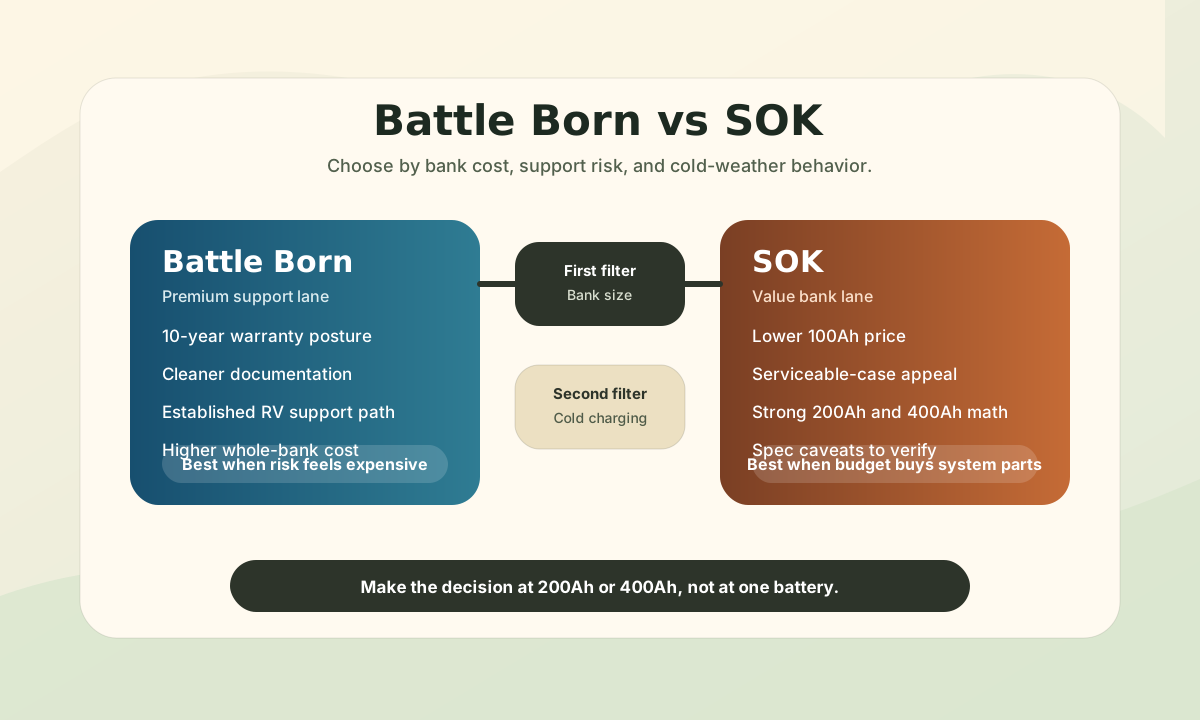
Battle Born vs SOK at a glance
Use this as a first-pass filter before you compare individual battery prices.
Best premium lane
Battle Born
Best fit when support, documentation, and lower buyer anxiety are worth the higher bank cost.
Best value lane
SOK
Best fit when savings can fund monitoring, charging, fusing, or cabling.
Bank size that matters
200-400Ah
The gap becomes real once you multiply the price across the full RV bank.
Cold-weather filter
Verify charge behavior
Confirm the current manual and compartment temperature before charging in freezing conditions.
System companion
Battery calculator
Use the calculator so bank size matches daily watt-hours, not the battery sale price.
Watch the caveat
SOK spec mismatch
SOK's page and spec PDF differ on some numbers. Use the conservative limit unless SOK confirms otherwise.
Why this comparison exists
Battle Born vs SOK is not just a brand debate. It is a risk, support, and whole-bank-cost decision.
If you are replacing one tired lead-acid battery for light weekends, the price gap may feel abstract. If you are building a 400Ah bank for boondocking, remote work, a compressor fridge, Starlink, or inverter use, the same gap can fund a battery monitor, DC-to-DC charging, fuses, busbars, or part of an inverter.
The mistake is comparing one battery sticker price and stopping there. A bank is capacity, discharge limit, charging profile, temperature behavior, support path, and wiring.
If you are still deciding whether lithium makes sense at all, start with lithium vs AGM RV batteries. If you already know you want LiFePO4, this page helps decide whether Battle Born's premium lane or SOK's value lane fits the build.
The exact batteries compared
This comparison uses the closest current 100Ah-class batteries that RVers usually mean when they ask about Battle Born vs SOK.
- Battle Born 100Ah 12V LiFePO4 Deep Cycle Battery, model BB10012: $949 regular official direct price, frequently discounted (recently about $679), re-checked June 5, 2026. Check price at Battle BornMerchant link. Direct merchant or retailer listing..
- SOK SK12V100P 12V 100Ah LiFePO4 Battery, Marine Grade: official direct price $316, re-checked June 5, 2026 (unchanged). Check price at SOKMerchant link. Direct merchant or retailer listing..
Both are 12.8V nominal LiFePO4 batteries in the 100Ah class. Both still need proper overcurrent protection, correct cable sizing, a main disconnect, and a real state-of-charge method.
Neither should be treated as a magic drop-in if your converter, solar controller, alternator charging, or inverter wiring is still built around lead-acid assumptions. Use the battery-bank sizing guide and the battery calculator before buying four batteries because a forum post made the bank sound easy.
Spec comparison
Battle Born publishes a very clean 2026 manual for the BB10012. SOK publishes a product page and a separate official spec PDF for the SK12V100P, but those two official SOK sources do not match perfectly on every number.
That matters. When official documents disagree, the safer RV planning move is to use the more conservative limit until the manufacturer confirms the current revision.
Compare
Official source comparison, re-checked June 5, 2026
Use one comparison matrix to scan the practical differences. Small screens stack each row; wider screens keep the first column pinned.
| Spec | Battle Born BB10012 100Ah | SOK SK12V100P 100Ah |
|---|---|---|
| Official direct price checked | $949 regular before tax, shipping, and accessories; frequently discounted (recently about $679) | $316 before tax, shipping, accessories, and stock changes |
| Nominal energy | 12V / 100Ah class, 12.8V nominal system planning | 12.8V / 100Ah / 1,280Wh listed in the official spec PDF |
| Warranty coverage | 10-year limited warranty listed on the product page and manual materials | 7-year warranty listed on the product page |
| Dimensions | 12.76 x 6.86 x 8.95 in. | 12.83 x 6.69 x 8.58 in. in the official spec PDF |
| Weight | 31 lb in the 2026 manual; the product page also describes the battery as 31 lb | 27 lb on the product page; the official spec PDF lists approximately 24.7 lb |
| Discharge rating to plan around | 100A continuous, 200A surge for 30 seconds in the manual | Use 100A-class planning unless SOK confirms otherwise; the product page lists 170A maximum continuous while the official spec PDF lists 100A continuous and 170A peak for 4 seconds |
| BMS notes | Internal proprietary BMS with low-temperature protection, high/low voltage protection, short-circuit protection, and cell balancing | Built-in smart Bluetooth BMS, auto balancing, low-temperature charge cut-off, high-temperature cut-off, and overcurrent protection listed on the product page |
| Serviceability | Sealed battery. You are buying the finished product and support path, not a user-serviceable case. | Detachable cover and replaceable BMS or cells are listed by SOK, which appeals to hands-on owners but also asks more from the buyer. |
| Cold-weather behavior | Standard model has low-temperature protection; heated models are separate. Plan standard-battery charging conservatively around above-freezing battery temperature. | Product page lists low-temperature charge cut-off, but temperature ranges differ across SOK's page and PDF. Verify the current manual before relying on freezing-weather charging. |
Whole-bank math for 200Ah and 400Ah
The real decision usually appears when you multiply the battery price by the bank size.
At official direct prices re-checked on June 5, 2026, the Battle Born 100Ah was about 3.0 times the SOK SK12V100P price at Battle Born's regular price, and closer to 2.1 times when Battle Born runs its frequent sale. Either way, Battle Born has to earn the difference through support confidence, documentation, warranty comfort, dealer familiarity, and lower perceived risk.
Compare
Whole-bank cost before tax, shipping, installation parts, monitors, fuses, cabling, busbars, and charger changes
Use one comparison matrix to scan the practical differences. Small screens stack each row; wider screens keep the first column pinned.
| Spec | Battle Born BB10012 | SOK SK12V100P |
|---|---|---|
| One 100Ah battery | $949 ($679 on sale) | $316 |
| Two-battery 200Ah bank | $1,898 ($1,358 on sale) | $632 |
| Four-battery 400Ah bank | $3,796 ($2,716 on sale) | $1,264 |
| Nominal energy at 200Ah | About 2.56kWh | About 2.56kWh |
| Nominal energy at 400Ah | About 5.12kWh | About 5.12kWh |
| Price difference at 400Ah | $2,532 more than SOK at regular price ($1,452 on sale) | $2,532 less than Battle Born at regular price |
That $2,532 difference at 400Ah (about $1,452 when Battle Born is on sale) can cover a serious chunk of charging and protection hardware. It can also disappear fast if a cheaper bank creates support delays, unclear specs, or cold-weather surprises.
Where Battle Born makes sense
Battle Born is the cleaner choice when the battery purchase is part of a larger system you do not want to second-guess.
Choose Battle Born if:
- you want stronger documentation and a more established RV support path
- you value 10-year warranty coverage more than the lowest bank cost
- you may ask an installer, dealer, or mobile tech to support the system later
- you are building a system where downtime would be more expensive than the battery premium
The downside is obvious: the bank gets expensive fast. If the premium forces you to skip a shunt, proper fusing, DC-to-DC charging, or correct cabling, you have bought premium batteries into an underbuilt system.
Battle Born also does not remove the need to read the manual. Standard LiFePO4 batteries still need correct charging settings and cold-temperature discipline.
Where SOK makes sense
SOK makes sense when the bank size is the main pressure point and you are comfortable being more involved in the details.
Choose SOK if:
- you are building a 200Ah or 400Ah value bank
- the price savings lets you afford a better monitor, safer protection, or stronger charging
- you like the idea of a detachable cover and listed replaceable BMS or cells
- you are comfortable checking the current manual before wiring series or parallel banks
The downside is not that SOK is automatically risky. The downside is that the buyer has to tolerate more ambiguity. Because SOK's official page and spec PDF differ on weight and discharge-current wording, size the bank, inverter, and protection around the conservative reading unless SOK confirms the current revision in writing.
SOK's serviceable-case story is useful for hands-on owners. It is less compelling if you do not want to troubleshoot at the component level.
Cold weather is the place to slow down
Discharging in cold weather and charging in cold weather are not the same issue. Many lithium batteries can discharge below freezing but should not accept charging current when the cells are too cold. The BMS is there to protect the battery, but a protected shutdown can still ruin your morning if the solar controller wakes up before the battery compartment does.
Battle Born's 2026 manual lists low-temperature protection and separates standard and heated models. SOK's product page lists low-temperature charging cut-off, while its published temperature lines are not perfectly consistent between the page and PDF.
Practical takeaway: if you camp in freezing mornings, treat the battery compartment as part of the system. A warm interior bank, heated model, or controlled charging strategy matters more than a bold product-page claim.
For a deeper cold-weather filter, use the cold-weather lithium RV battery guide before buying the bank.
Do not use a bigger inverter to outrun the BMS
A 3000W inverter can ask a 12V battery bank for very high current. If the bank is only one or two 100Ah batteries, verify the battery discharge limit, fuse rating, cable size, and inverter load before assuming the system can support microwave, induction, or air-conditioner use.
Which one should you buy?
Buy Battle Born if the premium buys something you will actually use: support confidence, clearer documentation, warranty comfort, dealer familiarity, and fewer gray areas during installation.
Buy SOK if your build is budget-sensitive and you are comfortable verifying the system yourself. SOK looks especially strong at 200Ah or 400Ah because the savings can fund the infrastructure that makes lithium safer and more useful.
For many RVers, the cleanest path looks like this:
- Weekend lithium upgrade with high support expectations: Battle Born.
- 200Ah value bank where the budget also needs a shunt and DC-to-DC charger: SOK.
- 400Ah remote-work or frequent-boondocking bank where price per usable kWh matters heavily: SOK, if you accept the documentation caveats.
- Cold-weather build where charging below freezing is likely: compare the exact heated or low-temperature-protected model, not the base-brand reputation.
- Installer-built system where the tech has a preferred ecosystem: ask what they will support after the invoice is paid.
If you are comparing more than these two brands, use the broader best lithium RV batteries shortlist after this page.
The mistake most RVers make
The common mistake is asking "which battery is better?" before asking "what bank am I building?"
A single 100Ah battery is not enough context. The bank may need to support a fridge overnight, a workday, a furnace fan, inverter cooking, CPAP use, or a cloudy-day reserve.
The second mistake is spending the whole budget on cells and leaving the system blind. A value battery can be a good decision, but only if the saved money improves monitoring, fusing, cabling, or charging.
Final thought
Battle Born is the easier premium answer. SOK is the stronger value answer. The right choice depends on whether you want to buy down support risk or preserve budget for the rest of the system. Either way, make the decision at the bank level, not the single-battery level.
Frequently asked
Questions RVers usually ask next.
Is SOK as good as Battle Born for RV use?
SOK can be a strong RV value battery, especially in 200Ah and 400Ah banks, but it is not the same purchase experience as Battle Born. Battle Born has clearer documentation and stronger RV-market support familiarity. SOK asks the buyer to verify more details.
Why is Battle Born more expensive than SOK?
The premium is mostly about support confidence, RV-market maturity, documentation, warranty coverage, and buyer trust. It may be worth it if you want fewer unknowns or plan to lean on installer support. It may not be worth it if the higher battery price forces cuts to the rest of the system.
How many 100Ah lithium batteries do I need in an RV?
A light weekend setup may be fine with 100Ah to 200Ah, while frequent boondocking, remote work, furnace use, or inverter loads often push the target toward 300Ah to 400Ah or more. Start with daily watt-hours, then add reserve days and recharge sources. The battery calculator beats guessing from someone else's rig.
Can I mix Battle Born and SOK batteries in the same bank?
Do not mix them casually. Different BMS behavior, age, internal resistance, capacity, charge history, and manufacturer guidance can create balancing and support problems. If you are expanding an existing bank, the cleaner move is usually to match the same model, age, and state of charge as closely as possible.
Should I buy heated lithium batteries instead?
Buy heated or cold-weather-specific batteries if the bank will be charged when the cells may be below freezing. If your batteries live inside a heated compartment and you avoid cold charging, standard batteries may still make sense. The important part is matching the exact model to your charging conditions, not assuming the brand name solves winter.
Freshness note
Last checked June 5, 2026
This topic can change when products, plans, prices, campsite rules, or fit guidance move. These notes show what was reviewed most recently.
This review included
- Checked Battle Born's official 100Ah 12V LiFePO4 product page and 2026 manual for price, dimensions, weight, warranty coverage, current limits, BMS notes, and temperature guidance.
- Checked SOK's official SK12V100P product page and official spec PDF for price, model name, warranty, BMS/serviceability claims, dimensions, weight, current limits, and temperature guidance.
- Calculated 200Ah and 400Ah bank cost from official direct prices before tax, shipping, discounts, accessories, and installation parts.
Recent change log
June 5, 2026
Freshness re-verify against official sources. SOK SK12V100P unchanged ($316, 7-year warranty). Battle Born BB10012 repriced since April: now $949 regular and frequently discounted (recently about $679, 28% off) on battlebornbatteries.com — was a flat $799. Updated the single-battery prices, the comparison table, and the whole-bank math (200Ah/400Ah totals, the 400Ah gap, and the price ratio) to the current regular price with the frequent sale noted. Warranty (10-year BB / 7-year SOK) and weights (31 lb BB / 27 lb SOK) re-confirmed unchanged.
April 18, 2026
Restored clear affiliate-disclosure language for product-link transparency.
April 17, 2026
Clarified that direct merchant links are not affiliate relationships before program approvals.
April 11, 2026
Published a Battle Born vs SOK comparison with official pricing, spec caveats, whole-bank math, and cold-weather decision guidance.
Broader editorial corrections are tracked on the Corrections and Updates page.
