How much fuel does an RV generator use?
A typical RV-sized inverter generator uses somewhere between 0.12 and 0.36 gallons of gasoline per hour, and where you land in that range depends almost entirely on how hard you are working it. Honda's popular EU2200i, a 2,200-watt-max / 1,800-watt-rated machine, draws from a 0.95-gallon tank for about 8.1 hours at a quarter load and about 3.2 hours at full rated load — which works out to roughly 0.12 gallons an hour light and 0.30 gallons an hour heavy. The slightly larger EU3200i carries 1.2 gallons and runs about 8.6 hours light or 3.3 hours at rated load, or about 0.14 to 0.36 gallons an hour. Those are the numbers most RVers actually live with.
The reason that range is so wide is that a modern inverter generator throttles its engine to the load. Charging a battery bank or running a few small things asks little of it, so the engine idles down, sips fuel, and stays quiet. Ask it to run an air conditioner near its rated ceiling and it spins up, burns two to three times as much, and gets loud. So "how much fuel does a generator use" is really "how much are you asking it to do," and the honest planning move is to estimate your real loads first — the appliance wattage reference is the fastest way to do that — and only then translate watts into gallons.
Load is the biggest variable by far
It is worth dwelling on load because it swamps every other factor. The same EU2200i that burns about 0.12 gallons an hour topping off a lithium bank will burn closer to 0.30 once you push it near 1,800 watts continuous, and an air conditioner is exactly the kind of load that does that. Inverter generators with an economy or "eco-throttle" mode make the light-load savings automatic: leave that mode on for charging and small loads and the engine drops to a fuel-sipping idle between demands. Turn it off, or stack heavy continuous loads, and you give up most of the efficiency you paid a premium for.
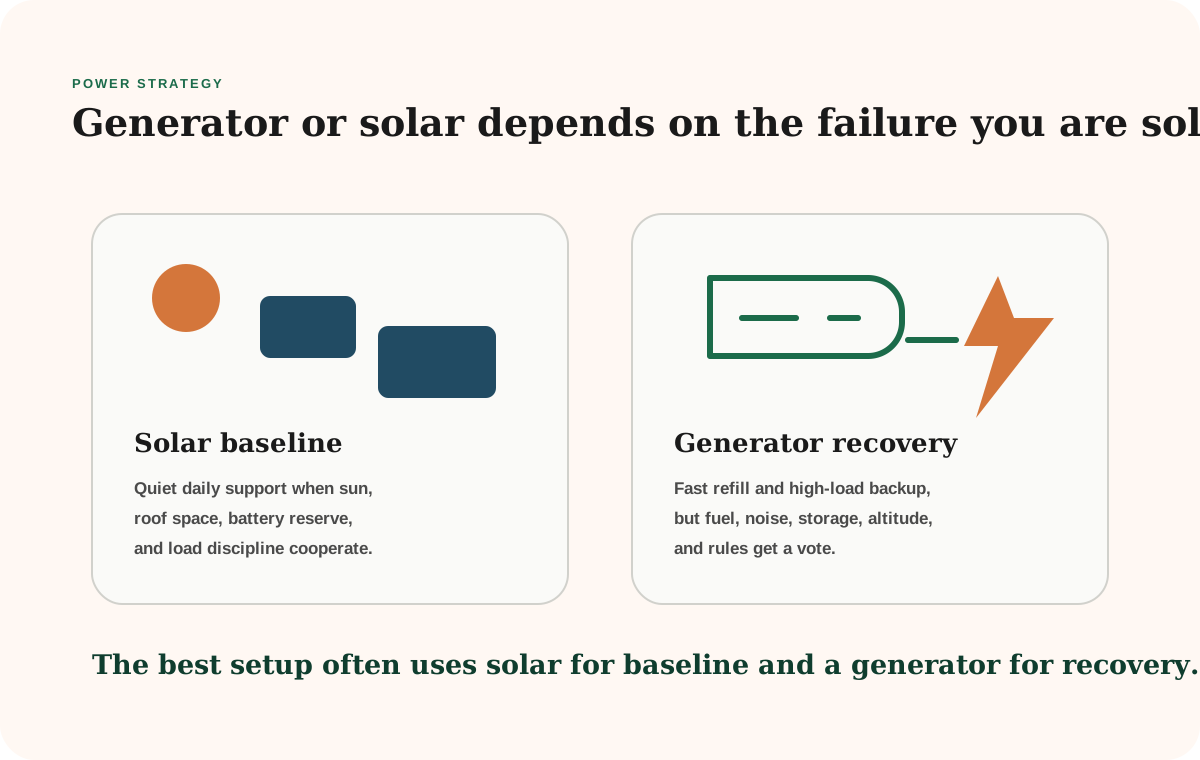
This is why two RVers with identical generators can report wildly different fuel use and both be right. The person who fires the generator for two hours each morning to bulk-charge batteries and run a coffee maker is living near the bottom of the range. The person who runs a rooftop air conditioner off the generator through a hot afternoon is living near the top, and may go through several gallons a day. Before you judge a generator's thirst, pin down which of those two RVers you are — and remember that the generator-versus-solar tradeoff often comes down to keeping yourself in that light-load lane.
Tank size sets your refill rhythm
Gallons per hour tells you the burn rate; the tank tells you how often you are standing at the machine with a fuel can. A 0.95-gallon tank at the light-load rate of about 0.12 gallons an hour gives roughly eight hours of run time, which for a light user can be most of a weekend of morning-and-evening charging on a single fill. Push that same tank toward rated load and it empties in a little over three hours, so an afternoon of air conditioning can demand a midday top-off. The EU3200i's 1.2-gallon tank stretches those windows a little; a larger conventional-style inverter such as the Champion 201318, with a 2.3-gallon tank and 3,500 running watts, holds more fuel for longer heavy runs but burns more when it is actually working hard.
The practical lesson is to size your onboard fuel to your pattern, not to the tank. A weekend battery-charger might carry a single spare gallon and never touch it; an air-conditioning-dependent camper in summer heat should plan on multiple gallons a day and store them safely and legally. Running a generator dry repeatedly is also hard on it, so most owners refill at a comfortable margin rather than chasing the last few minutes out of a tank.
Generator fuel use by model
Compare
Approximate gasoline use for common RV inverter generators, computed from published tank capacity and runtime
Use one comparison matrix to scan the practical differences. Small screens stack each row; wider screens keep the first column pinned.
| Spec | Tank | Light load (~1/4) | Rated load | Runtime light → rated |
|---|---|---|---|---|
| Honda EU2200i (1,800W rated) | 0.95 gal | ~0.12 gal/hr | ~0.30 gal/hr | ~8.1 hr → ~3.2 hr |
| Honda EU3200i (2,600W rated) | 1.2 gal | ~0.14 gal/hr | ~0.36 gal/hr | ~8.6 hr → ~3.3 hr |
| Champion 201318 (3,500W running) | 2.3 gal | Lower per hour, larger tank | More at heavy load | Longer per fill |
Generator fuel use at a glance
The numbers that decide how much gas you actually go through.
Light load (charging)
~0.12 gal/hr
An eco-throttled inverter sipping fuel to charge batteries and run small loads.
Rated load (AC)
~0.30-0.36 gal/hr
Worked near its ceiling — two to three times the light-load burn.
Tank runtime
~3-8 hr
A ~1-gallon tank runs about 8 hours light or 3 hours at rated load.
Biggest variable
Load
What you ask it to do swamps the model and the badge wattage.
What it actually costs to run
Multiply the burn rate by the price of gas and the dollars turn out to be modest. At an illustrative $3.50 a gallon — check the U.S. Energy Information Administration's retail gasoline figures for the current average, since pump prices move constantly — a light-load 0.12 gallons an hour costs about $0.42 an hour, and a hard-working 0.30 gallons an hour costs about $1.05 an hour. A typical two-hour morning charge therefore runs well under a dollar in fuel, and even an all-day air-conditioning grind lands in single-digit dollars. Compared with a campground's nightly rate, the gasoline itself is rarely the deciding number.
That is the point worth internalizing: the true cost of generator power is almost never the fuel bill. It is the weight and hassle of carrying gas cans, the chore of finding a station, the wear on the machine, and above all the noise — which is why so many off-grid setups use the generator as a quick recovery tool beside solar and batteries rather than an all-day power source. If you find yourself running it for hours just to keep up, the cheaper long-run fix is usually more battery and solar, not more gasoline.
Gas versus propane on a dual-fuel generator
Many RVers run dual-fuel generators that accept propane, and the fuel math shifts when they do. Propane carries less energy per gallon than gasoline — roughly 91,500 BTU per gallon versus about 114,000 for gasoline — so a generator running on propane typically makes a little less peak power and burns more volume for the same work, often a ten-percent-ish efficiency give-back. A 20-pound propane cylinder holds about 4.6 gallons, and the propane tank guide walks through how its roughly 430,000 BTU translate into run time across different loads.
What propane gives back in exchange is real: it stores indefinitely without going stale, burns cleaner, is easy to find, and lets one fuel system feed your furnace, fridge, stove, and generator. So the choice is rarely about saving money per hour — it is about convenience and storage. Boondockers who already carry propane for everything else often prefer feeding the generator from the same supply, accepting the small efficiency penalty for the simplicity of a single, shelf-stable fuel. The boondocking-with-a-generator guide covers how that fits a real off-grid routine.
A worked example: a charging weekend
Picture a three-day boondocking weekend with an EU2200i used the sensible way — about two hours each morning to bulk-charge the battery bank and run the coffee maker, plus a short evening top-off, at light-to-moderate load averaging maybe 0.15 gallons an hour. That is roughly 0.3 to 0.4 gallons a day, so the whole weekend burns somewhere around a single gallon of gas. The 0.95-gallon tank nearly covers the entire trip on one fill, the fuel bill is a few dollars, and you carry one spare can you probably never open.
Now change one thing: run a 13,500 BTU rooftop air conditioner off that same generator through a hot afternoon. The machine now sits near rated load at roughly 0.30 gallons an hour, so eight hours of cooling is about 2.4 gallons in a single day — more than twice the entire charging weekend, every day. Same generator, same campsite, completely different fuel logistics. That contrast is the whole reason "how much fuel does a generator use" cannot be answered without first answering "are you charging batteries or running air conditioning?"
The short version
An RV inverter generator burns about 0.12 gallons an hour at light load and about 0.30 to 0.36 at rated load, so a one-gallon tank lasts roughly eight hours charging or three hours flat out, and the fuel costs only a few dollars a day. Load drives everything: battery-charging is cheap and quiet, air conditioning is thirsty and loud. Propane on a dual-fuel machine trades a little efficiency for shelf-stable convenience. Estimate your real loads, match your onboard fuel to your pattern, and lean on solar and batteries for the steady stuff so the generator stays in its efficient, light-load lane.
How to estimate your own generator's fuel use
- Find the published tank size and runtime. Look up your model's tank capacity and its rated and quarter-load run times on the manufacturer's page.
- Divide tank by runtime for each load. Tank gallons ÷ runtime hours gives gallons per hour at that load — do it for both the light and rated figures to get your range.
- Estimate your real daily hours and load. Decide whether you are mostly charging (light) or running air conditioning (rated), and how many hours a day.
- Multiply out gallons and dollars. Gallons per hour × daily hours = daily fuel; multiply by today's local gas price for the cost.
- Plan onboard fuel to your pattern. Carry a margin for your heaviest day, store gasoline safely and legally, and offload steady loads to solar and batteries to shrink the burn.
Run generators safely — fuel and exhaust both matter
Never run a generator inside or under an RV, in a closed compartment, or near open windows — carbon monoxide is deadly and odorless, so keep a working CO alarm and place the unit well away and downwind. Store gasoline only in approved containers, never indoors or near ignition sources, and let the engine cool before refueling. Follow your generator's manual for grounding, oil, and load limits; these planning figures do not replace its safety instructions.
Official fuel and generator references
Verify tank size, runtime, and current fuel prices from the source before you plan a trip's fuel.
Frequently asked
Questions RVers usually ask next.
How much gas does an RV generator use per hour?
A common RV inverter generator burns about 0.12 gallons an hour at light load, such as charging batteries, and roughly 0.30 to 0.36 gallons an hour when worked near its rated output, such as running an air conditioner. Load is the main driver — eco-throttle mode keeps the light-load burn low.
How long will an RV generator run on a tank of gas?
Roughly 8 hours at light load or a little over 3 hours at rated load for a one-gallon-class tank like the Honda EU2200i's 0.95 gallons. Bigger tanks such as the EU3200i's 1.2 gallons or a 2.3-gallon Champion stretch those windows, especially for heavy continuous loads.
Is running a generator cheaper than a campground?
Usually, on fuel alone. At about $3.50 a gallon, light-load running costs around $0.42 an hour and heavy load around $1.05, so most days land in single-digit dollars. The real costs of generator power are hauling and storing fuel, engine wear, and noise — not the gasoline.
Does a generator use more fuel on gas or propane?
On propane a dual-fuel generator generally burns more volume and makes slightly less peak power, because propane carries about 91,500 BTU per gallon versus roughly 114,000 for gasoline. The trade is worth it for many boondockers because propane stores indefinitely and can share one fuel system with the furnace and fridge.
How much fuel should I carry for a weekend?
If you mostly charge batteries, about a gallon often covers a three-day weekend, since light-load use runs around 0.3 to 0.4 gallons a day. If you run an air conditioner, plan on a couple of gallons per day instead, and store gasoline safely in approved containers.
Freshness note
Last checked June 6, 2026
This topic can change when products, plans, prices, campsite rules, or fit guidance move. These notes show what was reviewed most recently.
This review included
- Computed gallons-per-hour from Honda's published EU2200i and EU3200i tank capacity and rated/quarter-load runtimes (0.95 gal at 3.2 hr rated / 8.1 hr quarter; 1.2 gal at 3.3 hr / 8.6 hr), cross-checked against the OffGridRVHub generator sizing guide.
- Framed the gas-versus-propane fuel difference with the standard EIA energy-content figures (gasoline about 114,000 BTU/gal, propane about 91,500 BTU/gal) and linked the propane tank guide for the BTU basis.
- Kept the fuel-cost example explicitly illustrative and pointed to EIA retail gasoline prices for the current average rather than asserting a pump price.
Recent change log
June 6, 2026
Published a generator fuel-consumption guide: gallons-per-hour by load for common inverter models, tank-to-runtime math, a cost example, a gas-versus-propane section, a weekend worked example, and a how-to for estimating your own burn rate.
Broader editorial corrections are tracked on the Corrections and Updates page.