How long does an RV propane tank last?
A 20-lb RV propane tank lasts anywhere from a couple of days to a couple of weeks, and the difference is almost entirely the furnace. Without heat, a tank running the refrigerator, occasional cooking, and a few showers commonly stretches one to two weeks. With the furnace cycling through cold nights, that same tank can be empty in two to four days. To know your number, you add up what each appliance burns per hour and multiply by how long you actually run it — the rest of this guide gives you those rates.
Propane is the third off-grid resource alongside power and water, and it follows the same rule the rest of this site keeps returning to: size from the real number, not a rule of thumb. The appliance wattage reference handles the electrical side; this page handles the gas.
How much energy is in a propane tank?
Propane carries about 91,500 BTU per gallon and 21,600 BTU per pound. Tanks are sized by the weight of propane they hold, and for safety they are filled to only 80% of their volume to leave room for the liquid to expand:
- 20-lb tank: about 4.7 usable gallons, roughly 430,000 BTU. The common portable size.
- 30-lb tank: about 7 gallons, roughly 645,000 BTU.
- 40-lb tank: about 9.4 gallons, roughly 860,000 BTU.
- Onboard ASME tanks (motorhomes) are fixed and rated in gallons; multiply gallons by ~91,500 BTU for the same math.
A 20-lb propane tank at a glance
The numbers that turn 'how long will it last' into an answer you can plan around.
Energy per tank
~430,000 BTU
About 4.7 usable gallons at roughly 91,500 BTU per gallon.
The swing factor
The furnace
20,000-40,000 BTU/hr when firing. Heat use decides everything else.
Refrigerator alone
~12-14 days
An absorption fridge sips ~1,400-1,500 BTU/hr, about 1.5 lb a day.
Cold-weather reality
~2-4 days
When the furnace runs most of the night, one 20-lb tank goes fast.
What burns the propane, appliance by appliance
Four appliances use propane in most RVs, and they are wildly uneven. The furnace dwarfs everything else; the rest are rounding errors by comparison.
Compare
RV propane appliances and how long a single 20-lb tank lasts running each one alone
Use one comparison matrix to scan the practical differences. Small screens stack each row; wider screens keep the first column pinned.
| Spec | Typical draw | Roughly how long a 20-lb tank lasts on this alone |
|---|---|---|
| Furnace (forced-air heat) | 20,000-40,000 BTU/hr while firing | ~2-4 days of hard cold-weather use — the big swing factor |
| Absorption refrigerator | ~1,400-1,500 BTU/hr (~1.5 lb/day) | ~12-14 days running continuously |
| Water heater (6 gal) | 8,800-12,000 BTU/hr in recovery cycles | Weeks — it only fires to reheat, not continuously |
| Cooktop burner | ~5,200-9,000 BTU/hr per burner | Weeks of normal cooking — minutes per meal add up slowly |
The takeaway is that propane planning is really furnace planning. A furnace cycling on a 20-degree night can burn a third of a gallon per hour while it is actually firing; even at a 30% duty cycle that is a gallon every several hours, which is why heat is the one appliance that can empty a tank in days. The fridge, by contrast, would run almost two weeks on the same tank, and cooking and hot water barely move the needle.
How long a 20-lb tank lasts by scenario
Because the furnace dominates, the honest answer comes by season and use, not a single number:
- Warm-weather weekend, no heat: fridge on propane, a couple of cooked meals, a few showers. A 20-lb tank commonly lasts one to two weeks of this — most people refill on a schedule, not because they ran out.
- Shoulder season, occasional heat: the furnace runs for an hour at dawn and a bit in the evening. Expect roughly one week from a 20-lb tank, give or take with the weather.
- Cold-weather camping, furnace heavy: the furnace runs much of the night to hold temperature. A 20-lb tank can be gone in two to four days, which is why winter rigs carry two tanks or a 30-40 lb tank and watch the gauge.
- Travel mode, fridge only: keeping the absorption fridge cold while you drive sips gas; a tank can last close to two weeks on the fridge alone.
If you want heat without the propane bill, an air heater is the efficient alternative — the best RV diesel heater guide covers units that burn far less fuel than a propane furnace for the same warmth, and a 12V heated blanket beats electric resistance heat for staying warm in bed.
A worked example: a cold weekend
Picture three nights of boondocking in 25-degree weather on a single 20-lb tank. The refrigerator runs on propane the whole time, the cooktop handles three dinners and morning coffee, and the furnace holds the cabin around 60 degrees overnight.
The fridge is easy to count: about 1.5 pounds a day, so roughly 4.5 pounds across the three days. Cooking adds maybe half a pound a day, call it 1.5 pounds total. The furnace is the variable that decides everything. On a cold night it might fire about a third of each hour; a 25,000 BTU furnace firing 20 minutes out of every hour averages around 8,000 BTU per hour, which is close to a pound of propane every couple of hours overnight. Across three long, cold nights, heat alone can easily eat 8 to 12 pounds of propane.
Add it up — roughly 4.5 pounds for the fridge, 1.5 for cooking, and 8 to 12 for heat — and you are pushing a 20-lb tank's usable propane toward empty by the third morning. Swap that 25-degree forecast for 55-degree nights and the furnace barely runs, so the same tank coasts past a week with margin to spare. That one variable, outdoor temperature, is why two campers with identical rigs report wildly different propane life. Run the numbers against your own forecast with the appliance rates above, and carry a spare if the nights will be cold.
Tank sizes and the 80% rule
Two details trip people up. First, tanks are never filled completely: the 80% rule leaves vapor space so the liquid can expand safely with temperature, which is why a "20-lb" tank holds about 4.7 gallons rather than a full 5. Second, propane behaves differently in the cold. As liquid propane boils into the vapor your appliances burn, it chills the tank; in very cold weather a small, nearly empty tank can struggle to vaporize fast enough to feed a hungry furnace. A larger tank, two tanks on an automatic changeover regulator, or simply keeping tanks fuller in winter all help.
For boondockers, the practical setup is two tanks with an auto-changeover regulator: one runs while the other waits, the indicator flips to red when the first empties, and you refill at your convenience instead of waking up cold. Motorhomes with a single fixed ASME tank do not have that luxury, so they plan refills around the forecast.
Should you keep appliances on propane or switch to electric?
Several RV appliances can run on either propane or electricity, and the smart choice flips depending on where you are parked.
On shore power, electricity is usually folded into your site fee while propane is money out of pocket, so it pays to move loads to electric: run the absorption refrigerator on its electric element, switch the water heater to its electric heating mode, and take the chill off with a small electric heater instead of the furnace. Do that and the only thing still burning gas is the cooktop, which is why a tank can last for weeks at a campground.
Off-grid, the logic reverses. Now electricity comes from a finite battery you are working hard to protect, while propane is the cheap, dense energy you carry in a tank. So out in the desert you do the opposite: let propane carry the heavy thermal jobs — heat, hot water, and the refrigerator — and reserve the battery for electronics, lights, fans, and the water pump. This is exactly why running an electric space heater off the battery is a mistake — it spends your scarcest resource on a job propane does almost for free.
A two-way or three-way refrigerator makes this painless: it runs on propane while boondocking and on shore power at the campground, automatically on many models. The same principle guides the appliance wattage reference — match each job to the energy source you have the most of. Plugged in, that is watts; off-grid, that is the propane in your tank.
How to stretch your propane off-grid
- Measure the furnace, not the rest. Heat is 80% of the question. Note your furnace's BTU rating and be honest about how many hours it really runs on a cold night.
- Insulate before you heat. Reflective window covers, a vent cushion, and a door draft stop cut furnace runtime more than any propane-saving trick — less heat lost means less gas burned.
- Heat the person, not the cabin, at night. A 12V heated blanket or mattress pad lets you drop the thermostat hours overnight and run the furnace far less.
- Consider an air heater for long cold trips. A diesel or gasoline air heater delivers cabin heat on a fraction of the fuel a propane furnace uses, and it does not touch your cooking-and-fridge propane supply.
- Carry a spare and watch the gauge. Two tanks with a changeover regulator turn "ran out at 2 a.m." into "swap when convenient." Keep an inline gauge so the level is never a guess.
Propane is combustion — treat it that way
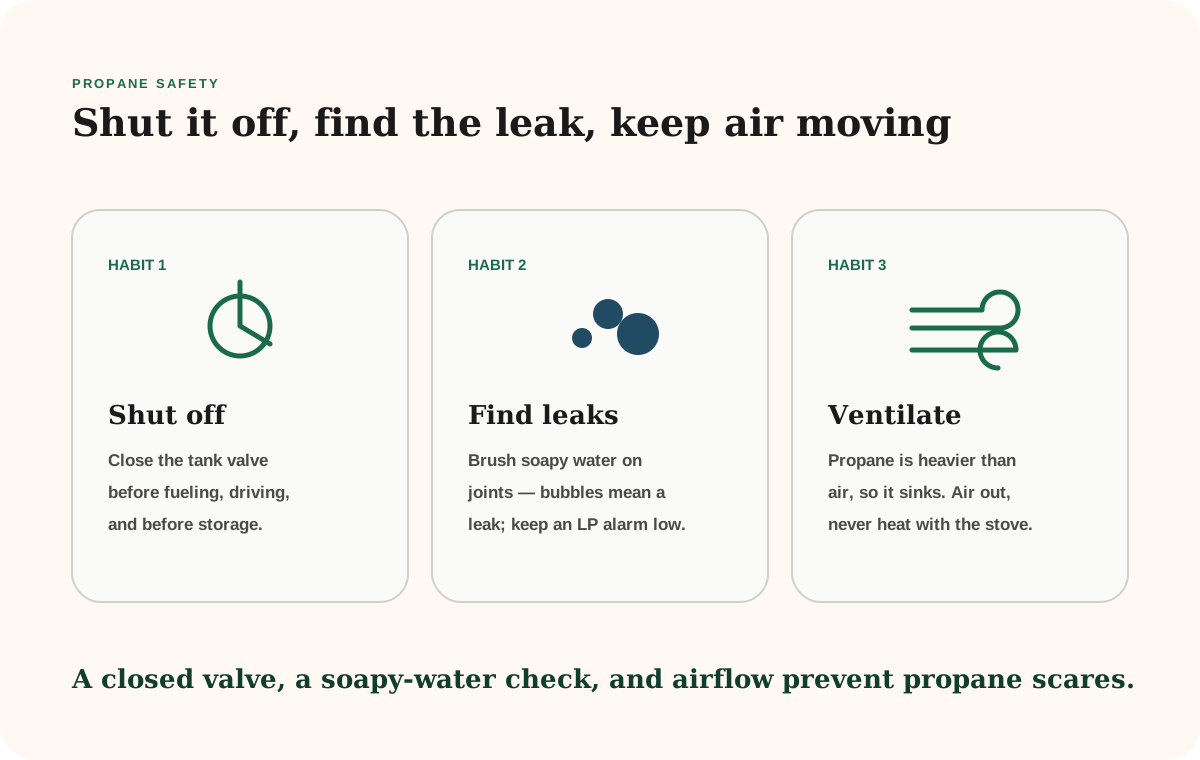
Every propane appliance produces combustion byproducts. Keep a working carbon monoxide alarm and an LP (propane) leak detector, and make sure required vents stay clear. Never use the cooktop or oven to heat the cabin — they are not vented for it and can produce dangerous carbon monoxide and deplete oxygen in a closed RV. Check fittings with soapy water after any tank swap, and shut propane off at the tank when refueling or in storage.
The short version
A 20-lb RV propane tank holds about 430,000 BTU — roughly two weeks of fridge, cooking, and hot water, or as little as two to four days once the furnace runs hard in the cold. Size your tanks around heat, insulate to cut furnace runtime, lean on a 12V heated blanket or an air heater for efficient warmth, and carry a spare so an empty tank is an inconvenience instead of a cold night. Then, like power and water, propane stops being a mystery and becomes one more number you plan around.
Official propane references
Confirm energy content and your exact appliance BTU ratings before you build a refill plan around them.
Frequently asked
Questions RVers usually ask next.
How long does a 20-lb propane tank last in an RV?
It depends almost entirely on heat. With no furnace use — just the refrigerator, cooking, and hot water — a 20-lb tank commonly lasts one to two weeks. With the furnace running hard through cold nights, the same tank can empty in two to four days.
How much propane does an RV furnace use?
An RV furnace is rated around 20,000 to 40,000 BTU per hour and burns roughly a third of a gallon per hour while it is actually firing. Because it cycles on and off, real consumption depends on how cold it is and how well insulated the rig is, but heat is by far the largest propane load.
How long will an RV refrigerator run on propane?
An absorption refrigerator uses about 1,400 to 1,500 BTU per hour, roughly 1.5 pounds of propane a day. On a single 20-lb tank that is close to two weeks of continuous cooling, which is why the fridge is rarely the reason a tank runs out.
How many gallons are in a 20-lb propane tank?
About 4.7 usable gallons. Tanks are filled to only 80% of their volume for safety, so a '20-lb' tank holds less than a full 5 gallons — roughly 430,000 BTU of energy.
How can I make my RV propane last longer?
Cut furnace runtime, since heat dominates: insulate windows and vents, use a 12V heated blanket to drop the overnight thermostat, and consider a low-fuel diesel or gas air heater for long cold trips. Carrying two tanks on an automatic changeover regulator means an empty tank is a convenient swap rather than a cold surprise.
Freshness note
Last checked June 6, 2026
This topic can change when products, plans, prices, campsite rules, or fit guidance move. These notes show what was reviewed most recently.
This review included
- Confirmed propane energy content (about 91,500 BTU per gallon, 21,600 BTU per pound) and the 20-lb tank's ~4.7 usable gallons against U.S. Energy Information Administration and propane-industry figures.
- Checked RV appliance draw rates — furnace, water heater, absorption refrigerator, and cooktop BTU per hour — against current manufacturer specifications.
- Framed all consumption as planning bands grounded in published BTU ratings, with a combustion-safety note.
Recent change log
June 6, 2026
Published an RV propane-tank-life guide: energy per tank, appliance-by-appliance burn rates, realistic days by season, tank sizes and the 80% rule, and a stretch-your-propane HowTo with combustion-safety guidance.
Broader editorial corrections are tracked on the Corrections and Updates page.