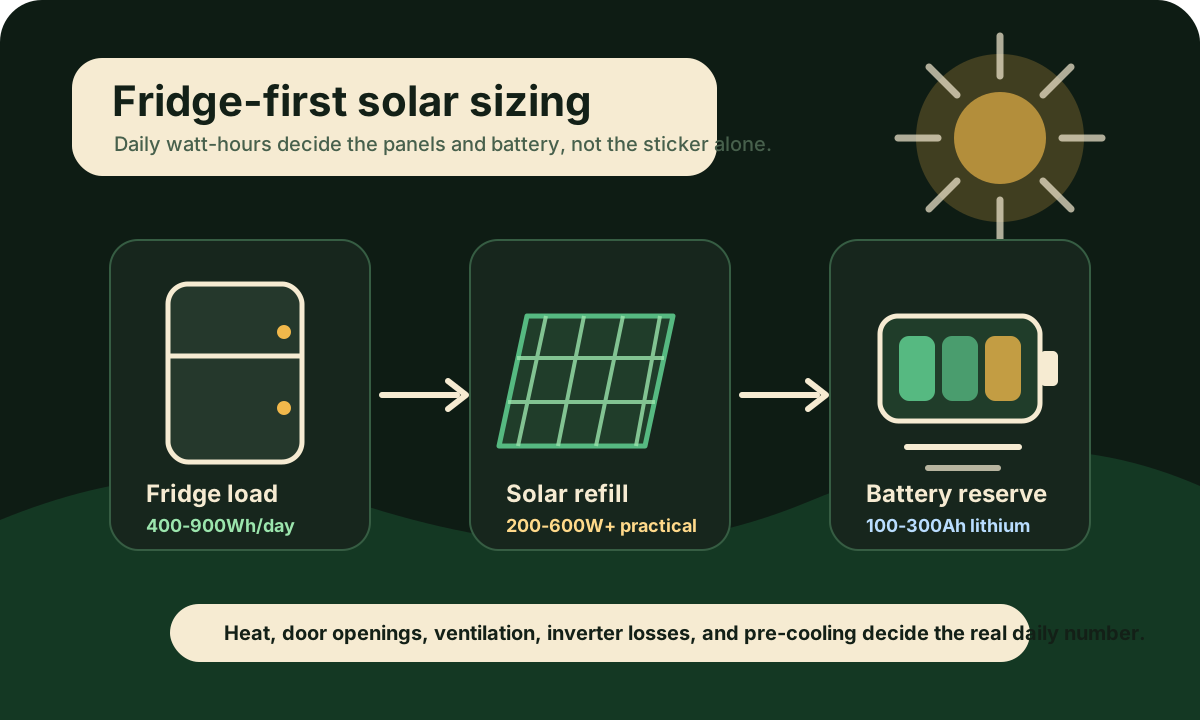
RV refrigerator solar sizing at a glance
Use these as first-pass planning lanes. Your exact fridge label, manual, battery monitor, and travel climate get the final vote.
12V compressor fridge
400-900Wh/day
Often the most common modern RV solar fridge question. Heat, ventilation, and door habits decide where you land.
Propane absorption on LP
Low 12V controls
The cooling energy comes from propane, but the control board and fans can still use battery power.
Residential fridge
800-1,800Wh/day
The inverter path adds losses, startup behavior, and a much larger daily battery requirement.
Solar starting point
200-600W
Light fridge-only support starts lower. Real boondocking with other loads usually needs more.
Battery starting point
100-300Ah lithium
The fridge needs overnight reserve before solar helps again. Lead-acid usable capacity is tighter.
Best next step
Run the actual load
Use the appliance chart, then enter the fridge and other loads into the solar and battery calculators.
The short answer depends on fridge type
"How much solar do I need to run my RV refrigerator?" sounds like one question, but it is really three questions.
A 12V compressor refrigerator, a propane absorption refrigerator, and a residential refrigerator do not behave the same way. They may all keep food cold, but they ask very different things from the battery bank.
That is why generic answers like "just add a 100W panel" or "you need 600W minimum" are not useful until you know the fridge type, daily runtime, and what else is running in the rig.
Use the RV appliance wattage chart if you want the broader load list. This guide stays focused on the fridge because it is one of the few loads that can matter every hour of the day.
The math: watts, hours, and cycling
Solar does not size from the fridge's biggest moment. It sizes from daily watt-hours.
The basic formula is:
- watts while running x equivalent run hours = watt-hours per day
- amps x volts = watts
- daily watt-hours / realistic sun hours = minimum panel watts before margin
A fridge that pulls 70W while the compressor is running does not use 70W every hour. It cycles. If it runs the equivalent of 10 hours across the day, that is roughly 700Wh.
That same fridge in a hot desert campsite, with weak ventilation and frequent door openings, may run much longer. In cooler weather, with the fridge pre-cooled and packed sensibly, it may use less.
That spread is why the label is only the starting clue.
Compressor refrigerators are usually the solar-friendly lane
Most modern 12V compressor RV refrigerators are realistic solar loads because they cool efficiently, cycle on and off, and avoid inverter losses when wired directly to the 12V system.
A useful planning range for many 12V compressor fridges is:
Compare
12V compressor RV refrigerator solar planning ranges
Use one comparison matrix to scan the practical differences. Small screens stack each row; wider screens keep the first column pinned.
| Spec | Daily fridge use | Solar starting point | Battery reserve to feel calm | Best fit |
|---|---|---|---|---|
| Efficient small fridge or cool weather | 300-500Wh/day | 150-250W dedicated refill capacity | 100Ah lithium can work if other loads are light | Small trailers, vans, weekend rigs, shoulder-season trips |
| Typical 8-11 cu ft RV compressor fridge | 500-900Wh/day | 250-450W dedicated refill capacity | 200Ah lithium feels much calmer | Modern travel trailers and fifth wheels with normal food storage |
| Hot weather or heavy door use | 900-1,300Wh/day | 450-700W dedicated refill capacity | 300Ah+ lithium if other loads run overnight | Desert camping, families, poor ventilation, frequent openings |
The word "dedicated" matters here. A 300W solar array may refill a fridge load on paper in decent sun, but it is not only feeding the fridge. Lights, fans, water pump use, phone charging, furnace controls, routers, and parasitic loads are also in the battery story.
If the fridge is the only load you size around, the system will look good in a spreadsheet and feel thin in camp.
Propane absorption fridges change the question
An absorption refrigerator running on propane is not primarily a solar load. The cooling energy comes from LP gas, while the battery supports the control board, igniter, interior light, and sometimes small fans or climate features.
That can make absorption fridges attractive for light electrical systems. They reduce the daily watt-hour burden compared with a compressor fridge.
The tradeoff is that absorption fridges are more sensitive to leveling, ventilation, ambient heat, and operating mode. They also burn propane, which becomes its own refill and safety planning item.
The big mistake is running an absorption fridge on 12V electric heat as a boondocking strategy. That mode can pull heavy DC power continuously and is usually meant for limited travel use in specific installations, not for sitting in camp on battery alone.
If your fridge has LP, AC, and DC modes, read the exact manual before assuming the DC mode is "solar mode." It usually is not.
Residential refrigerators need a bigger system
A residential refrigerator can work in an RV, but it changes the electrical baseline.
The fridge usually needs 120V AC, so the battery power has to pass through an inverter. That adds conversion losses, standby draw, startup behavior, and a larger daily reserve requirement.
For planning, many residential-fridge RV setups land closer to:
Compare
Residential refrigerator planning differences
Use one comparison matrix to scan the practical differences. Small screens stack each row; wider screens keep the first column pinned.
| Spec | Planning range | Why it is different | What to verify |
|---|---|---|---|
| 800-1,200Wh/day | Smaller or efficient residential fridge in moderate conditions | Still larger than many 12V RV compressor fridge days | Inverter idle draw, startup behavior, and daily battery trend |
| 1,200-1,800Wh/day | Common planning band for larger or harder-working residential setups | Can consume most of a small solar system by itself | Battery capacity, inverter efficiency, defrost behavior, and hot-weather use |
| 2,000Wh/day+ | Hot weather, weak ventilation, older fridge, or heavy door openings | This is no longer a light-load solar question | Whether generator, alternator charging, or shore-power recovery is part of the plan |
If your RV has a residential fridge, run the whole rig through the battery calculator, not just the solar calculator. Overnight reserve matters because the fridge keeps cycling after sunset.
How much solar is enough?
Start with daily fridge watt-hours, then divide by realistic sun hours.
If the fridge uses 700Wh per day and you expect five usable sun hours:
700Wh / 5 sun hours = 140W before losses and margin
That does not mean a 140W panel is the right build. Real RV solar needs margin for flat-mounted panels, heat, controller losses, imperfect orientation, clouds, shade, dirty panels, battery charging behavior, and the other loads in the RV.
A more realistic fridge-first solar target might look like this:
Compare
Solar wattage starting points for refrigerator support
Use one comparison matrix to scan the practical differences. Small screens stack each row; wider screens keep the first column pinned.
| Spec | Fridge-only math | Realistic solar target | Why the target is higher |
|---|---|---|---|
| 400Wh/day fridge | 80W at 5 sun hours | 200W+ if the rest of the rig is very light | You need margin for clouds, charge losses, and overnight recovery |
| 700Wh/day fridge | 140W at 5 sun hours | 300-400W for a practical small RV setup | The fridge is not the only daily load |
| 1,000Wh/day fridge | 200W at 5 sun hours | 500-700W if boondocking without generator support | Hot weather and other loads can erase a small array quickly |
| 1,500Wh/day fridge | 300W at 5 sun hours | 700W+ or hybrid charging support | This is residential-fridge or hard-working-fridge territory |
For a fridge-first starting point, run the numbers through the RV fridge solar calculator, which sizes panels and overnight reserve around the refrigerator load specifically. Then, for your exact route, use the solar calculator after you choose a realistic fridge watt-hour number. The calculator lets you change sun hours by camping region, compare installed panel wattage, and include the rest of the daily load.
Battery reserve matters more than beginners expect
Solar runs the fridge during the day only if there is enough harvest. The battery runs it at night, during storms, under trees, and before the morning sun gets useful.
That is why battery capacity is part of the fridge question.
For lithium batteries, a rough fridge-first planning ladder looks like this:
- 100Ah lithium: workable for a small compressor fridge and light overnight loads if solar recovery is dependable.
- 200Ah lithium: a calmer starting point for a typical compressor fridge plus normal lights, fans, pump use, and device charging.
- 300Ah lithium or more: better when the fridge is large, weather is hot, remote work is involved, or you want a full cloudy-day buffer.
For lead-acid or AGM, the usable reserve is more limited. A 100Ah lead-acid battery is not the same practical fridge reserve as a 100Ah lithium battery.
If you are trying to understand a small bank, the 100Ah RV battery runtime guide is the better next stop before buying panels.
What changes refrigerator power use
Fridge power is not fixed.
The biggest movers are:
- Ambient temperature
- Direct sun on the fridge wall or vent area
- Cabinet ventilation
- Door openings
- How much warm food gets added
- Freezer setting
- Frost or defrost behavior
- Door seal condition
- Whether the fridge was pre-cooled before leaving
- Whether battery voltage stays high enough for compressor operation
Dometic's general RV refrigerator guidance emphasizes practical habits like pre-cooling, not overloading, and keeping door seals in good condition. Furrion's 12V refrigerator manual makes the same field point from another angle: a 12V refrigerator has to be planned around available battery capacity, limited replenishment, food temperature, door openings, ventilation, and under-voltage behavior.
That is the real lesson. A fridge is not a fixed wattage label. It is a system load that reacts to how the rig is used.
Pre-cool on shore power when you can
If you can pre-cool the fridge and freezer before leaving, do it. Starting cold reduces the first-day battery hit and gives the solar system a better chance of maintaining temperature instead of doing a hard pull-down in camp.
A simple sizing workflow
Use this order:
- Identify the fridge type: 12V compressor, propane absorption, or residential.
- Estimate daily fridge watt-hours from the table above or your monitor.
- Add the rest of the daily loads from the RV appliance wattage chart.
- Decide how much overnight and cloudy-day reserve you want.
- Run the full daily load through the solar calculator.
- Check the resulting battery target with the battery calculator.
- Only then decide whether panels, batteries, ventilation, habits, or hybrid charging are the best fix.
That sequence prevents the common mistake of adding one panel to a system that really needed more battery reserve, or buying batteries when the fridge ventilation and usage habits were the larger problem.
Common mistakes when sizing solar for an RV fridge
The first mistake is treating a compressor fridge like a light accessory. It may be efficient, but it runs every day.
The second mistake is treating a propane absorption fridge's 12V mode like a free solar setting. If that mode uses electric heat, it can be a battery-drain problem rather than a solar solution.
The third mistake is ignoring inverter idle draw with residential refrigerators. The fridge may be efficient enough, but the inverter can add a quiet baseline load.
The fourth mistake is sizing from perfect summer sun. Winter sun, forest shade, wildfire smoke, clouds, and flat panels all reduce harvest.
The fifth mistake is forgetting that a fridge needs reserve before and after sunlight. A solar array that barely covers midday math can still leave the battery low by breakfast.
Final thought
A fridge is one of the best loads to size honestly because it exposes the difference between a camping toy and a dependable off-grid system.
If your refrigerator uses 600-900Wh per day, build the solar and battery plan around that reality before you add laptops, Starlink, furnace use, fans, cooking, or medical devices. Once the fridge baseline is honest, the rest of the solar plan stops feeling like guesswork.
Sources and verification notes
- Department of Energy appliance-use guidance supports the watts, amps, runtime, and watt-hour formulas used in this guide: Estimating appliance and home electronic energy use.
- Dometic's RV refrigerator guidance informed the pre-cooling, loading, door-seal, and RV-specific refrigerator caveats: Dometic RV refrigerators.
- Dometic's DMC4081 product data provided a current example of an 8 cu. ft. 12V compressor RV refrigerator with a rated DC input current: Dometic DMC4081 12V refrigerator.
- The Furrion/Lippert 12V refrigerator manual informed the battery-capacity, ventilation, door-opening, under-voltage, and energy-saving guidance: Furrion FCR11DCGTA instruction manual.
Frequently asked
Questions RVers usually ask next.
Can a 100W solar panel run an RV refrigerator?
Sometimes, but usually only as partial support for a small or efficient fridge in good sun. A 100W panel may produce enough on paper for a light fridge day, but real RV use needs margin for losses, clouds, flat mounting, and overnight battery recovery.
How many watts does a 12V RV refrigerator use?
Many 12V compressor RV fridges pull roughly 45-100W while the compressor is running, but daily use depends on duty cycle. A realistic planning range for many rigs is about 400-900Wh per day, with hot-weather or heavy-use cases higher.
Can I run an absorption fridge on solar?
An absorption fridge running on propane only needs modest 12V support for controls and related electronics. Running an absorption fridge on electric heat from batteries is usually not a practical boondocking plan because it can draw heavy power continuously.
Do I need a battery if I have solar for the fridge?
Yes. The fridge runs after sunset, during clouds, under shade, and before solar harvest gets strong in the morning. Solar refills the battery; the battery keeps the fridge alive when solar is not producing enough.
Why does my RV fridge use more power in the desert?
Hot ambient temperature, warm food, more door openings, poor cabinet ventilation, and direct sun exposure can make the compressor run longer. That turns the same fridge into a larger daily watt-hour load.
Freshness note
Last checked April 10, 2026
This topic can change when products, plans, prices, campsite rules, or fit guidance move. These notes show what was reviewed most recently.
This review included
- Checked refrigerator power math against Department of Energy watt-hour estimation guidance.
- Checked RV refrigerator behavior against Dometic refrigerator guidance and current Dometic 12V compressor refrigerator specifications.
- Checked 12V compressor refrigerator operating and battery-warning language against a current Furrion/Lippert refrigerator manual.
Recent change log
April 10, 2026
Published a refrigerator-first solar sizing guide with compressor, absorption, and residential fridge planning lanes.
April 10, 2026
Added a custom fridge solar sizing visual and linked the guide into the solar sizing, appliance wattage, and calculator paths.
Broader editorial corrections are tracked on the Corrections and Updates page.

